


This is the final installment in The Stone series.
[Here’s Part 1, Part 2, Part 3, Part 4, Part 5, Part 6, and Part 7.]
I started Post 1 with a question I asked myself as a nineteen-year-old:
How do I actually steer this thing called life?
How do I cross from where I am to where I could be—on purpose?
How do I not waste potential?
You’d think by now we’d have figured this out.
We split the atom. We sequenced the genome. We predict weather six days out and land robots on other planets. But ask someone how to actually change their life—how to get unstuck or how to become someone new—and we still get what we’ve always gotten:
More frameworks and recipes. Things that worked for someone else, once, under conditions nobody recorded.
Meanwhile, every generation of chemists builds on the last. Yet every generation of humans navigating change starts from scratch.
Your grandmother’s hard-won wisdom about change died with her. Your therapist and coach operate from different maps of the same territory, and neither knows it. Teams rediscover “culture eats strategy.” Marriages rediscover that trust matters. Cities rediscover that systems can hollow out without “breaking.”
We have sciences for everything except the thing we care about most: how change becomes real.
Why?
Not because the physics doesn’t exist. It does. Over the past century and a half, multiple fields laid the groundwork for reading transformation—without realizing they were building pieces of the same instrument.
So what’s missing?
Not more insight or theory. Literacy.
Think about it. We don’t lack ideas about change. We lack the ability to read change in a useful, practical way.
And that distinction changes everything.
Literacy
Before the periodic table, chemistry was a collection of local recipes.
This powder plus that acid yields a blue precipitate.
Useful—if you had the recipe. Useless if you didn’t. Without the table, knowledge stayed local. Every lab carried its own recipe book. It’s like every generation rediscovering oxygen like it was new.
The periodic table didn’t add new knowledge. It organized what was already known into a shareable address system.
Suddenly, why some reactions worked and others didn’t became visible.
Local recipes became cumulative. And because the knowledge had addresses, it became portable: one chemist could build on another's work.
That’s what literacy is. It’s what literacy does. A system that lets knowledge compound rather than die with the practitioner.
Right now, transformation has no shared address system. There’s no standard way to point to where the constraint lives.
So we keep paying the same tax. A hundred years of organizational psychology, and we’re still having versions of the same arguments, but with better slide decks.
Because we’re essentially illiterate when it comes to reading change.
This series introduces Genesis Theory—a synthesis of existing physics assembled into a tool for reading and writing change. Not new physics. Existing physics that nobody put together because the pieces lived in different fields.
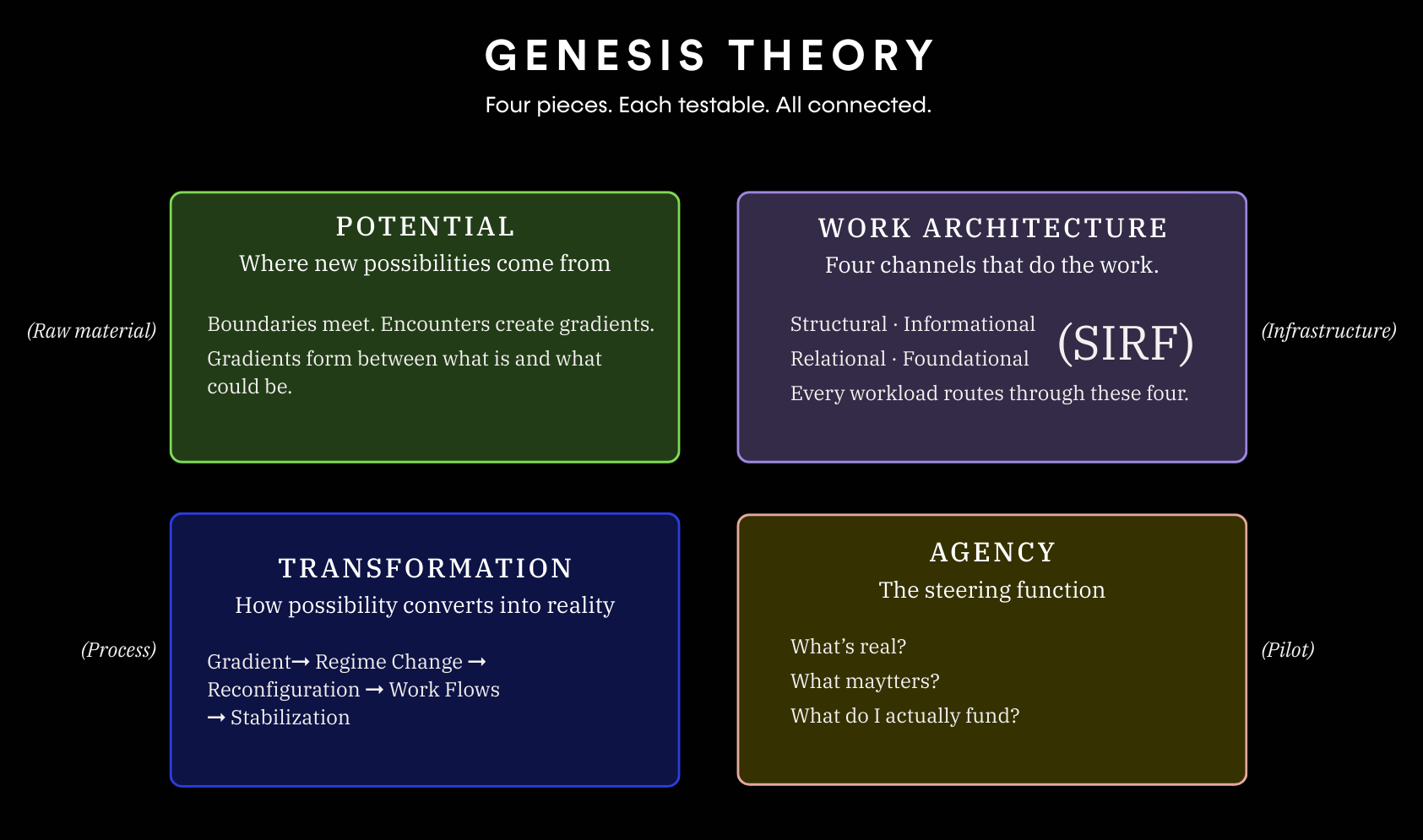
Four pieces. Each grounded in established science. Each testable on its own.
The 4 pieces
Potential: Where new possibilities come from: boundaries, encounters, collisions.
Transformation: How possibilities convert into reality: the pattern of regime failure → reconfiguration → stabilization.
The work architecture (SIRF): Four channels every organized system runs on: structural, informational, relational, and foundational work-functions. They handle every job the system does—surviving, maintaining, converting, exploring, and dissolving.
Agency (the navigator): the steering function: what you treat as real, what you treat as valuable, what you actually fund.
And the hidden invariant underneath all four: Systems produce results consistent with configuration. Always.
In other words, systems don’t lie about what they are.
Literacy turns scattered knowledge into instruments. And the first instrument this literacy gives you is a diagnostic.
Diagnostics
A diagnostic does something simple and brutal. It turns “I’m stuck” into an address—where the actual constraint lives.
Here’s why this matters.
The power of reading constraints
Think about what happened before germ theory. Doctors couldn’t read what was killing their patients. They tried harder and tried new frameworks. They even blamed the patient’s constitution. Meanwhile, the constraint remained invisible, and the intervention was trivial: wash your hands. Illiteracy isn’t stupidity. Reading constraints were revolutionary and saved countless lives.
Another example. Scurvy killed sailors for three centuries. The British Navy even discovered the fix—citrus—then somehow lost it. They had to rediscover it decades later while thousands more died of something that costs pennies to prevent. That’s what happens when knowledge can’t compound.
The periodic table itself. Alchemists tried to turn lead into gold for three thousand years. The constraint was atomic number—you can’t change elements by mixing them. Once the address was readable, chemistry stopped chasing transmutation and started doing synthesis. Sure, the constraint killed alchemy but birthed modern chemistry.
Right now, transformation sits where medicine was before germ theory. We see the symptoms. We try frameworks. We might even blame character. Yet the constraint sits there, unread, governing every output because we have no way to point at it.
Without diagnostics, you try harder. Pour resources into the wrong place. Blame yourself when nothing moves. Rinse. Repeat.
With diagnostics, you can point to the bottleneck. You can name the constraint. Most of all, you can stop fighting battles that can’t possibly convert into desirable change.
Imagine being able to tell the difference between:
“I’m lazy,” versus “my fuel is below threshold.” Or, “We need better culture,” versus “our relational channel can’t carry exchange.” Or “I’m confused,” versus “I can’t tell signal from noise anymore.”
A diagnostic doesn’t guarantee steerability. But it does make transformation legible so you can stop mistaking motion for progress.
Let’s run through an example.
Even dreams need addresses
I watched Amadeus at 44 and thought, “I’m going to be a conductor!”
Not “I want to learn an instrument” or take a music class. Conduct an orchestra.
I couldn’t read a note of music. I once described Beethoven’s Fifth as “the one that goes DUN DUN DUN DUNNN,” and a friend asked if I knew there were four others.
“Wait. There’s more?”
Anyway, how hard can it be?
I googled conducting programs before the credits rolled. I watched John Williams videos until 2 am. I stood in my kitchen with a wooden spoon, conducting the dishwasher—then caught my reflection in the window. I put the spoon down.
Eleven days later, the dream was laid to rest in the great scrapheap of broken promises.
Was it another failure of character? Or physics catching up to me?
Let’s read the constraints.
First, signal. I can’t read music. I don’t know what a time signature does. I can’t tell what’s happening inside a score because I don’t know what the score is saying. That isn’t a weak informational channel. There’s no channel—not yet.
Second, exchange. I don’t know a single musician. Not one. My entire world is marketing, startups, and people who think “score” means ESPN. If I needed a teacher, a mentor, a reality-check—who would I call?
Third, the container and fuel. I have a mortgage. Work. Relationships. A substack to write. I've got ninety minutes after 9 pm. My life is built around a completely different future. Rearranging it for “conductor” wouldn’t be an adjustment—it would be demolition. And the energy for that demolition isn’t sitting around unused.
And steering all of it? That silly story: “How hard can it be?” A poorly drawn map from a film I watched in boxers. I had no feedback. I had no contact with reality.
So I do what my system is capable of. I browse. I fantasize. I spend eleven nights watching the highlight reel version of someone else’s life. Then I see myself with the spoon, conducting my dishwasher, and my body responds honestly. I stop.
Nothing’s broken. It’s just configured for something else.
Every part of the machinery worked. The structure held the life I’ve built, and I didn’t want to crank up the bulldozer. Fuel went to commitments—good there. And the navigator, running on movie magic, couldn’t steer toward a destination it hadn’t mapped.
But here’s the part that matters.
What if I could’ve read the address before the spoon incident? Not “conductor or bust!” What was the real gradient I was feeling?
Maybe it wasn’t “conduct the Berlin Philharmonic.” Maybe it was: I need music in my life, and I don’t have enough of it. I could take a few lessons. Have a conversation with at least one musician. But these are different destinations.
The desire is there. I’m the same person. But a totally different reading of the situation. And likely, a more fruitful outcome.
That’s one person, just one address.
Let’s scale it.
Rosetta
A CEO says, “We need better execution.” A therapist says, “He’s avoiding vulnerability.”
They’re looking at the same system through different lenses—and neither knows it. Both are reading something real. Both are incomplete. But now they can point at the same place on the map and know they’re pointing at the same thing.
When translation becomes reliable, knowledge compounds.
What a therapist learns about relational repair in a marriage maps onto what a mediator learns about relational repair between departments. A systems engineer’s bottleneck is a teacher’s classroom dynamic because constraints travel.
When the same constraint shows up in a coral reef, a startup, and a marriage—and responds to the same reading—we leave the realm of metaphor and arrive at an address. The same four channels translate all three, like a modern-day Rosetta Stone. When one channel drops below threshold, the system stalls—whether it’s made of polyps or people.
Legibility makes this a science. A literacy with measurable variables, falsifiable claims, and results that don’t depend on who’s holding the instrument.
Two systems meet. Four channels do the work. Three questions steer. One pattern runs underneath. A new alphabet for change.
The alphabet doesn’t limit what you can write. It tells you what you’re writing with.
And once you can read, the next step is unavoidable: writing.
Engineering
Literacy doesn’t just read. It builds.
An underfunded school isn’t just lacking money. If parents can’t read what the school needs, and the school can’t read what families face, you can pour resources in and nothing converts. The money arrives, but change doesn’t.
The policymaker who reads only the funding line misses three-quarters of constraints.
How do you find where the constraint actually lives, and resource that?
Instead of aligning parents with your mission statement, you facilitate the meeting where a parent can say, “My kid hasn’t eaten since yesterday,” and a teacher can say, “Sorry. I didn’t know.”
That’s the move from reading to engineering. We go from “What is this system producing?” to “What would it take to produce something else?”
If I’d known this in my fictional conductor episode, I wouldn’t have aimed at “conductor.” I would have aimed at where the music actually lives in my life.
We carry the engineering by carrying the physics as questions:
Four questions for the work architecture:
What’s holding this together? What am I noticing or missing? Who do I need—and can they reach me? What’s actually fueling this?
Three for the navigator:
What’s real? What matters? What do I actually fund?
The stone doesn’t give answers. It gives constraint addresses. And once we can read those, we can fund the right thing.
The ethical consequence
We started with translation. But literacy doesn’t stop at reading across fields.
The Rosetta Stone made languages readable. The Philosopher’s Stone makes systems—including the one you’re running—readable.
And here’s what it reveals:
None of these systems are broken.
The reorg, the underfunded school, or the failed conductor-to-be are not “failing.” Each is reliably producing what it’s currently configured to produce.
Think about a parent watching the distance grow at holiday dinners. They raised their kids with a clear picture of what a good life looks like. That picture became part of who they are—a belief, an identity, a story. And now the kid has grown into someone who doesn’t match it.
Their system doesn’t fail at connection. It succeeds at protecting a story they can’t update without feeling like they’re losing themselves. The distance isn’t a malfunction. It’s the cost of a model that’s working exactly as designed.
“Failure to change” doesn’t exist in the way we talk about it.
You’re not watching systems fail (people, schools, institutions, companies, etc.). You’re watching systems succeed at something you didn’t ask for. The system isn’t lying. You just haven’t learned to read what it’s telling you.
The Stone doesn’t show you what’s broken. It shows you what you’re building and gives you the chance to decide if that’s what you meant to build.
We’re not merely moving from ignorance to knowledge. We’re moving from story to physics.
And that shifts blame.
Literacy—the ability to read transformation accurately—shifts blame from character to constraints. The reorg didn’t fail because people are lazy. The structure was already at capacity, and there was nothing left to hold a new shape. That's not a moral failing—it's purely mechanical.
But don’t mistake responsibility for blame.
The person at 2 am who could make the call, send the email, start the hard conversation—but watches another episode instead. That’s a choice made visible. Literacy doesn’t add blame. It reveals the choice, if you’re willing to look.
And someone who never had the channels to begin with—born into survival conditions, cut off from resources—they can see exactly what’s happening and still can’t change it.
For them, the stone doesn’t demand self-fixing. It sends a signal to the people who can act: policymakers, designers, funders, or anyone with surplus to allocate.
The question shifts from “whose fault is it?” to “who can see this address and do something about it?”
The stone doesn’t judge. It reads. And if we’re properly resourced, we can write, too.
The Stone
The alchemists spent three thousand years seeking a physical object—a Philosopher’s Stone that transmutes base matter into gold.
They were right about the question. They were wrong about the form.
The stone was never a substance. It’s physics literacy.
A literacy that can read any system — including yourself — and show what that system is building. What it’s actually building, right now, with its current configuration.
So what does this change?
What happened after germ theory? Doctors stopped killing patients. Surgical survival rates transformed. Public health became a field. Cities built sewage systems. Child mortality fell dramatically. Why? Because a constraint became visible. And once it was visible, every practitioner in every context could act on it.
Think about what happened after the periodic table. Chemistry stopped being a collection of local recipes and became a cumulative science. A chemist in Berlin could build on a discovery in Tokyo because they shared the same alphabet, the same language. This birthed new materials, new medicines, and new industries.
Now imagine that for transformation—for reliably and predictably converting possibilities into real outcomes.
A therapist reads a client’s relational channel and recognizes the same constraint a mediator published about last year—and applies the fix.
A policymaker reads a school’s actual channel profile instead of just the funding line—and resources the bottleneck, not the surplus.
A parent catches the drift in their own navigator before twenty years of distance accumulates. Did they become wiser? Maybe. But they became literate first.
That’s what physics enables. No, not a frictionless life because friction is how systems learn. But what if everyone could go from “why do things keep failing?” to “what’s the address, and who can resource it?”
This series gave you an introduction to Genesis Theory. But we’re just beginning.
We haven’t built the full diagnostic toolkit. We haven’t shown what happens when AI helps people use this literacy in real time—tracking signals, constraints, and drift in ways no single person can hold in their head.
More is on the way.
For now, this series introduced you to a physics—made for the messy middle that humans occupy—and asked something simpler, and harder:
Why is thriving the anomaly?
Because thriving requires four pieces running together. And any one can fail quietly. And until now, we’ve had no way to see which one.
That concludes The Stone—an introduction to Genesis Theory. Eight posts to lay the foundation. I know it’s been a bit dense.
What’s coming up is different. Now that the foundation is laid, we can build on it. What exactly? Diagnostics, tools, real applications, and how this physics helps me imagine a whole new world.
Thank you for reading this far.
Status on claims
Established science: Each piece traces to validated physics. Potential and boundary dynamics: Prigogine’s dissipative structures, far-from-equilibrium thermodynamics. Work architecture channels: Gibbs (energy/thermodynamic potential), Shannon (information theory), Schrödinger (exchange and negative entropy), Prigogine again (structural maintenance). Transformation dynamics: non-equilibrium phase transitions, well-documented across physics and chemistry. Confidence: ~95%.
This series’ synthesis: That these pieces form a minimal complete set for reading transformation at any scale. That the work architecture handles every job an organized system does—surviving, maintaining, exploring, converting, dissolving—through the same four channels. That the bottleneck constraint governs conversion capacity. That agency distorts across all stages. That the whole system produces results consistent with configuration, not intention. Confidence: 60–80%. Under test.
What would break it: A fifth work channel that can’t reduce to these four. Organized complexity that persists without one. Transformation success independent of channel health. A steering function that doesn’t distort the architecture. If you find any of these, the synthesis fails. The underlying physics doesn’t, but the claim that this set captures the minimum needed does.