


The Stone, part 1.

When I was nineteen, I wanted a simple thing: to make something happen.
Nothing mystical or grandiose. A solid career, you know, something that wouldn’t kill me. A decent relationship. And money, lots of money.
So I did what most people do. I looked for direction.
I spent years in bookstores, pulling books off shelves like they were reality manuals. Eastern philosophy. Self-help. Psychology. Business. Whatever aisle held the missing key.
Some of the books were good. Some were brilliant. None of them answered the question I was actually asking:
How do I actually steer this thing called life?
Not “what should I value?” or “what habits should I build?” I needed something more tangible than a 15-minute meditation promising abundance.
These questions never left me.
Why do some people grow and compound while others, who are equally smart and equally driven, stall? And why can’t any of these books explain this to me with the same precision my doctor uses when he reads my blood panel?
I didn’t have the vocabulary for it then. Up until recently, I would’ve never asked, but the question underneath all those books was always the same:
Is there a physics for this?
The two forces that drive everything
Here’s an observation.
Underneath every book’s concept—regardless of category—two forces were always running underneath the advice: entropy and emergence.
It’s these two forces that underpin all of human behavior. We spend our lives either preventing unwanted change from happening, such as aging (entropy), or trying to make wanted change happen (emergence).
In life, everything drifts toward entropy. Your office gets messy the moment you stop cleaning it. A close friendship fades when nobody calls. A team loses coherence once your startup scales. Stop going to the gym, and see what happens to your body.
You never have to try for entropy. Simply ignore something, and it arrives on its own—disorder increases, structures dissolve, and things fall apart. Entropy is relentless.
Emergence is the rarer thing. An original piece of art. A conversation that launches a movement. The company that compounds—not just grows. The recovery that takes hold when the right conditions are met.
Call them decay and creation if you prefer. The labels don’t matter. The asymmetry does: one is automatic; the other is rare.
And we spend our entire lives navigating between these two forces. Either you generate something (emergence) and hold off decay (entropy) long enough to build something that lasts.
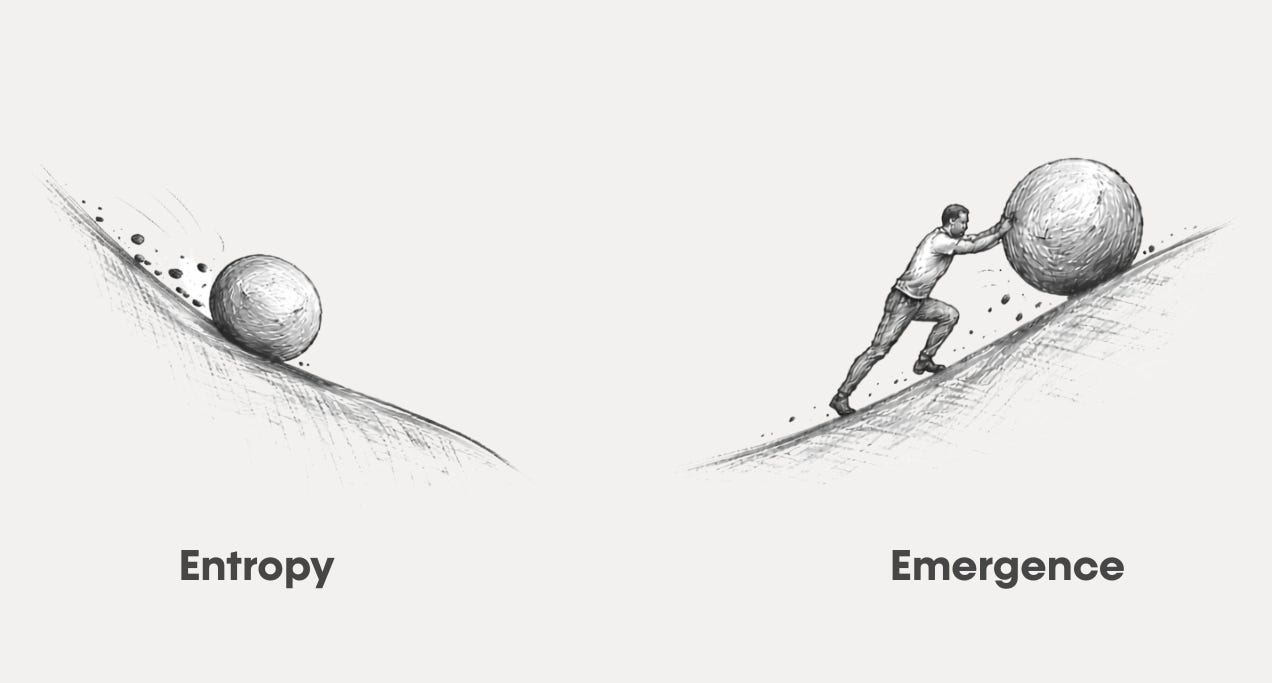
Over time, I learned that building complexity is harder because entropy is always lurking, waiting for you to divert your attention. And the greater the scale, the less you can attend to everything, the harder it is to hold complex things together.
You, as an individual, can white-knuckle entropy for a while. And a civilization? That’s millions of moving parts, all drifting toward disorder unless something actively holds the structure together. It’s a miracle of coordination and sheer will.
Remember: Entropy is always available. Emergence is not.
That’s why we chase emergence—or even pretend to. And yet most of us chase it without a proper steering wheel.
The gold problem
This was alchemy, beneath the furnaces, mysticism, and the trope of turning lead into gold.
Alchemists watched the world change. Metals rusted, liquids evaporated, substances reacted, things broke down, and recombined somehow. Reality was convertible.
So they asked: Can we make transformation obey us?
Can we make the wanted change happen more reliably? Can we prevent unwanted change long enough to build something that lasts?
They called the wanted change “gold.” They called the key to making this happen “the Philosopher’s Stone.”
Today, we’re still asking the same question. We just swapped furnaces for frameworks.
And we mostly approach it the same way they did—searching for some magical stone or recipe. Some life-changing morning routine that carries the confidence of a sacred text.
Some recipes work—sometimes. But they share a fatal limitation: they mostly can’t tell you why they work when they work, and they can’t name the constraint that binds when they fail.
So when the recipe fails, we blame who? The book? The author? Ourselves? Or the recipe? Then we try another one.
But what if every recipe “works” in one sense: it reliably reveals what your system’s constraints will and won’t allow?
The machinery always produces something
Here’s what took me years to see.
Transformation doesn’t fail. It’s already running. Right now. At every scale. Without exception.
Every company already converts capital, labor, and attention into capacity or decay. The thriving ones don’t run on different machinery than the surviving ones. They just run on different configurations.
Even relationships convert an interaction into something—it could be trust or noise, intimacy or grift.
Every person converts time and energy into something—health or illness, growth or stagnation, order or chaos.
The machinery everything operates on doesn’t take days off. It doesn’t care about your goals. It outputs whatever the system is actually configured to output.
And if it’s already running and working flawlessly, then it must have observables, right? Signals we could, in principle, detect and measure. Which would mean that transformation isn’t so mystical after all. We just have a dashboard problem.
But even without instruments, we don’t fail to get results, because everyone gets some kind of result or output. We succeed at getting results we can’t read.
…
Have you ever burned out from overwork or exhaustion? Burnout is not a ‘failure’. It’s your system converting inputs into exhaustion. Stagnation isn’t a lack of potential. It’s the machinery maintaining the pattern it’s running, even if the person hates the outcome.
So, much like alchemists, we chase gold. We use frameworks, models, cheat codes, shortcuts, or anything that might help us steer toward the changes we want. Sometimes we get a nice reaction, sometimes the recipe doesn’t work.
So burnout advice that works for one person backfires for another—because it’s a recipe, and nobody diagnosed it correctly.
The “culture change initiative” dies on contact with real incentive structures because culture isn’t something you install—it’s something the system already produces.
The diet that ignores recovery until the body breaks down because the recipe doesn’t account for maintenance.
Same pattern. Different domain. No shared language for why. But the machinery we all operate on remains the same.
If you can see that, maybe we can start asking different questions.
If it’s the same machinery, then why can’t we see it?
If it's been running this whole time, why doesn't it have a manual?
And what would change if we could actually read it?
Chasing gold
Flashback to nineteen, standing in that bookstore, I thought my problem was ignorance and a lack of direction. I thought if I found the right book, the right recipe, I’d know which way to go and how to get there. Don’t get me wrong, they helped.
But I was completely wrong about the problem. It was never about finding the right recipe, framework, or wisdom.
I just couldn’t read the machinery I was already inside.
In other words, I couldn’t see what my system was configured to produce:
lack of clarity, direction
few opportunities and limited options
a crappy paycheck
Get it? I was highly successful at producing things I didn’t want. And I couldn’t diagnose why.
I couldn’t tell where energy was going versus where I thought it was going. I couldn’t distinguish a real path from a fantasy dressed up as a goal.
I was trying to write to my reality before I’d learned the alphabet.
And when you can’t read cause and effect, you collect rituals. You try one recipe, then another, then another. And when none of them work reliably, you start to wonder if the problem is you.
It’s not you. It’s that nobody taught you to read this.
The alchemists had the same problem. They chased gold for centuries. They cataloged recipes, refined techniques, and built elaborate trial-and-error systems. They were brilliant people doing serious work—with the wrong model.
Then someone stopped asking “what’s the recipe?” and started asking “what are the constraints?” Because that’s physics in a nutshell: constraint literacy.
Not a better recipe or framework. Which led to a different kind of question.
What if we can learn to read the machinery of change and finally steer it?
That’s next.
Next: Part II: What happened when we stopped guessing about bridges — and what physics actually buys you that a thousand smart people and their recipes can’t.