


The Stone, Part 3

A thousand frameworks, yet none of them converge into a shared understanding.
That’s strange, if you stop to think about it.
We’ve had decades of organizational theory, psychology, leadership development, and change management. Thousands of practitioners. Millions of hours of effort. Enormous sincerity. And what do we have to show for it?
More frameworks. Not fewer. Not a convergence toward shared understanding. Just... more.
Seven habits. Four agreements. Five dysfunctions. Eight steps. Enneagram. DISC. Lean. Agile. OKRs. EOS. Holacracy. Each one captures something real. Each one useful in some contexts. But none of them can talk to each other.
If you’ve spent any time trying to improve yourself, your team, or your organization, you’ve lived this. You’ve read the books. Tried the methods. Wondered why the thing that worked for someone else produced nothing in your hands. Wondered which framework was “right” when the answer might be that each holds fragments of something none of them can name.
This is the water we swim in. We barely notice it anymore.
But the pattern points to something.
The missing Rosetta Stone
When organizations operated as islands, framework incompatibility was tolerable.
At my first startup, we used V2MOMs to set goals. After a few years of hypergrowth, we adopted OKRs. These are recipes. They worked in our kitchen. Nobody needed our vocabulary to translate into anyone else’s.
But the world stopped being kitchens.
…
Two companies merge. One spent five years building a culture around “psychological safety.” The other invested in “radical candor.” Both produced real results. Neither framework can describe what the other actually did because they don’t share operational definitions.
So the merger team has to translate between two sophisticated vocabularies that are mutually unintelligible—while the clock runs and talent walks.
…
Zoom in and the same problem follows you home.
You’re in therapy working through a pattern your therapist calls “avoidant attachment.” Your executive coach calls the same pattern “low accountability.” A self-help book on your nightstand calls it “fear of vulnerability.”
Three sophisticated vocabularies. All pointing at the same bottleneck. None of them talks to each other.
So you do the translation work in your head, at midnight, wondering which framework nails it. What if the answer might be that they’re all seeing fragments of something none of them can name?
…
Everywhere we interface—every place where coordination actually happens—has no shared language at all.
The more connected we become, the more integrated systems become, the higher the cost of a missing Rosetta Stone.
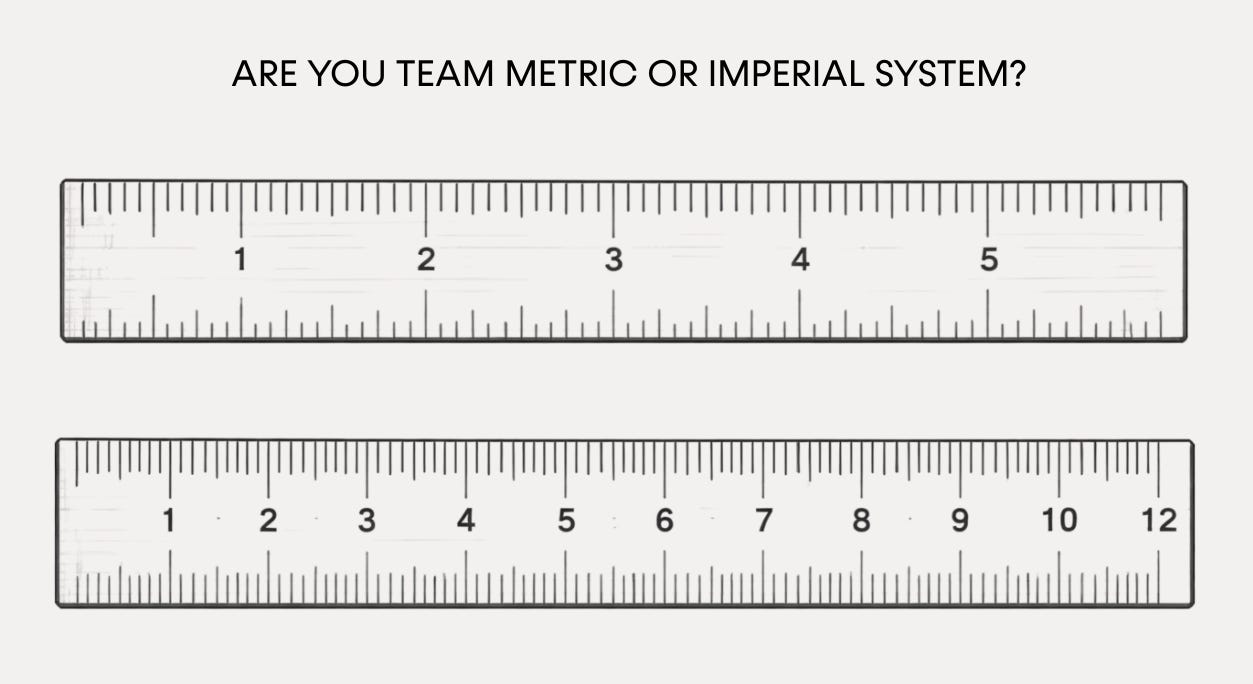
Think about what happened before the metric system. Every region measured differently.
A “foot” in Paris wasn’t a “foot” in London. Trade happened, but at enormous cost. Every exchange required conversion, every conversion invited error, and every error carried financial consequences. Like illiteracy and healthcare costs today.
The metric system didn’t make measurement possible because measurement already existed. It made measurement portable. It made coordination at scale achievable.
We still don’t have a metric system for transformation.
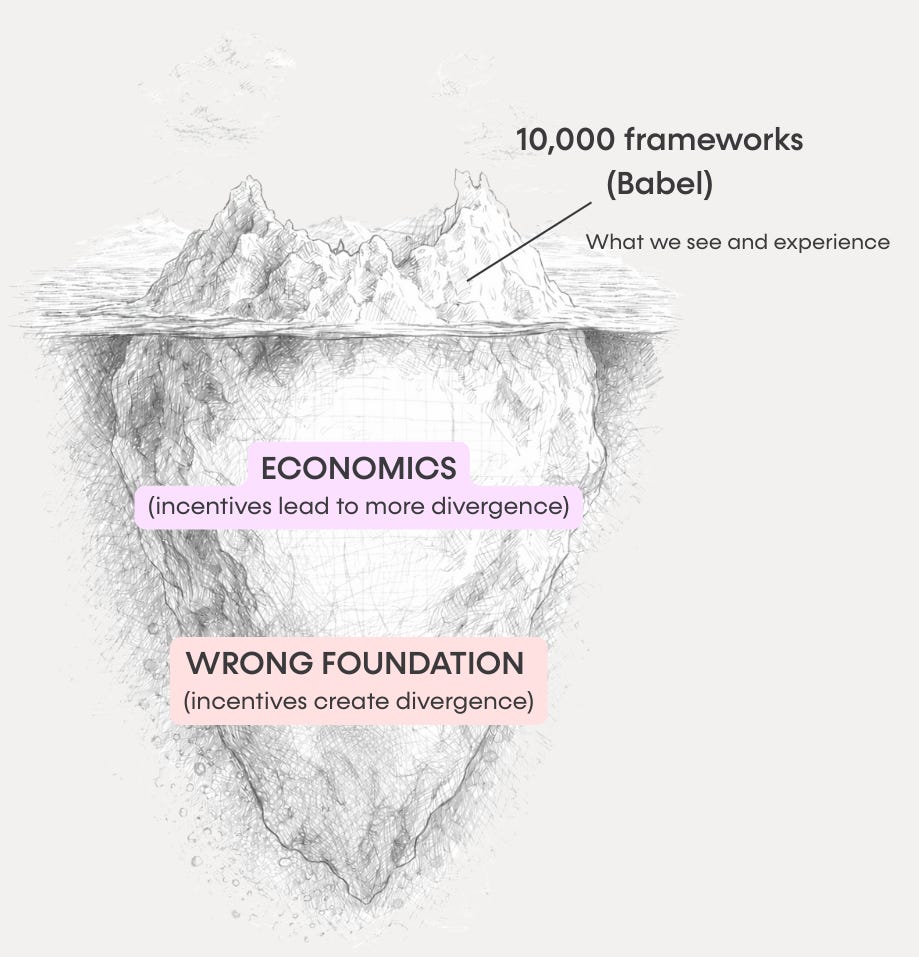
We have a thousand local measurement systems, each internally consistent, none compatible with any other. And the friction cost of that incompatibility compounds with every connection we add.
Why nothing converges
The natural question: if a common language would help this much, why hasn’t one emerged?
One big reason is economics.
For example, a proprietary framework functions as an asset. It generates consulting clients, certification programs, book deals, keynote fees, and corporate training contracts. The Enneagram has an ecosystem. So does DISC. So does Lean. Every notable methodology sits at the center of a ring of practitioners whose livelihoods depend on its distinctiveness.
And nobody profits from a periodic table.
What did the periodic table actually do for practical chemistry? It didn’t destroy expertise—it just grounded it. The best alchemical recipes kept working. But now you knew why they worked, which ones to trust, and how to design new ones from first principles instead of stumbling onto them by accident.
Aristotle established the concept of first principles.

He called it arche (ἀρχή) — "the first basis from which a thing is known." In his Posterior Analytics, he argued that all demonstrable knowledge must rest on foundational propositions that are:

- True
- Primary (not derived from anything else)
- Immediate (self-evident)
- The cause of everything that follows

The contrast is reasoning by analogy (this worked before, so it should work again) versus reasoning from fundamentals (what do we actually know to be true, and what follows from that?).
Practical chemists became more valuable after the periodic table, not less. Though there was a cost: they lost their monopoly on expertise.
But the scientific community gained something. Knowledge became cumulative instead of proprietary. New practitioners could learn in years what used to take decades of apprenticeship. As a result, progress accelerated.
The framework economy can’t survive the loss of exclusivity.
…
This is exactly what happened with the metric system in America.
The metric system exists. It’s objectively better for coordination. Most of the world adopted it, with the US the only holdout—still using feet, miles, and Fahrenheit. It’s not just stubbornness—the switching costs would fall on individuals until the benefits accrue to the collective.
Think about every road sign, building code, and every tool in every garage. Every recipe in every cookbook. The cost of switching is immediate and concrete, but the benefits remain diffuse and distant.
Congress passed the Metric Conversion Act in 1975. It was voluntary. Yet almost nobody volunteered, to no one’s surprise.
The same dynamic plays out everywhere markets reward proprietary knowledge over shared understanding. The incentive structure rewards divergence, not convergence.
In other words, you get paid for being different, not for being compatible.
So fragmentation persists because the economics make convergence irrational for any individual actor. Every person in the system behaves reasonably. The system produces incoherence anyway.
Fragmentation isn’t failure. It’s equilibrium. And that's worse.
What if incentive structures change?
Let’s suppose the economics changed tomorrow.
Or that some foundation funded convergence, a common language. And that practitioners coordinated and willed it into being.
What would they converge on exactly? Where would they even begin?
…
“But wait a minute,” you might object—didn’t some domains switch to metric?
Yes, science uses the metric system. Medicine uses metric. International engineering uses metric. Even in the US. Why?
Because in those domains, the cost of not coordinating became unbearable. Scientists need to talk to scientists in other countries. Doctors need drug dosages that translate across borders. The forcing function was strong enough to overcome the coordination trap.
The metric system didn’t win by existing. It won in domains where the pain of fragmentation exceeded switching costs.
So the question for transformation frameworks isn’t just “could they converge?” But has the pain become unbearable enough to force it?
Maybe. The tempo has changed. Organizations restructure annually. Markets shift quarterly. Mergers happen across framework boundaries. The cost of translation failure keeps rising.
But even if the pain is there—even if practitioners wanted to converge—there’s still a deeper problem we need to address.
Right city, wrong map
Even if everyone sat at the same table, they’d have nothing to converge on. And the reason has nothing to do with economics.
Pull any framework off the shelf from leadership development, organizational change, personal growth, therapy, coaching, or education reform. Listen to how it talks about what it’s trying to do.
“Unlock your potential.”
“Unleash your team’s hidden capabilities.”
“Tap into what’s already inside you.”
“Discover the leader within.”
“Activate your untapped resources.”
Five different frameworks. Five different methodologies. One common assumption: the raw material for transformation resides within the system, and the right method extracts it.
It’s the water every framework swims in. Not something they even bother to argue for—it’s assumed before arguing begins. Commencement speeches assume it. TED talks assume it. Executive retreats, therapy modalities, and parenting books all assume it.
That potential is intrinsic.
A hidden treasure. Buried inside. Waiting for the right map, the right technique, the right guru to unearth it. Every framework offers a different map. But they all agree on the territory: the gold is buried within.
If that assumption is right, a thousand proprietary methods for finding it make perfect sense. Each guru sells a different map to the same buried gold. The maps are the intellectual property. The gold is assumed.
But what if the gold was never buried there?
What if we have the right city, but the wrong map?
The human potential movement continues to navigate with maps that sometimes lead somewhere good, but can’t explain why. We trust the map because a technique worked. But when the same route fails next time, we don’t know what changed. The map can’t tell us which parts were accurate and which parts were luck. So we can’t retrace our steps. We can’t teach the way. We can only say ‘it worked for me’ and hope.
And when it doesn’t work for you? The map isn’t questioned. You are. “It’s worked for thousands of people—maybe you need more 1:1 time.” So failure protects the franchise.
Frameworks work beautifully in one context and fail mysteriously in another. And when recipes and maps can’t explain their own success, they can’t replicate the conditions that made them succeed.
Without a shared foundation—a common alphabet, a shared physics—we keep inventing new words, new models, new frameworks. Each one trying to navigate the same territory. Each one speaking a language no one else can read.
But what if it’s not just the vocabulary that’s fragmented? What if the base assumption underneath all of it is wrong—categorically, ontologically wrong?
When medicine assumed disease came from bad air, we built hospitals with windows facing the wrong direction. When we assumed ulcers came from stress, we let people suffer for decades while bacteria went untreated. Wrong foundations don’t just slow progress. They aim effort in the wrong direction. Sometimes for centuries. Sometimes lethally.
The Phlogiston phenomenon
In the eighteenth century, chemists explained combustion with phlogiston—an invisible substance released when things burned. The theory worked. Practitioners could predict and control fire with real skill.
But some metals gained weight when they burned. If burning meant releasing something, they should weigh less. So how could these metals weigh more?
For decades, everyone patched around it. Maybe phlogiston had negative weight. Maybe the scales weren’t precise enough. Maybe metals were a special case. Each patch preserved the theory at the cost of making it stranger—and nobody bothered to question the foundation because everyone assumed the foundation was correct.
Overnight, the same skilled practitioners found their recipes sitting on top of a completely different physics.
The real cost of wrong physics
You might argue that a thousand recipes, each capturing a fragment of something real, is good enough. People muddle through. Some frameworks help some people sometimes.
But wrong physics doesn’t just fail to converge. It systematically misallocates effort.
Every intervention designed on the intrinsic potential model optimizes the same thing: the actor. Develop the leader. Train the team. Coach the individual. Upskill the workforce. The assumption says the raw material lives inside someone, so that’s where all the energy flows.
But what if the assumption is wrong, and that energy is building better doors to a room that doesn’t exist?
This is why organizations can invest millions in leadership development and see no systemic improvement. Or why someone can do years of genuine personal work and stay stuck. And why nations can pour resources into education and watch outcomes flatline, if not worsen.
The effort is real. The model directing that effort points at the wrong target.
We can’t close the gap with better recipes. Not even with more recipes. The gap exists because the shared assumption underneath them all prevents convergence even in principle, and because interventions built on wrong physics systematically miss the target, no matter how well they’re executed.
The question underneath
So here we are.
A thousand frameworks, and yet none converge. No common substrate beneath them. Not because we haven’t tried. Not just because economics prevent it. But because they all share a foundation that makes convergence almost impossible.
The alchemists couldn’t converge either. Hundreds of years, thousands of practitioners, enormous effort, and sincerity.
Turns out they just needed a periodic table.
What’s actually at stake
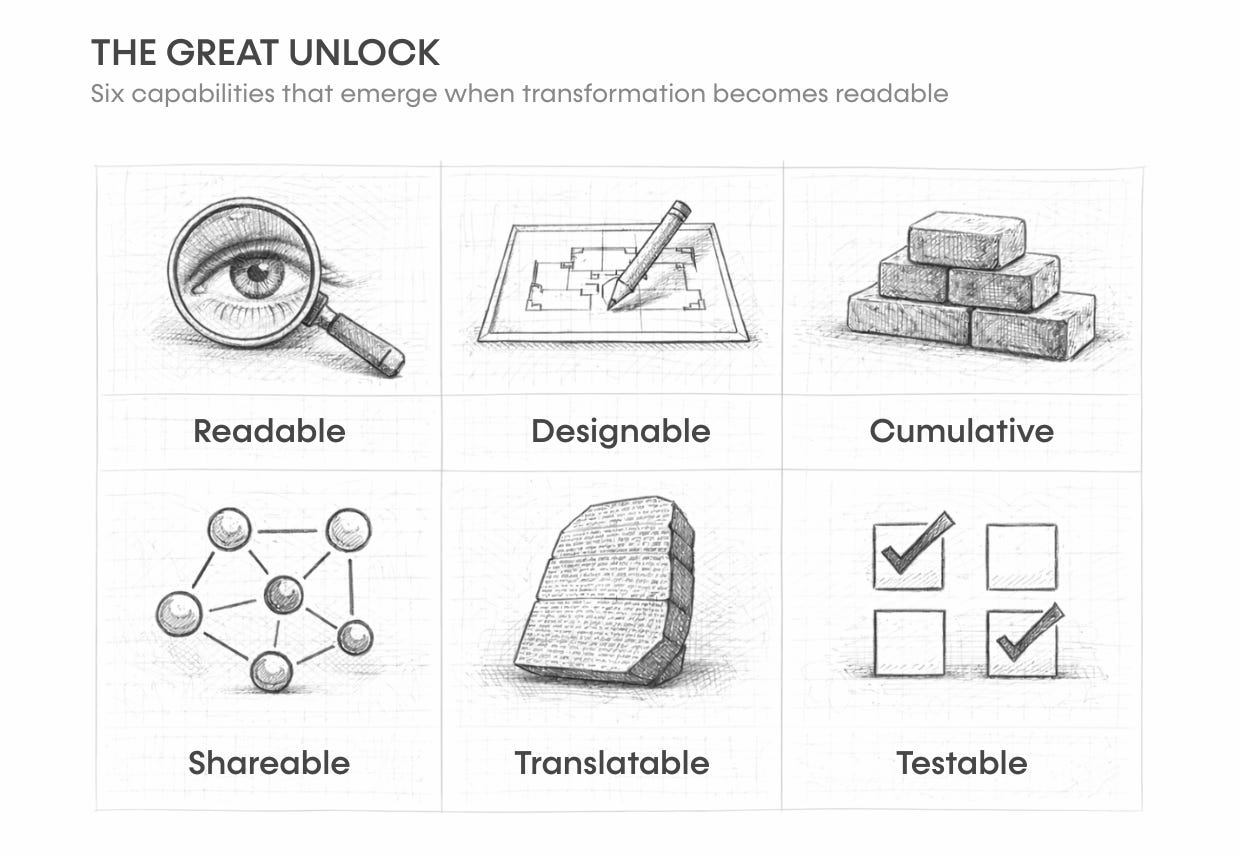
We’ve talked about a world without a shared alphabet, language, and physics for us messy humans. Here’s what becomes possible the moment we have shared physics:
The world becomes readable. “Culture problem” becomes as vague as “bad humours.” You can see what’s actually happening. From which function is bottlenecked, to what capacity is missing, to which configuration is producing the result you don’t want. Diagnosis becomes possible—and more accurate.
The world becomes designable. We can stop guessing and start engineering. The periodic table didn’t just explain chemistry—it makes chemistry designable. We can predict what would react with what before we even try it. Bridges don’t collapse because we now have load physics.
Progress becomes cumulative. Each generation builds on the last instead of starting from scratch. Science accelerates because knowledge compounds. Without shared language, every practitioner reinvents the wheel.
Expertise becomes more shareable. What used to take decades of apprenticeship can be taught in years. The expert actually becomes more valuable. They can explain why their methods work, not just that they work. Their skill sharpens. But their monopoly dissolves.
Note: Frameworks won’t die when we have physics. They’ll sharpen. With physics, you can finally see how each one was grounded. Psychological safety addresses a real function. OKRs work when a specific constraint is binding. The frameworks that survived decades of practice weren't accidents—they were pointing at physics. They just couldn't name it.
Translation becomes possible. The merger team can better integrate the two cultures because they share common terms. A therapy insight can inform organizational intervention. Different fields can finally learn from each other.
Claims become testable. Anyone can be proven wrong. This is how science self-corrects. Without shared physics, every framework is unfalsifiable. “It didn’t work because you implemented it wrong,” comes under more scrutiny.
…
That’s what’s on the table.
Not just “better coordination” in some abstract sense. But the difference between guessing and knowing. Between recipes and engineering. Between a thousand local maps and an actual picture of the territory.
Science adopted the metric system when the pain of fragmentation became unbearable. Chemistry adopted the periodic table when phlogiston couldn’t explain what was in front of everyone’s face.
The question isn’t whether we need shared physics for transformation. The question is whether the pain has become unbearable enough, and, more importantly, whether the physics actually exists.
It does.
The pieces are scattered across well-established physics: thermodynamics, information theory, open systems dynamics, and control theory. The same physics that tells you why bridges hold and engines run.
What if they just need to be synthesized?
Next: The synthesis: Four questions, one physics