


The Stone, part 2.

Last post, I ended with three questions:
If it’s the same machinery everywhere, why can’t we see it?
If it’s been running this whole time, then where’s the manual?
And what would change if we could actually read the outputs?
Let me start with the last one and connect some dots.
The world, pre-manual
For most of human history, the world was dense with invisible tripwires.
In 1854 London, a single public pump on Broad Street delivered perfectly normal-looking water that quietly killed entire families. Their neighbors on a different supply lived. Nobody could see why—because nobody could see cholera.
In a Vienna maternity ward in the 1840s, one in ten women died of childbed fever. A young doctor named Semmelweis started washing his hands between the morgue and the delivery room. Deaths collapsed to under two percent. The medical establishment rejected him.
Whole districts burned or fell because no one understood how flames jumped. A broken leg could kill you. A scratch could become an infection that could end your life. Life expectancy hovered in the thirties.
Then, domain by domain, people cracked the code.
John Snow sketched water-related deaths on a map and traced a neighborhood’s agony to one contaminated pump. Semmelweis proved that contamination traveled on doctors’ hands. Engineers calculated how much weight stone and steel could carry and built bridges that could hold up under increasing pressure instead of hoping.
Things that used to kill people now almost never do. We finally had a manual for survival.
The result? A world so survivable you hardly notice it. You drink from a tap without fear, most of the time. You give birth in a hospital where death is the exception. You sit under a ceiling that’s certain to remain a ceiling and not a new floor.
Once reliability becomes normal, people forget how deadly guessing used to be.
The invisible ninety percent
And the manual is everywhere now, and grows every day. You’re soaking in it.
The word “technology” evokes screens and gadgets—the visible, glamorous stuff. That’s maybe ten percent of our science-based reality.
The other ninety percent is invisible. And it’s the part that saved human lives.
The building you’re in doesn’t collapse. Why? Because someone did the math.
Structural engineering, load calculations, and material tolerances are set so precisely that you don’t bother to look up.
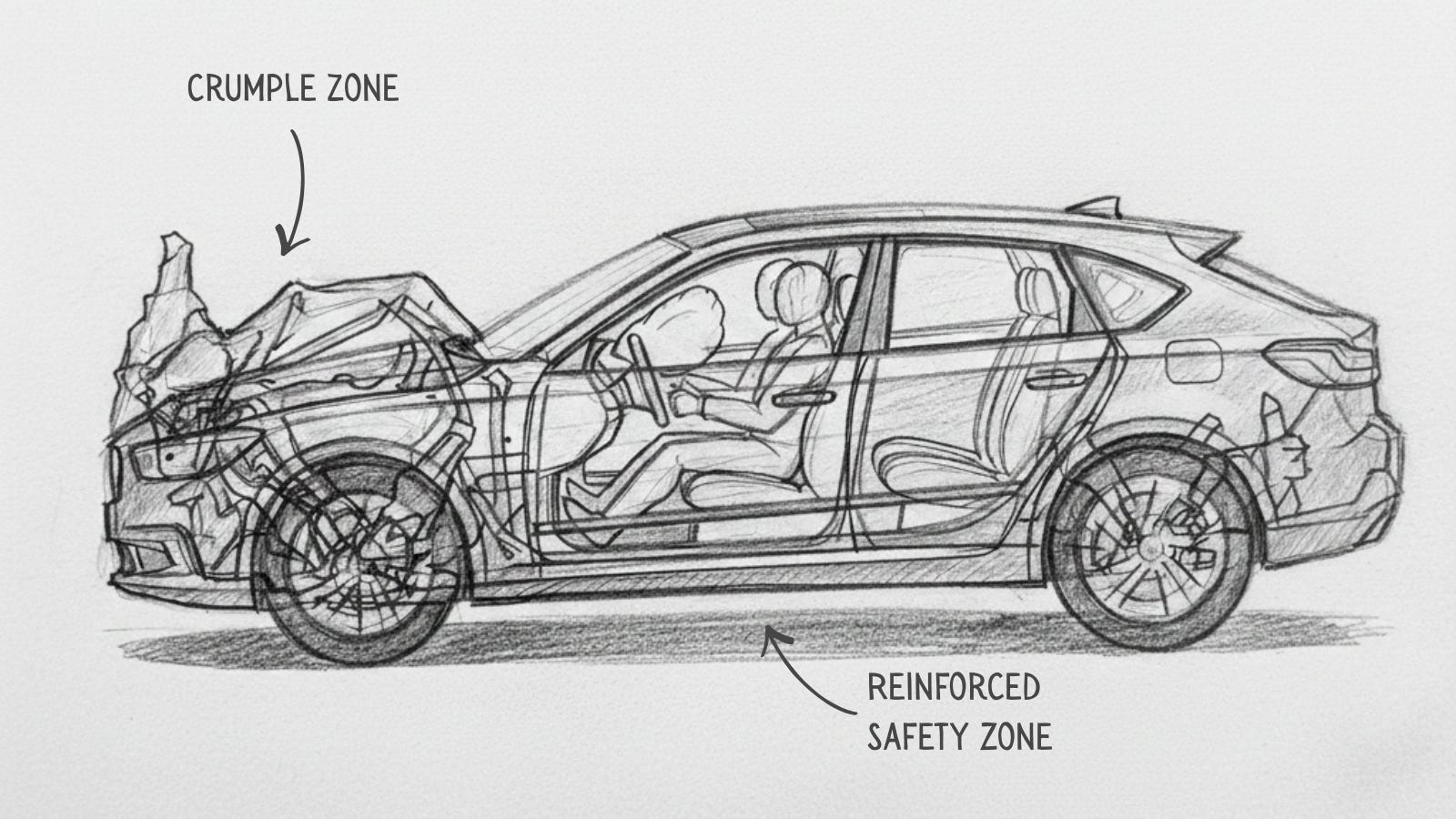
Your car is designed to crumple in a specific pattern during a crash—not randomly, but because engineers modeled how the metal should deform to soak up the impact so your body doesn’t have to.
The food in your fridge doesn’t poison you because refrigeration, pasteurization, and cold-chain logistics all rest on thermodynamics someone mapped two centuries ago.
You board an airplane and fall asleep in a metal tube seven miles above the Earth. Why? Because engineers have spent decades modeling how wings, engines, hydraulics, and computers can fail. They added layers of redundancy until the whole experience feels boring—until that baby behind you starts crying.
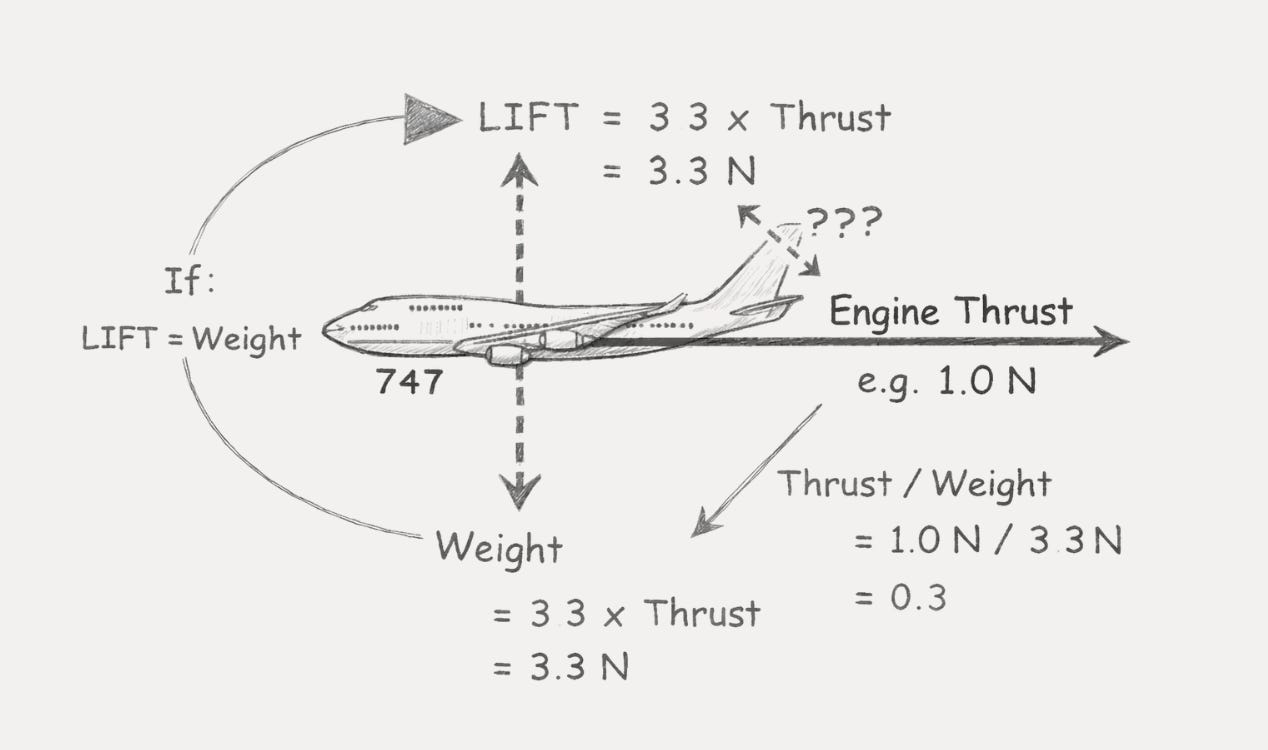
Behind all of it sits a handful of variables most people never consider: load limits, energy thresholds, friction coefficients, feedback delays, capacity constraints, and interface tolerances. You know, physics.
It’s not glamorous or intuitive. Just the hidden architecture that determines whether the bridge holds or the plane flies and safely lands.
Each one of these examples started the same way. Someone stopped asking “what’s the recipe?” and started asking “what does the physics actually constrain?”
What physics actually gives us
Physics doesn’t give us better instructions. It provides something that recipes cannot.
Legibility.
A recipe states: perform these steps in this order and expect a certain result. When it works, you don’t know why. When it doesn’t suit your taste, you don’t know why—so you try a different recipe.
A constraint says: here’s the boundary. These outcomes are reachable. Those aren’t. And here’s why.
Constraints don’t shrink options. They make options real.
Without constraints, you have infinite possibilities—most of which are fantasy. With constraints, you have fewer — but they’re reachable. You can engineer instead of gamble. That’s the difference between an alchemist and a chemist. Infinite ambition and no map, versus a bounded map and the ability to actually get somewhere.
You can feel this in your own life, even without the vocabulary.
People argue endlessly about diets, but energy balance and recovery are constraints. Violate them, and it doesn’t matter how clever the meal plan is.
People debate organizational culture, but incentive structures and information flows constrain it. Ignore them, and your values statement becomes theater.
People argue about motivation, but environment design and friction are constraints. Ignore them, and willpower burns out like a match.
In each case, the recipe sounds plausible. The constraint determines what actually happens. And when constraints dominate — which they almost always do — effort becomes a rounding error.
Physics isn’t an aesthetic. It’s compression: fewer rules that explain more outcomes.

The asymmetry that should bother you
So here’s what we’ve got.
Semmelweis figured out why mothers were dying.
Snow figured out why neighborhoods were dying.
Engineers figured out why buildings were falling.
In every case, someone identified the constraint, and the dying stopped.
When your relationship cracked, who identified the constraint?
When your company's growth stalled, who modeled the failure mode?
When your kid dropped out of school, who identified her bottleneck?
Nobody.
Because for the scale where humans actually live—relationships, teams, organizations, communities—we don’t have instrument-grade constraint knowledge. Not yet.
Human-scale systems are more challenging because of its unwieldyness. Materials adapt, boundaries shift, and variables interact. But harder doesn’t mean impossible. It just means nobody’s finished the work.
Though we’re not starting from zero, to be fair.
The pieces exist, scattered across control theory, systems science, complexity research, thermodynamics, information theory, and cognitive science. Serious, Nobel-prize-winning, field-defining work that we’ve accumulated over decades.
But no shared literacy that travels between them. No integration that lets you carry a finding from one domain to another without reinventing the vocabulary from scratch.
Instead, we accept practices that would be criminal in any other engineering discipline.
We’d pull the license of a pharmacist who said “everyone’s body is different” and ballparked the dosage. We’d ground every aircraft if the manufacturer said “flying is art” and skipped the failure analysis. We’d shut down a construction site if the engineer shrugged and said, “Buildings are complicated.”
But for human systems? We accept “change is hard” as wisdom. “It depends,” as an answer. “Everyone’s different,” as the final words. A phrase that replaces mechanism, rather than a starting point for understanding variance.
We have manuals for survival—and vibes for everything else.
And the gap is widening
So? Why does any of this matter? In a word: complexity.
Human-scale systems such as organizations, markets, supply chains, and institutions get more interconnected every decade. Decisions propagate faster, cascades travel farther, and second-order effects are harder to see. As complexity climbs, constraint literacy stays flat.
That’s not a gap. That’s a divergence curve.
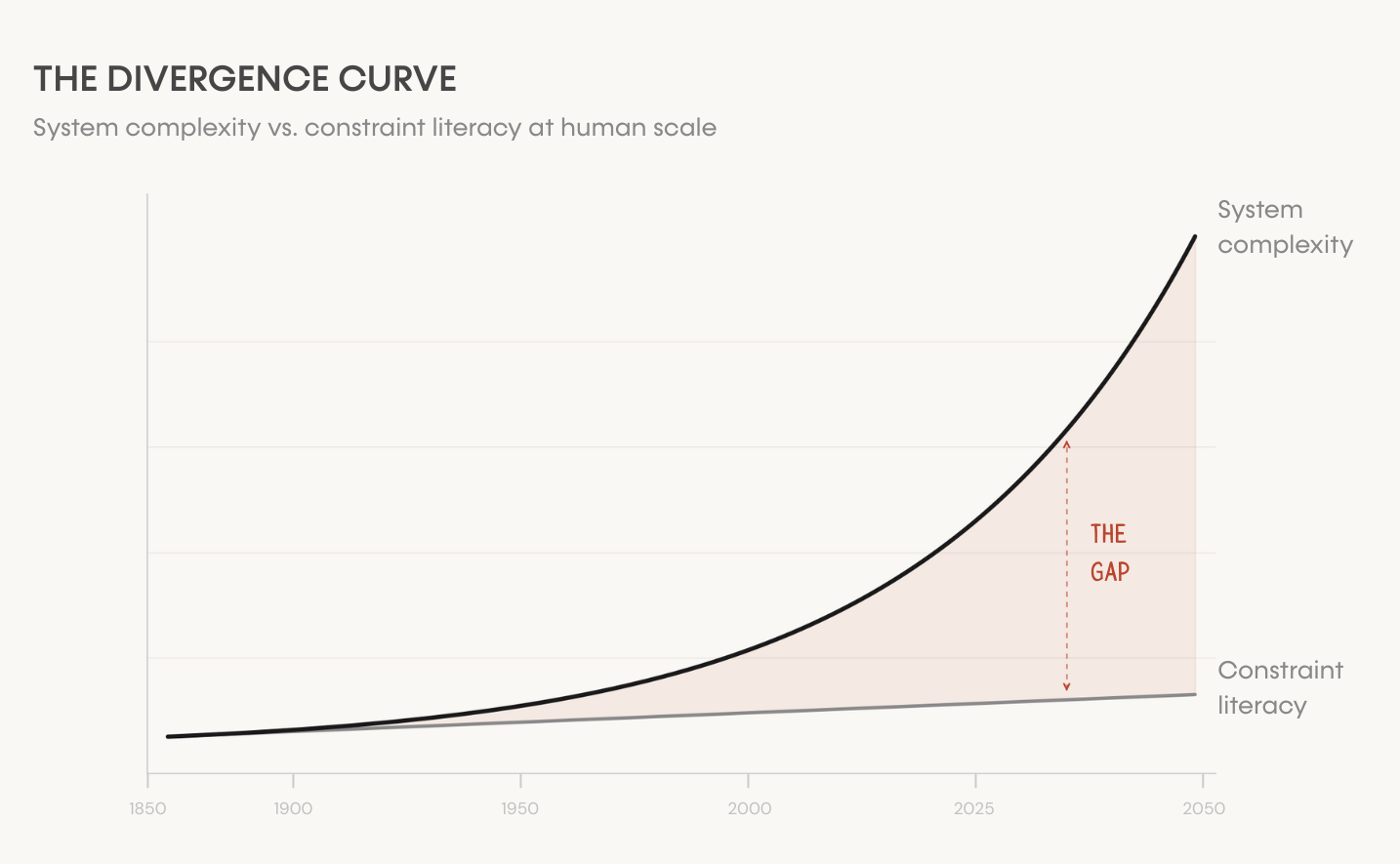
And “successful” physics makes the problem worse.
When infrastructure works, it becomes invisible. When it becomes invisible, people forget it was ever necessary. The manual disappears into its own success—and the void fills with intuition, ideology, and proprietary frameworks.
Consider measles. The vaccine worked so well that the US declared the disease eliminated in 2000. A generation grew up never seeing a child with measles. The threat vanished—and with it, the felt urgency of the thing that made the threat vanish. Vaccination rates drifted down. And in 2025, measles came back: over two thousand confirmed cases, forty-nine outbreaks, children dying from a disease their grandparents’ generation had already solved. Ninety-four percent of cases were in people who were unvaccinated.See the pattern? Not ignorance in the absence of knowledge, but ignorance generated by the success of knowledge. The better the manual works, the less anyone remembers why it exists or matters.
…
Now bring that dynamic to the one domain where the manual was never written. No shared constraints. No common instrumentation. Just thousands of proprietary recipes, each one someone’s livelihood, consulting practice, or book deal. The fragmentation isn’t just an intellectual gap. It’s an economy. And economies defend themselves.
The people selling recipes aren’t foolish. They’re working with what exists. But what exists isn’t enough, and the distance between what we need and what we have grows every year.
The missing manual
Before we had the manual, we had Miasma Theory.
For centuries, the smartest people on Earth believed disease was caused by ‘bad air’ (miasma). It was a remarkably sophisticated framework. Doctors noticed that sickness clustered around stinking sewers and rotting swamps, so they concluded the smell was the disease. It’s a perfect correlation.
So they built massive ventilation systems, carried bouquets of flowers to ‘purify’ the air, and designed elaborate masks with long beaks to keep the ‘foul vapors’ at bay.

They did everything right according to the ‘recipe’ of their time. They managed the symptoms perfectly. But because they couldn’t see the germ—the hard physical constraint—it was like spraying perfume on a burning building. They were busy fighting the odor while the bacteria kept on killing.
This is the signature of a pre-physics world: High sophistication, zero mechanism.
…
We’re in the miasma phase for transformation. We have sophisticated reasoning about why change fails. Entire industries built on it, including consulting firms, business schools, self-help empires, therapy modalities, and policy institutes. Detailed frameworks, documented meticulously and wrapped in nice packaging.
And yet, the failures keep compounding.
Every failed reorganization that cost millions but changed nothing. The company bought the recipe, but nobody identified the actual constraint.
Every policy designed to help—that made things worse—because nobody mapped the second-order effects.
Every talented person who stalled in an environment that couldn’t generate what they needed, and concluded they were the problem.
Every leader who ran a team into the ground while “following best practices” and still watched it fall apart.
Recipes hide the bill. They promise the outcome and bury the cost. The cost of time, attention, relationships, recovery, and the things you have to stop doing so the new thing has room to breathe.
Physics doesn’t hide the bill. Here’s what this requires, here’s what it costs, and here’s what happens if you don’t pay. You might not like the number. But at least you can budget for it.
Failed reorgs, self-defeating policies, and stalled careers are not tragedies of fate. They’re simply symptoms of a missing science.
The miasma doctors weren’t stupid. They were just working without physics.
So are we.
Three things
So what does physics actually buy you that a thousand smart people and their recipes can’t?
First: constraints. What can’t be bypassed. The non-negotiable boundaries that separate reachable outcomes from fantasy. Once you see them, you stop wasting years pushing against walls that were never going to move. You stop asking “why isn’t this working?” and start asking “what does this system actually require?”
Second: asymmetries. Once you know the constraints, you start seeing where small moves produce outsized effects, and where massive effort produces nothing. You stop pushing everywhere and start pushing where it matters. Most of the time, that’s exactly one place.
When everything is a priority, nothing is.
And finally: costs. Every change spends something—energy, time, attention, relationships, optionality. Physics prices it honestly. You stop getting blindsided by the price tag, and you start making real tradeoffs instead of pretending everything is free.
Constraints narrow the space. Asymmetries reveal where to act. Costs tell you what it takes.
A transformation instrument—if one existed at human scale—would do all three: detect constraints, estimate leverage, and price the cost. The kind of readout you get from a blood panel or a structural analysis.
Physics doesn’t eliminate uncertainty. Nothing does. But it raises the floor. It turns mysteries into variables. It makes reliability possible—not guaranteed, but possible in a way that recipes never will.
The fingerprint
Every physical law is a constraint.
Conservation of energy: you can’t create something from nothing.
Second law: entropy increases.
F=ma: force, mass, and acceleration are locked in relationship.
These aren’t descriptions of what happens—they’re boundaries on what can happen. And everything useful follows from knowing where those boundaries sit.
Feynman said something similar: physics tells you what nature forbids, and everything else is permitted.
The power isn’t in knowing what’s possible (that’s infinite). It’s in knowing what’s not—which collapses the space down to something navigable.
If constraint knowledge separates “guessing” from “engineering” in every domain where the shift already happened, and if we don’t have that shared constraint knowledge for human-scale transformation yet, then what do we have instead?
A thousand recipes. Each one captures a fragment of something real, yet none of them converge, and all of them argue with each other.
That’s a signature—and a critical clue. When you see a thousand frameworks tackling the same problem and none of them agree on a mechanism, you’re looking at the fingerprint of a missing language.
That sprawl is the data.
Next: A thousand recipes for gold. Why framework sprawl is a clue to a missing science.