


This is Part 6 of The Stone series. [Here’s Part 1, Part 2, Part 3, and Part 4, and Part 5.]

What does it mean to exist?
Not in the philosophical sense, but in the physics meaning of the word?
Some things just sit there like rocks and crystals, but they still exist. And they exist without much effort. But what about you, me, families, companies, and societies? What does a living, organized thing have to do to maintain itself—from cells to civilizations—actually do to keep being itself?
The answer is work. Not like effort, labor, or a job. But work in the physics sense of the word: the thing reality demands of anything that wants to stay organized and hold off disorder. The thing that, when it stops, means you stop.
This series circles one question from the start: why does thriving remain the anomaly—and not the norm?
We’ve got two pieces of the answer so far. Potential doesn’t live inside you—it shows up at boundaries, where two organized systems meet and produce something neither carried in alone. And transformation follows a readable pattern: gradient, regime failure, reconfiguration, work flows, stabilization. Potential realized.
The raw material exists. The process works. And yet, thriving stays rare anyway.
Because a process needs something to run on. We’ve got potential at boundaries and a transformation sequence that converts it. But what is the system that actually does the converting? What keeps it running—or stops it cold?
Take two kids. Same summer camp. Same classroom. Same teacher. Same boundary. The question was never about the conditions. The real question: whose machinery had a better chance of processing what the teacher offered? The kid who arrived well-fed and well-slept? Or the one where breakfast and a full night’s rest were luxuries?
Same raw material. Same process available. Different converters. And that difference decided everything.
So what’s the machinery made of?
Four wires
Let’s be cruel for a moment. I’m going to strip four things from you, one at a time. If work really comes in four kinds, each removal should produce a different death.
In other words, if there are only four types of work, then there are only four ways to die.
Lose the signal
Wake up tomorrow morning. No sight. No hearing. A faint smell of coffee—maybe. Your phone buzzes somewhere nearby. You might as well be on Mars.
Someone stands six feet away, offering the opportunity you’ve spent three years chasing. You’ll never know.
The gradient exists. The boundary exists. The encounter exists. But you can’t detect any of it. Every possibility that could move you toward thriving just became invisible.
Scale it.
Romanian orphanages, late 20th century. Thousands of children warehoused in cribs. Fed. Warm. Physically intact. But nobody talked to them. Nobody responded to their cries. Nobody even made eye contact. The hardware for sensing and processing was present, but the calibration work didn’t run.
Many children adopted years later struggled to read faces, track emotional cues, or distinguish safe from threat. Not because the equipment was missing. Because the channel that processes reality never got built through use.
That’s informational work: sensing, processing, modeling, updating. Signal processing. Every organized system runs it or slides toward noise. Strip it and the system doesn't just go quiet. It drowns. A brain without signal doesn't sit in peaceful darkness—it generates its own noise to fill the void, then acts on it. The informational death is the inability to distinguish reality.
The question this channel answers: What am I noticing—and what am I missing?
That question sounds benign. But informational death doesn’t look like darkness—it looks like noise. Imagine living in a world you can’t sort.
The engineer who hasn’t updated his model in six years still gets information. He reads the same feeds, attends the same meetings, hears the same chatter. He just can’t tell which signals matter anymore. Neither could the Romanian orphans. Neither can any system whose informational channel dropped below threshold. You don’t notice this death. That’s what makes it first.
Starve
Four days without food. Hands shake. Vision narrows to a tunnel. The room tilts when you stand. While you slept, your body ran the numbers and triaged learning, curiosity, and ambition as luxuries it can’t fund.
Opportunity walks through the door. You can see it now—your signal channel works again. You just can’t metabolize it.
When fuel is scarce, the future gets taxed first.
Soon, the body starts eating itself. Muscle first. Then deeper tissue. One system cannibalizes another to keep the lights on. Remember that image.
That’s foundational work: acquiring energy, storing it, allocating it where it needs to go. Every organized system runs it or slides toward shutdown. The foundational death is the one everyone recognizes—the lights go out. No negotiation, no slow fade. The machinery doesn't argue. It powers down.
The question this channel answers: What’s actually fueling this—and is there enough for the crossing?
The janitor who wants to become a software engineer can see the path. But after an eight-hour physical shift, does he have the energy and time to study? The body triages ambition when it’s exhausted. This question decides whether transformation is possible today—not someday.
Lose exchange
Seal yourself off from the world—physically. Nothing crosses your boundary in either direction. No oxygen crosses the alveolar membrane. No nutrients cross the gut wall. No waste leaves through the kidneys. No sunlight hits the skin. No heat escapes.
You’d be dead in minutes.
That’s relational work at its most basic—managed exchange across boundaries. What flows in, what flows out, what gets filtered, what gets blocked. This isn’t about trust or relationships in the social sense—it’s about crossing. Every organized system survives by importing what it needs and exporting what it can’t keep. Isolate completely and the system poisons itself.
Let’s scale to the human level.
Kalief Browder. Sixteen years old. Nearly two years in solitary confinement at Rikers Island—never convicted of anything.
Strip a human of managed exchange long enough and the relational channel can reconfigure around isolation as baseline. Normal social contact overwhelms the system. The channel that carried resources, vulnerability, and knowledge across boundaries locks shut—often permanently.
The relational death isn’t loneliness. It’s a poisoning. A system that can’t exchange accumulates what it can’t export and depletes what it can’t import. Chronic isolation suppresses immune function, degrades cognition, and accelerates organ failure. The body doesn’t die of sadness. It dies because nothing crosses the boundary anymore.
The question this channel answers: Who or what do I need—and can they reach me?
Lose structure
Now imagine that your address disappears. Literally. No stable place to sleep. No reliable calendar. No predictable rhythm. No place to store anything. Every day is improv, fighting against entropy.
You’ve got everything else back. You can see. You can eat for fuel. You can trust.
But there’s nowhere to put any of it.
That’s structural work: maintaining boundaries, holding shape, keeping constraints and rhythms intact long enough for organization to form. Strip it and the system doesn't collapse from starvation or isolation or noise. It loses shape.
Everything runs, but nothing holds in relation to anything else. A cell without its cytoskeleton becomes a puddle of organelles with no spatial organization. The structural death is dissolution without a single other channel failing.
This is about the container. The great gym exodus in February doesn’t happen just because people lose motivation—it happens because there’s no schedule holding the new routine, no identity scaffolding supporting the new behavior, no protected time anchoring the new configuration. The change landed but had nowhere to live.
The question this channel answers: What’s holding this together—and can it hold something new?
…
That’s four removals. Four ways to stop existing as a system. Not four ways to struggle—four ways to cease. Drop any single one to zero and the other three can run perfectly, but it doesn’t matter.
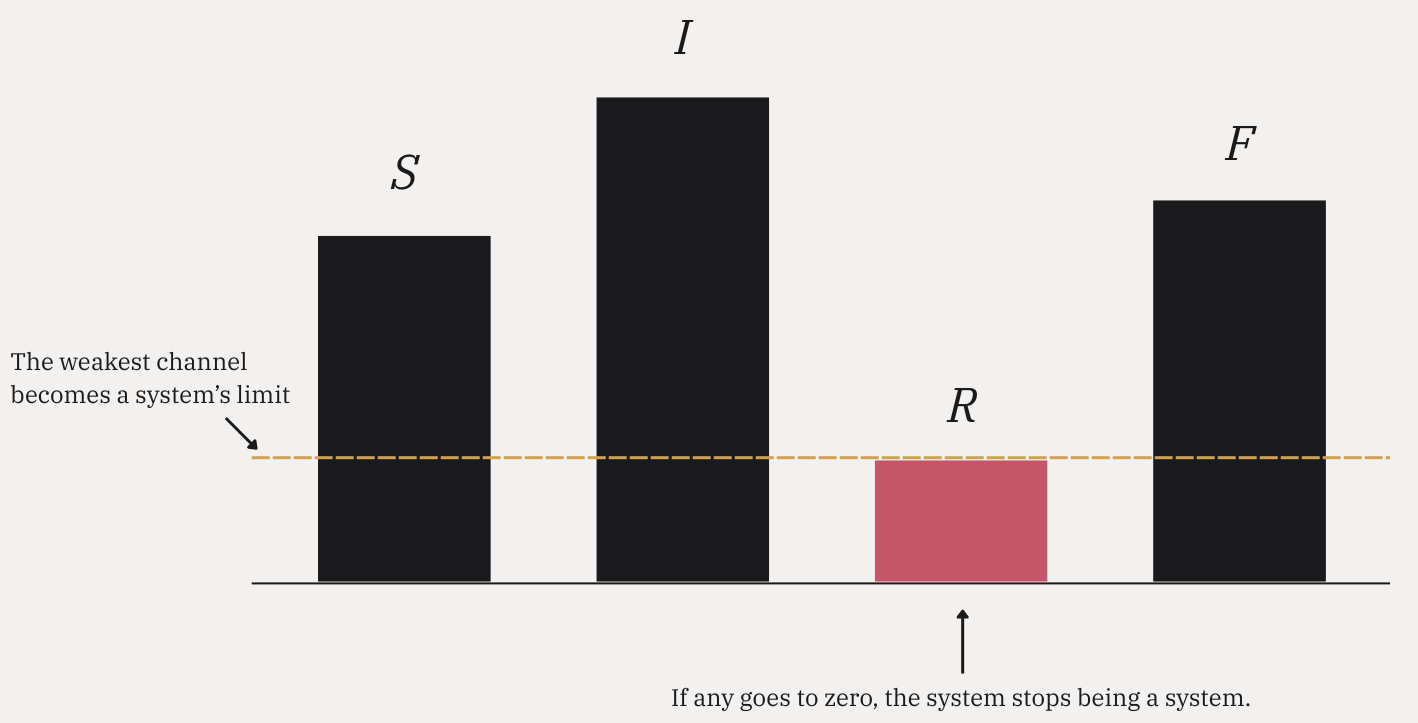
One rule governs all of it: the weakest channel sets the ceiling. Not the average. Not the sum. The minimum. System capacity (Ψ, the system’s ability to convert potential into transformation) tracks the minimum channel:
Pour resources into three while the fourth crumbles, and capacity stays pinned to the floor. Three out of four running isn’t 75% of capacity—it’s fatal. The bottleneck always governs.
Four questions
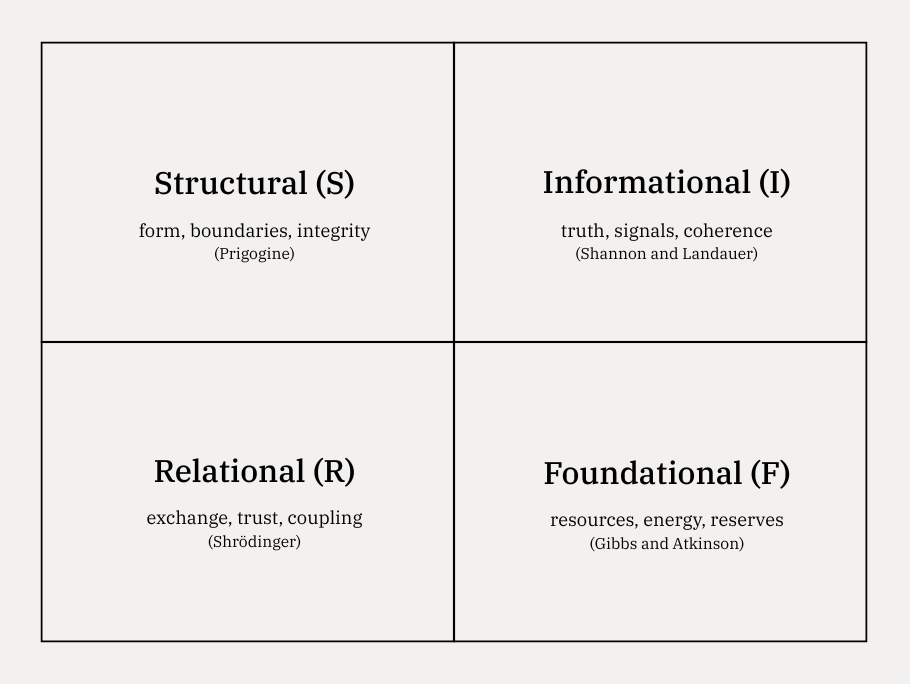
Four kinds of work. Four questions that read any system at any scale:
What am I noticing—and what am I missing? (informational)
What’s actually fueling this—and is there enough for the crossing? (foundational)
Who or what do I need—and can they reach me? (relational)
What’s holding this together—and can it hold something new? (structural)
You don’t need to know the physics to use the questions. But physics explains why they work and why they’re the only four you need.
Not just you
That was personal. You felt each wire pull because you recognized your own machinery. But the same four run in systems with no psychology, no willpower, and no character to blame.1
It applies to Cells. A membrane holds within a boundary (structural). Receptors read gradients (informational). Transport proteins move molecules in and out (relational). Mitochondria turn fuel into usable energy (foundational). Knock out any one and the cell doesn’t “struggle.” It dies.
Even a coral reef. Structure creates habitat. Signals coordinate symbiosis. Exchange moves nutrients across species. Energy from sunlight and currents funds it all. When the energy relationship breaks, everything else unravels.
And startups. Incorporation, the org chart, and processes hold shape (structural). Market feedback reads reality (informational). Trust and coordination move value (relational). Runway funds work (foundational). Lose runway and watch the company cannibalize itself—remember that image from earlier.
Cells never heard of these channels. Coral reefs don’t strategize. The startup might name them, but the channels ran long before anyone bothered to.
Everything has four
Now it gets a little strange.
Imagine a rock. It has structure—crystalline arrangement, shape, boundaries. It has information—molecular configuration, pattern. It exchanges—gravitational connection to the earth, thermal exchange with the air. It has a foundation—mass, chemical bond energy.
The rock is four things. So are you. So is everything.
Everything can be described in these four terms. But only some things must actively keep doing four kinds of work to remain what they are. Equilibrium draws the line.
The rock sits at equilibrium with its surroundings. Nothing pulls it toward dissolution, so nothing has to push back. The rock just sits there. Entropy will erode it eventually—it’s not fighting.
You exist far from equilibrium. Entropy keeps pulling at organization like yours, and only ongoing work pushes back. Stop the work and the ‘you’ doesn’t weaken—it dissolves.
But we do.
Being = doing
Now rewind to the wire-pulling. Because something happened in that exercise that matters more than learning four categories.
I didn’t take away four things. I took away four kinds of work. And when the work stopped, you didn’t diminish—you disappeared. Piece by piece. There was no residual “you” sitting behind those four channels, watching them fail. When the work stops, the entire system it constitutes stops with it.
Here’s what I’m saying. What you are and what you do aren’t two separate realities. They’re one reality described two ways.
The way a whirlpool’s shape and its motion aren’t two things. The motion IS the shape. Stop the flow, and the shape doesn’t just break—it vanishes. There was never a solid thing in there being maintained by the motion. The motion was the thing.
You are four kinds of ongoing work. So is an organization. So is a waterfall. So is a planet.
And the word “work” was holding this all along. Work the noun—that’s what exists. Work the verb—that’s what continues.
English already knew what physics confirms: anything that exists, works to exist. These aren’t two different worlds. They’re two views of the same reality.2
Here’s the practical consequence:
If being = doing, then reading the work IS reading the system. The diagnosis doesn’t point toward a prescription. The diagnosis is the prescription.
“This channel runs below threshold” tells you both what’s wrong and what to do about it in the same sentence.
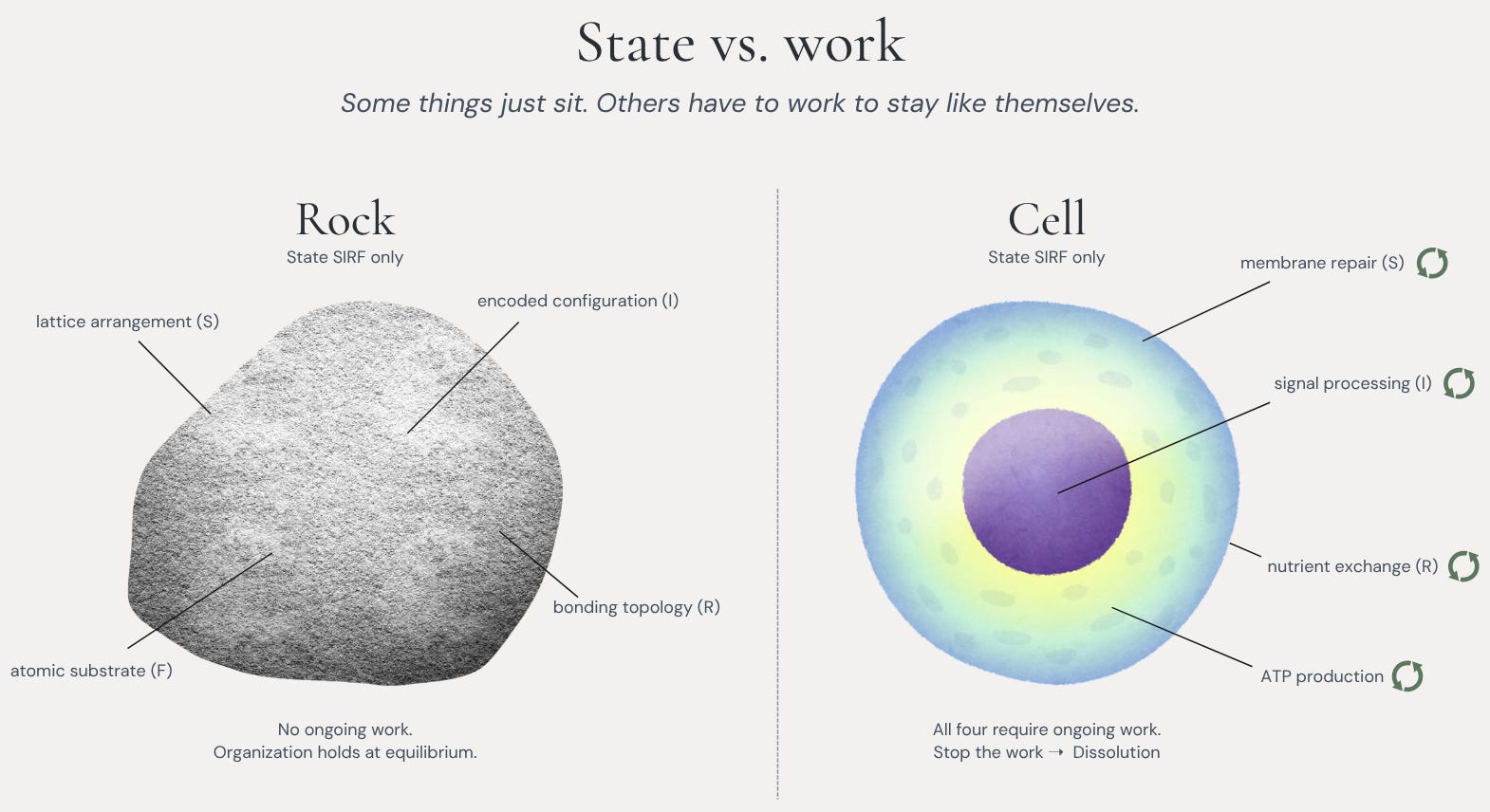
The four questions don’t just diagnose the converter. They are the converter, described as questions instead of physics. Ask them honestly and you’ve read your own address.
You don’t need a therapist to tell you what to do after the session reveals you haven’t talked to your sister in three months. The diagnosis—relational work dropped below threshold—IS the prescription. You know what to do when you have a clear diagnosis.
Same machinery, two jobs
Now let’s put everything back. All four channels above threshold.
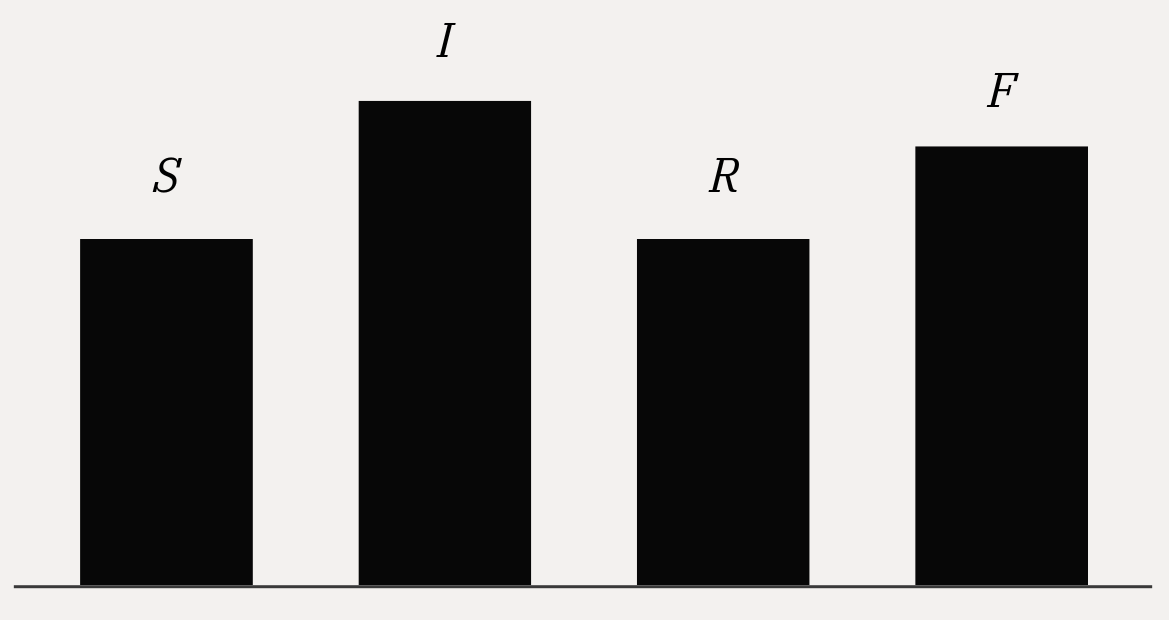
We stripped four channels and watched you dissolve. Those same four don’t just hold you together. They’re how you build things up. The machinery that fights entropy and the machinery that drives emergence share the same four staff.
Informational work doesn’t just keep you oriented. It detects the gap between where you stand and where you could stand. The same channel that scans for threats scans for opportunities.
Foundational work doesn’t just keep the lights on. It resources the crossing. Every transformation costs energy until the new configuration locks in.
Relational work doesn’t just maintain connections. It carries exchange across every boundary you’ll ever cross—knowledge, trust, resources, vulnerability.
Structural work doesn’t just hold your current shape. It holds the new shape long enough to become permanent.
So why does thriving stay rare?
Because both surviving and thriving draw from the same budget. Survival gets first claim—not because it outranks becoming something else, but because the consequences of underfunding it hit fastest. Skip foundational work and the system destabilizes in hours. But skip exploration and the cost might not surface for years.
That’s why change can feel like dying. The maintenance side might read transformation as a threat to the structure it protects.
That’s why comfort traps us. When survival costs almost nothing (thank you, technology), the channels run idle. Surplus exists, but nothing pushes it toward a new boundary. Why should it?
And that’s why a crisis can paradoxically become generative—because it forces the old work order to collapse (regime failure), and the channels become available for a different job.
Yasmin doesn’t just need these four to survive. She needs the same four to become a doctor. The same four that keep her alive carry the conversion. Diminish any one, and she doesn’t just get sicker—she loses a channel of becoming.
We’re just reading physics, which holds the system that destroyed those channels accountable—not her.
And no organized system gets the luxury of “build once, keep forever.” The invoice recurs.
You wouldn’t clean your house once and call it a decade. You don’t get to fill up your car—and drive it—and not expect to fill it up again.
Every channel requires continuous work. The habit IS the channel. The moment work stops, dissolution begins.
A channel can look healthy in its state but sit idle in its work—or be overworked while its state depletes underneath.
That's why 'try harder' is often wrong. You can exhaust what's already running on empty, or neglect what's quietly atrophying. The question isn't effort. It's which work, at what rate, through which channel.
Where transformation chokes
The pattern told you where conversion stalls.
The four types of work (SIRF) tell you why.
You’ve seen this play out. The reorg that reverted back within six months—structural work couldn’t hold the new shape. The brilliant strategy that never launched—foundational work ran dry. The team that lost its best people and couldn’t rebuild—relational work failure, nothing crossed.
And it starts before transformation even begins. Your work health doesn’t just determine whether you can convert an opportunity—it determines whether you notice it at all.
What this doesn’t explain
The machinery works. It’s always run. Four channels, readable at any scale—from cells to civilizations. The same physics that reads Yasmin reads you and me. Different addresses, same machinery.
But what happens when a system can imagine? When it can model a future it hasn’t reached… and mistake the model for the world?
The machinery isn’t the problem. The problem comes when the machinery backs a story reality doesn’t share.
That’s next.
Next: Part 7 — The physics of agency. What happens when a system can lie to itself?
Addendum: status on claims
Established science: Each channel traces to validated physics: Prigogine (structure), Shannon (information), open systems thermodynamics (relational exchange), Gibbs (energy). Confidence: ~95%.
This series’ synthesis: That these four form a minimal complete set — necessary and sufficient for organized complexity at every scale. That being and doing are one reality. That they serve dual roles (survival and becoming) drawing on the same capacity pool. That’s the bottleneck constraint:
This notation governs conversion capacity—and the combinatorics of four independent thresholds explains why thriving stays rare. Confidence: 60–80%. Under test.
What would break it: A fifth channel that can’t reduce to these four. Or a third. Organized complexity that persists without one. Conversion success independent of channel health. If you find any of these, the synthesis fails. The underlying physics doesn’t—but the claim that four captures everything does.
The claim that these same four channels operate at every scale—from cells to civilizations—is a Genesis Theory synthesis, not established consensus. Each channel traces to validated physics individually. The claim that they form a minimal complete set across all organized complexity is under test.
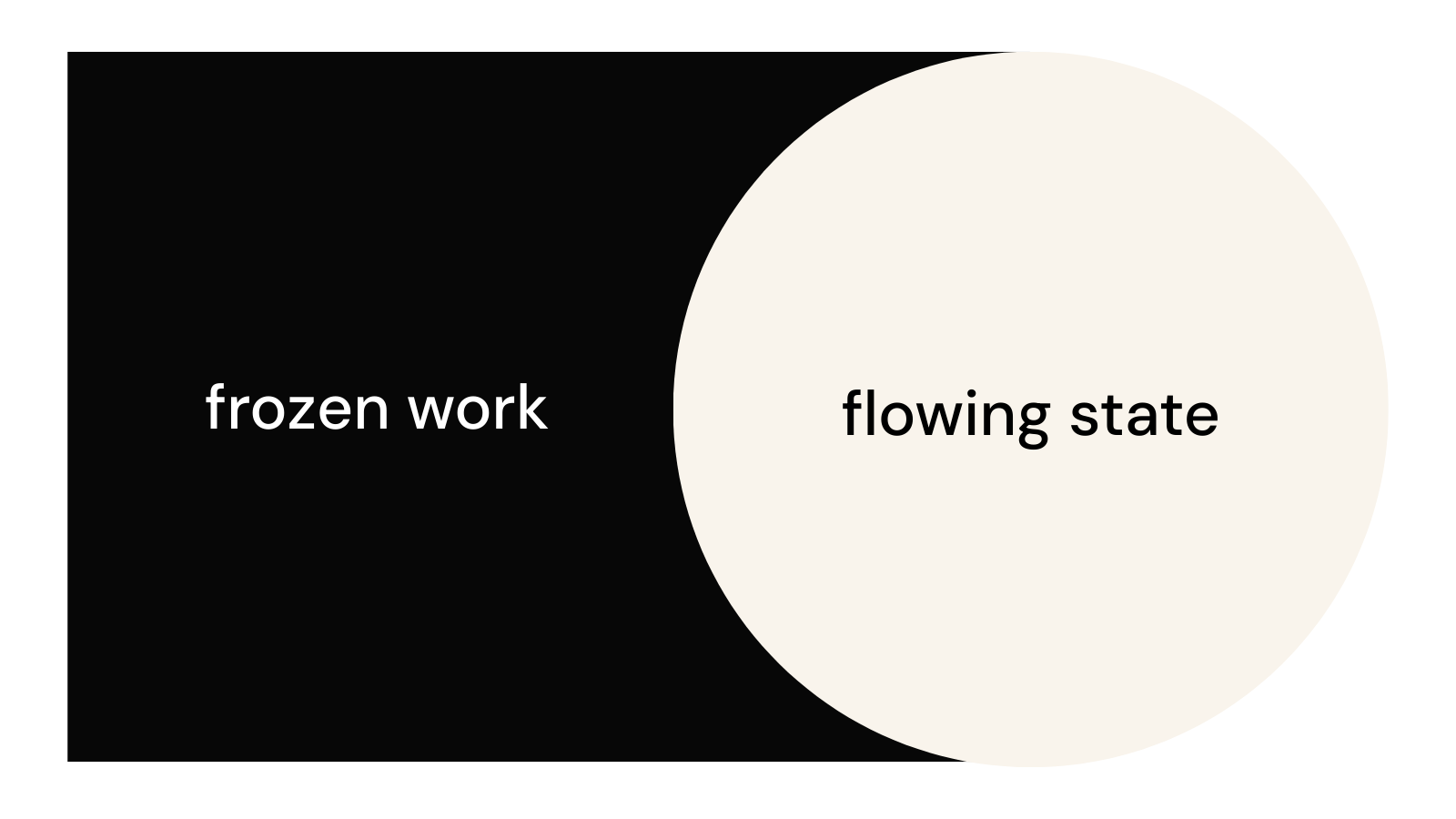
The physics notebook: This is the dual-aspect invariant. For organized complexity, state (what you are) and function (what you do) map to the same four channels—because state is frozen work, and the work is flowing state. Knowing what a system is tells you what it must do.
Paul just read it, theoretically I sort of understand what you’re saying but I’ll have to read it again to get a deeper grasp of the implications of your discoveries. Can you give me a concrete example of how this could apply to someone who is a janitor and wants to become a hedge fund manager. Is that too silly. For some reason I thought of that, it may not apply. Peace and justice. Bernie