


This is part 4 of The Stone series.
[Here’s Part 1, Part 2, and Part 3.]

The obvious goal
Ask a parent what they want for their child. You might hear “I want them to be happy.” Or “Successful!” Or, if life has roughed them up enough, just, “I want them to be ok.”
Ask a CEO what they want for their company. They might say, “Non-stop growth.” Or “Market dominance,” or something to that effect.
Ask a principal about their students. “Achievement.” “Readiness.”
Ask a mayor about their city. “Jobs.” “Safety.” “Opportunity.”
Different words, even different scales. But underneath every answer, there’s a shape: we want something that keeps becoming more than it was.
A child who doesn’t just cope but expands into someone greater. A company that grows and renews its team. A city that functions and produces futures nobody planned for.
What would you call that? It’s not just growth—growth alone can turn cancerous. It’s not just success—chasing it can hollow you out. It’s not just happiness—happiness can plateau into complacency.
I think the word we’re all reaching for is thriving.
Everybody wants it. Nobody really names it. And we’ve never done worse at producing it—not just for a few, but for the many.
Why? Not for lack of trying. We’ve never had more frameworks, more research, more tools aimed at helping people and organizations develop into something greater. Thousands of leadership models. Entire industries built around personal growth. Billions spent annually on change initiatives, talent programs, educational reform. The sheer volume of advice on how to reach your potential could fill libraries—and does.
Yet nearly half of all change initiatives fail. Most teams perform well below what their talent suggests. Same goes for families and local communities.
So what explains the gap between effort and outcome? Motivation? Character? Grit? I think it points at a map. Something about how we understand potential and human development sends people to the wrong coordinates—across every domain, for a very long time.
How do we thrive?
So what does thriving actually require? We must become something we aren’t yet. We must transform—new capabilities, new configurations, new futures that weren’t reachable before.
And what does transformation require? Raw material. Something has to generate the possibility of change before change can happen.
We’ll call that raw material potential—the physics version of that word. Here’s how we’ll define it, in plain language:
Potential, a physics definition: The set of reachable futures that open up when a real boundary encounter happens—an exchange across an interface. Those futures aren't guaranteed and they aren't infinite. Their likelihood and reach depend on what you bring and what a given situation permits. And crucially: until the encounter happens, that potential doesn't exist.But does realizing potential alone produce thriving? No. Potential describes what becomes reachable—including destructive futures.
A toxic merger generates new futures. A charismatic leader encounters a grievance-filled population, and possibilities emerge that nobody wanted. The encounter doesn’t care what you hope for. It generates whatever the configuration allows.
Think of it this way: thriving compounds. Realized potential produces new capability, and that added capability lets you reach new potential that wasn’t available before—which builds more capability, and on it goes. Each turn of the cycle expands the next. Stagnation happens when the cycle stalls. Collapse happens when it runs in reverse.
Still, without realized potential, thriving can’t happen. You can’t become something new without the raw material to become it.
So if we want to generate more thriving, we need more realized potential. And if we want more realized potential, we need to understand where potential actually comes from.
And it turns out, we got potential all wrong.
The oldest error
Every field that touches human development gives the same answer to “where does potential come from?”
The same answer spiritual traditions have given for millennia.
From inside.
Unlock your potential.
Develop your talent.
Actualize yourself.
Every tradition, every discipline, every billion-dollar industry points inward. The assumption runs so deep it doesn’t register as an assumption. Just how we think about potential—something you have, in varying quantities, waiting for release.
…
Spiritual and religious traditions placed potential inside the soul. The divine spark within. The seed of enlightenment waiting to bloom. Buddhism’s Buddha-nature, Christianity’s imago Dei, Hinduism’s Atman—each locates something already inside that its spiritual practice reveals or liberates. Buried treasure. A seed that contains the tree.
Philosophy kept the structure and changed the vocabulary. Aristotle’s dynamis. Plato’s acorn that contains the oak.
The Enlightenment swapped terms again—inherent capacities, natural rights, the rational faculty within—but never questioned the architecture.
Psychology formalized it: Maslow's self-actualization, the humanistic tradition's conviction that every person contains a fully realized self, with our task reduced to removing obstacles.
Management science quantified it: human capital theory treats potential as an intrinsic asset, talent as something people carry in varying quantities. "High-potential employees," as if potential were a trait like height.
Self-help commercialized it. “Unlock your potential.” “Unleash what’s inside.” “You already have everything you need.” An entire industry built on transformation-as-excavation. Just dig deeper to find what was always there.
Each tradition reinforced the last. By the time anyone thought to question the assumption, it had become invisible. Uncontested. Undefended. Until it became the air we breathe.
Parents optimized their children’s internal properties—skills, knowledge, resilience—because the model said that’s where potential lived.
Schools sorted students by measured internal capacity. Companies invested in “developing their people.” The entire infrastructure of human development pointed at the same target: the actor. Make the person better. Sharpen the individual. Improve the system.
And when it didn’t work—when the improved actor still didn’t thrive in their role—nobody questioned the target.
What the error actually costs
Why did this assumption survive three thousand years without serious challenge? Because the cost of getting it wrong stays invisible.
When a bridge collapses, you see the failure. When a treatment kills instead of cures, you count the dead. Those costs force correction.
But what happens when potential never emerges? Nothing. And that’s the whole problem.
Someone builds capacity for years—therapy, coaching, training, real effort—and stays stuck. Everyone, including them, assumes they haven’t dug deep enough yet.
A team with extraordinary talent produces ordinary results, and the diagnosis always lands on “execution” or “culture.” It’s never “the boundaries between these people generate nothing worth converting,” because, why would it? A community with every resource stagnates, and nobody asks whether its encounter architecture produces anything new.
The model says potential lives inside. So that’s where everyone keeps digging.
Even physics language gets sloppy
But before we can measure the cost, we need to untangle something physics language got sloppy about a long time ago.
A ball sits at the top of a hill. Any physics textbook will tell you the ball “has” potential energy. Has. As if potential lives inside the ball, waiting for release.
The math tells a different story. That energy belongs to the configuration—ball plus gravitational field plus height. Remove the hill, the energy vanishes. Remove the gravitational field, it vanishes. Nothing about the ball changed. The potential was never inside it.
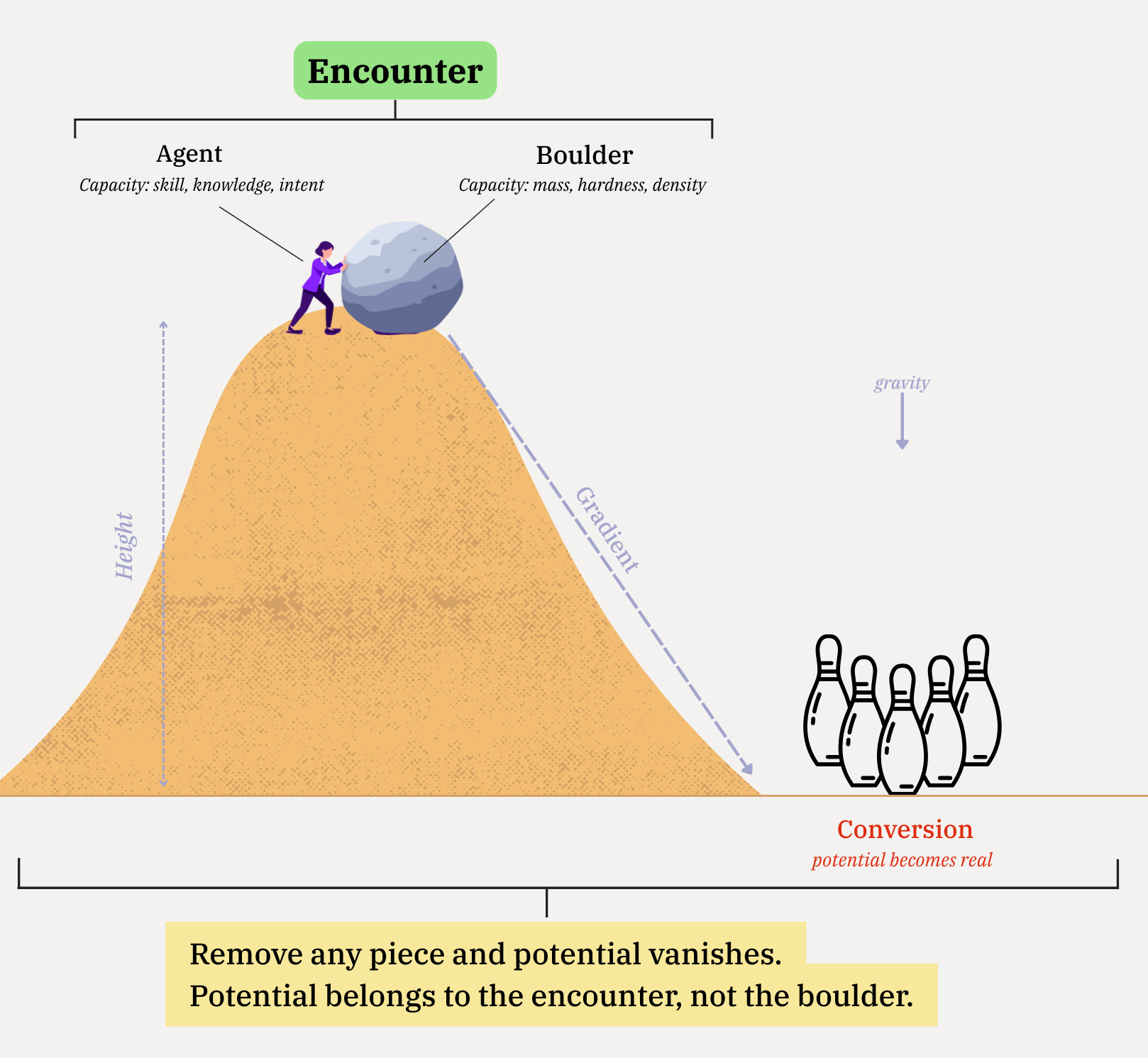
Even physicists—the people best equipped to know better—talk about potential as if it were an intrinsic property. The equations say relational. But their language says possessed.
That conflation matters. Because potential and capacity describe fundamentally different things.
Capacity describes what a system brings. Internal properties, buildable in isolation. A rock's capacity: mass, hardness, chemical bond energy, and crystalline structure. You can measure these with the rock alone. No context required.
Potential describes what becomes reachable. The futures that open up given a specific configuration—a relationship between the system and something else.
A rock alone in a field. What’s its potential? To do what? For who? The question collapses without gravity or another agent in the picture, whether human or animal. The rock has capacity. It has no potential. Not yet.
The distinction sounds academic. It determines where every dollar, every hour, and every institutional resource allocated to development actually goes.
And we’ve aimed them at the wrong target. For millennia.
Lost talent
Economist Raj Chetty and his collaborators went looking for the cost—and found it. Their research on “Lost Einsteins” showed that children from low-income families who scored high on early math tests became inventors at a fraction of the rate of their wealthier peers with identical scores.
The difference wasn’t in their ability. It was exposure. Exposure to patent-holders, to innovation environments, to the kind of encounters where inventive potential actually emerges. Chetty's team estimated that the U.S. loses the majority of its potential innovators this way.
Those kids don’t lack capability. They just never encountered the boundaries where that capacity could become something.
The intrinsic model reads that data and says: what a waste of talent.
Read it again with the distinction in hand: talent was never the constraint. Quality encounters were.
You can’t mourn what you never knew was possible. But sometimes you can count it.
That’s why the error persisted for three thousand years. The evidence of unrealized potential was never a catastrophe. It’s a slow, invisible bleed—a civilizational accumulation of what could have been, visible only if you knew where to look.
Setting the record straight
Let’s go back to the rock.
A human picks it up.
Tool potential. Weapon potential. Building material. Art medium. Grindstone. Anchor. The same rock, unchanged in every physical property, now carries thousands of possible futures that didn’t exist ten seconds ago.
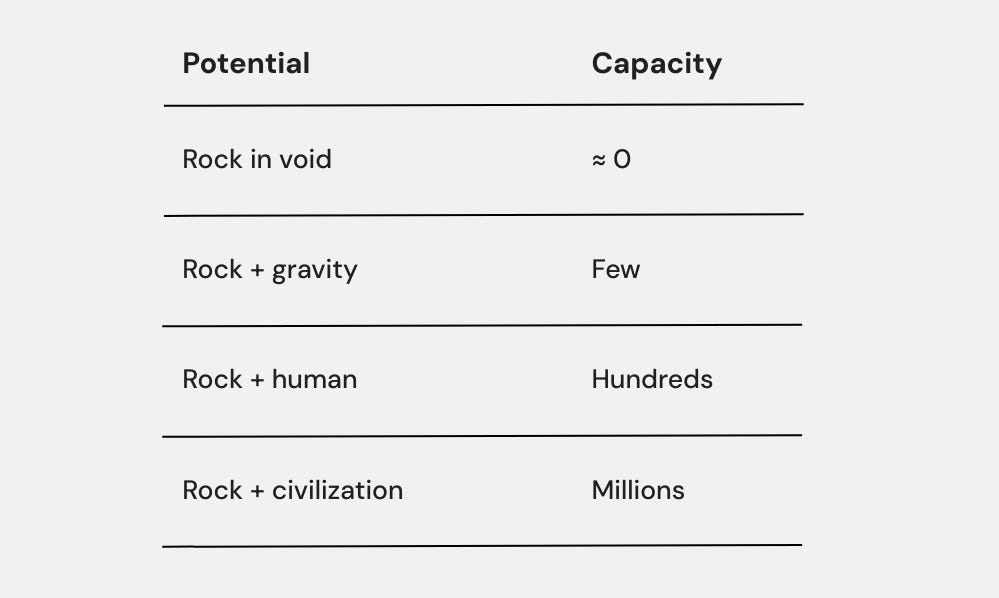
Nothing got unlocked inside the rock. The encounter generated possibilities that didn’t exist before either system showed up.
Simple example. Here’s a more complex one.
…
Two researchers meet at a conference. One studies information flow in biological systems. The other studies organizational communication breakdowns. Neither one’s work has stalled. Both produce results.
A conversation starts. A connection forms between two separate domains that had never coupled before. A research direction emerges that neither could have imagined independently, because the raw material for that idea didn’t exist until their knowledge met.
The new direction wasn’t hidden inside Researcher A or Researcher B. It emerged at the boundary between them.
Why? Because work requires gradients. In other words, a difference that can drive change. A gradient exists wherever different things meet: different expertise, different experience, different ways of organizing knowledge. Inside homogeneous systems where everything has already equilibrated, gradients vanish. So do possibilities.
No boundary, no gradient. No gradient, no new possibilities.
…
Let’s take another case. Someone does years of genuine developmental work. Therapy, coaching, meditation, journaling—the whole nine. And yet somehow, they stay stuck.
The intrinsic model offers one answer: look harder inside. So they do. A different book. A different coach. A different program. Each one feels like a fresh start because the method changed. But the direction never does—every approach still points inward, at the actor, at the self.
They're digging the same hole with different shovels.
But look at their life. Dead-end job. Narrow social circle. A routine that repeats weekly. They haven’t encountered a genuine difference in years.
They’ve built real capacity. Their internal properties genuinely improved. But capacity and potential aren’t the same thing. They’ve become a better rock—harder, denser, more crystalline—sitting alone in a field.
They sharpened themselves into a better version of stuck.
…
Jim Rohn famously said, “You’re the average of the five people you spend the most time with.”
He meant it as motivation: choose better people, become a better person by proximity to greatness (or whatever they represent).
But read it again. What he actually described—without the physics language—was encounter architecture. Those five people are your boundary conditions. They determine what potential your daily life generates.
Five people who challenge how you think, who work differently than you, who see what you can’t? New possibilities at every conversation.
But five people who think like you, work like you, see like you? No difference, no new possibilities—no matter how much you improve yourself.
Rohn told you to choose better people. Physics says choose different ones.
Internal work can reorganize what’s already inside. Expansion requires encounter with difference. And that’s the point. Internal processing rearranges furniture in the same room. Boundary encounters build new rooms.
Where potential comes from
Potential emerges at boundaries—when organized complexity meets organized complexity in ways that generate new possibilities. Not before. Not without the encounter.
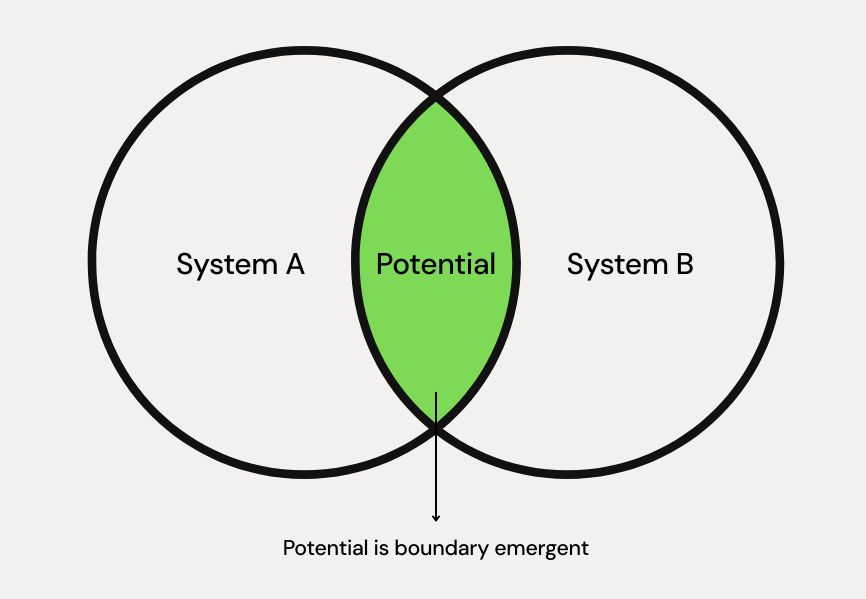
A book can change your trajectory. A conversation can reframe everything. A team can demand capabilities you didn’t know you had. A relationship can make you someone you couldn’t have become alone.
None of it was unlocked. All of it was created—at the boundary—when your organized complexity coupled with someone else’s.
Potential isn’t a property of actors. It’s a property of encounters.
If that holds, then every framework that treats potential as intrinsic has the physics backwards. And here’s the twist: many of them work anyway—sometimes. A therapy session functions as a boundary encounter. A coaching conversation operates as an interface between different organized complexities. The team offsite generates potential through coupling that didn’t exist before.
They work even when they accidentally create quality encounters. They fail when they don’t. And because their model points at the wrong thing, they can never explain the difference.
The cost of getting it wrong
If potential emerges at boundaries, then every institution built on the intrinsic assumption optimizes the wrong variable. Run it through.
Parents drill skills, stack credentials, build the child’s internal résumé—when the physics says: curate the encounters.
Schools sort students by measured capacity and then wonder why innovation clusters geographically instead of following test scores. Chetty’s lost Einsteins aren’t a talent pipeline problem. They’re a boundary architecture problem. The encounters that generate inventive potential don’t distribute evenly—and nobody designs for them, because the model says potential lives inside the student.
Companies invest billions in developing individual performers—training, coaching, leadership programs—while the boundaries between those performers generate nothing. Two brilliant people in adjacent offices who never have a conversation that couples their knowledge haven’t failed at collaboration. Their encounter architecture failed them.
Cities zone residential apart from commercial apart from creative apart from industrial—an architectural decision about boundary density, made without knowing it. Fewer interfaces. Fewer gradients. Less potential generated per square mile.
We found a way to build better rocks—and then leave them alone in fields.
What becomes possible
So what changes?
Start with education. Right now, schools sort children by measured capacity—test scores, grades, and tracked classes. And they call it development. A boundary-emergence model asks a different question: what encounters does this student’s life architecture generate?
Picture a school that treats encounter design the way current schools treat curriculum design. A first-generation college student paired not with a tutor who drills content, but with a patent attorney, a biotech founder, a city planner—people whose organized complexity differs from anything in that student’s daily life. Think of it as mentorship as boundary architecture. Chetty’s data suggests this predicts outcomes better than any test score. Because the encounters generate possibilities tests can’t measure.
…
How about organizations? The question shifts from “how do we build better performers?” to “what’s the quality of the boundaries between our performers?”
Think about what most companies actually do: hire talented people, train them individually, evaluate them individually, then sit them in teams where everyone shares the same training, the same frameworks, the same mental models. They’ve built a room full of excellent, identical rocks.
Now picture the alternative. A product team where a former nurse, a jazz musician turned developer, and a logistics specialist encounter each other’s thinking daily—not in a brainstorm, but in the structure of the work itself. The gradients between them generate directions no individual development program could produce. Each conversation couples knowledge that never coupled before.
And that reframes one of the most politically charged conversations of our time. Diversity isn’t a values statement. It’s real thermodynamics. Different organized complexities meeting at boundaries generate possibilities that sameness can’t. You don’t need a moral argument for it. The physics makes the case on its own.
…
How would this new frame change communities? A neighborhood where everyone resembles each other generates low gradients—comfortable, stable, and slowly dying. One where different kinds of organized complexity intersect—artists and engineers, immigrants and natives, and new industries and old trades—generates potential at every interface.
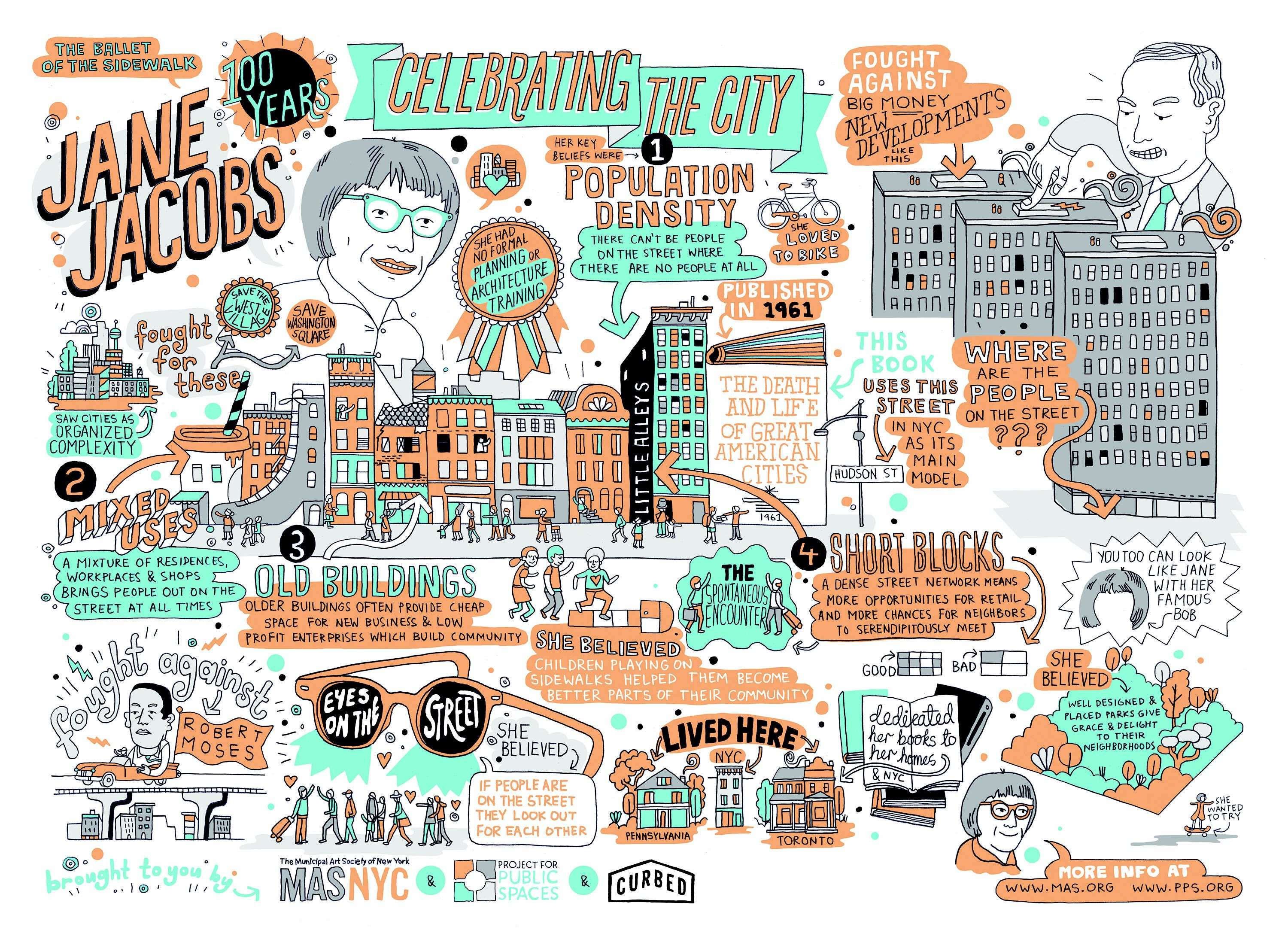
Jane Jacobs saw this sixty years ago in Greenwich Village. The ballet of the sidewalk wasn’t just charm. It was encounter architecture operating at urban scale, generating possibilities no zoning board planned for. When cities zone residential apart from commercial, apart from creative, apart from industrial, they make a decision about boundary density without knowing it. Fewer interfaces. Fewer gradients. Less potential per square mile.
The question transforms from “how do we attract talent?” to “how do we structure boundaries that make potential unavoidable?” None of this promises perfection. But it promises a different target, one that physics supports.
The intrinsic model held the default position for three thousand years. The results speak for themselves: most potential goes unrealized. And we keep blaming the actors when the constraint was never inside them.
What comes next
This post established one thing:
Potential doesn’t live inside systems. It emerges at boundaries.
That single correction restructures where you point every resource, every institution, every hour of developmental effort.
But knowing where potential comes from doesn’t tell you how to convert it.
Potential emerges at boundaries—fine. But what determines whether a system can actually metabolize what the encounter generates? What do you need to show up at a boundary ready to convert? How does conversion actually proceed—and why does it stall? What changes when the system doing the converting can imagine, plan, and deceive itself?
Those questions need answers. And we have them—grounded in physics that already exists but has never been synthesized this way.
Next: The philosopher’s stone