



It’s summer, 1938. A thirty-year-old psychologist named Abraham Maslow steps off a train in southern Alberta and drives to the Siksika Nation reserve. He carries a six-week research grant from the Social Science Research Council, sent at the urging of his mentor Ruth Benedict—who thought his ideas had promise but his perspective ran narrow. He’d never had a cross-cultural experience. She sent him to get one.
He arrives carrying a social personality index he’d developed at Columbia. He wants to study dominance hierarchies and security needs. He expects to find familiar patterns in an unfamiliar place.
What he finds completely wrecks his expectations.
He encounters what the historian Adrea Lawrence describes as “an educated, secure people, who had a fully formed system of education grounded in reverence for children, stories, ceremonies, songs, language, humor, land, and connection, all of which had been tested over millennia.”1 This wasn’t a community struggling under deprivation—which is what a dominance-hierarchy researcher might expect to find on a reserve under colonial control—but a community whose members displayed a quality of psychological security Maslow had rarely seen anywhere.
Then the data. In his unpublished 1939 manuscript, Maslow reported that 80–90% of the Blackfoot exhibited what he called a distinct quality of “dominant feeling,” compared with 5–10% of his own Western sample. He also reported that 70–80% appeared more ego-secure than the most secure 5% of his comparison population. He wrote that it was “impossible to rate members of both groups on the same continuum.”23
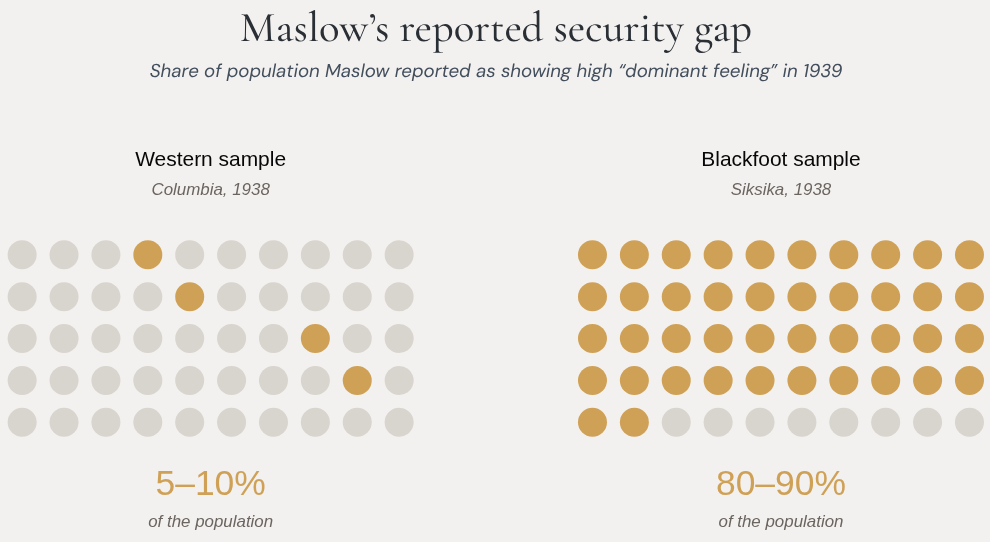
The terms are Maslow’s. Yes, the instruments were crude for their time and perhaps the comparison wouldn’t survive modern methods review. But still, his claim is hard to dismiss: he believed he had encountered a community where psychological security appeared as a norm rather than an exception.
How was this possible? Because, to him, what showed up in a sliver of his Columbia students showed up as the baseline in an entire community.
He knew the frameworks were incommensurable—not simply hard to compare, but built on different assumptions about what was being measured.
For example, Maslow’s scale treated security as a quality inside the individual. What he encountered at Siksika didn’t fit that scale at all.
So this wasn’t a case of one group scoring higher than another on the same scale. It was closer to trying to measure weather with a compass. They were simply different kinds of things, organized by different units of reality.
Scholars agree it stuck with him. What they disagree about is what he did with it.
The lens
Before we get to what Maslow saw, let’s name the lens he used. Remember, every framework or mental model becomes a lens you view the world through. It tells you where to look, what counts as evidence, what gets named, and what stays invisible. Maslow’s was no exception.
His lens begins with the individual.
Maslow sees one human being as the basic unit of analysis. The hierarchy of needs applies to a person. Safety is something a person needs. Belonging is something a person lacks. Esteem is something a person develops. Self-actualization is something a person achieves.
Individualism is only obvious because we inherited it. Western psychology, economics, education, management, and self-help all learned to begin in the same place: the individual.
But once the individual becomes the unit, something has to live there, and that something is capacity.
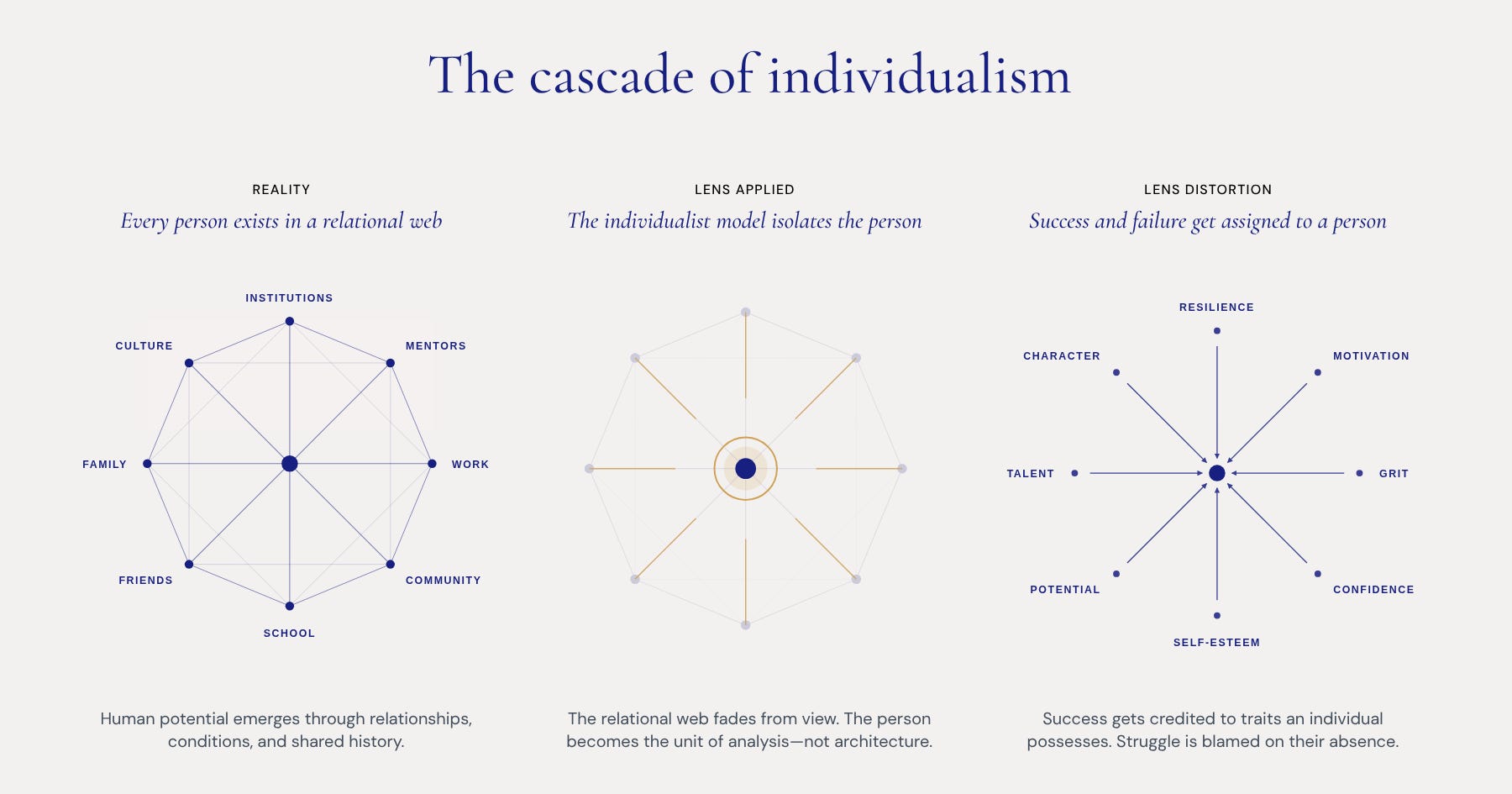
If the person is the thing being studied, capacity gets read as something inside the person. The lens has no other place to look—any conditions around the person are outside the unit of analysis, so they become invisible.
Then more confusion. Potential becomes talent and everything that supports it. Drive. Resilience. Grit. Mindset. Character. Motivation. Self-esteem. All of it located inside as well.
In this frame, the conditions around the person still matter, of course. But they become background. Inputs. Influences. Context. The person remains the explanatory object.
So individualism produces intrinsicism. The unit-of-analysis choice (individual) forces the location-of-potential answer (intrinsicness). And once that’s the dominant model—once it runs through psychology, schools, workplaces, healthcare, policy, and the language we use to describe each other—we stop seeing the conditions that let systems thrive. We stop noticing the architecture that actually produces the potential we keep looking for inside individuals.
And once that model—this lens—is installed, it starts confirming itself. Schools grade individual students. Hiring systems evaluate individual candidates. Performance reviews rate individual outputs. Clinical systems diagnose individual patients. Self-help tells individuals to improve themselves.
Each institution then produces data that appears to confirm the lens, because each one measures the thing the lens already told it to measure.
Why does the architecture remain invisible, even if it’s operating? Because nothing has been built to see it.
Just saying that “relationships matter” isn’t enough. A relational model doesn’t merely add relationships around the individual. It changes the unit. The relational web becomes the thing being studied, and the individual just one expression of it.
That web’s name is Encounter Architecture. It's what the relational model studies—and what individualism can't see.
Maslow did not invent the inward lens. He inherited it. But his hierarchy gave it one of its cleanest modern diagrams. The diagram traveled. The lens got installed. And the cost is what we’re about to see.
Institutionalizing the lens
Everyone knows the pyramid. You learned it in school, maybe in a psych course, maybe in a management seminar. Physiological needs at the bottom. Safety above that. Then belonging, esteem, and at the top—the rare summit—self-actualization. The idea entered Western culture so completely that most people don’t think of it as a model anymore. It just feels like how things work.
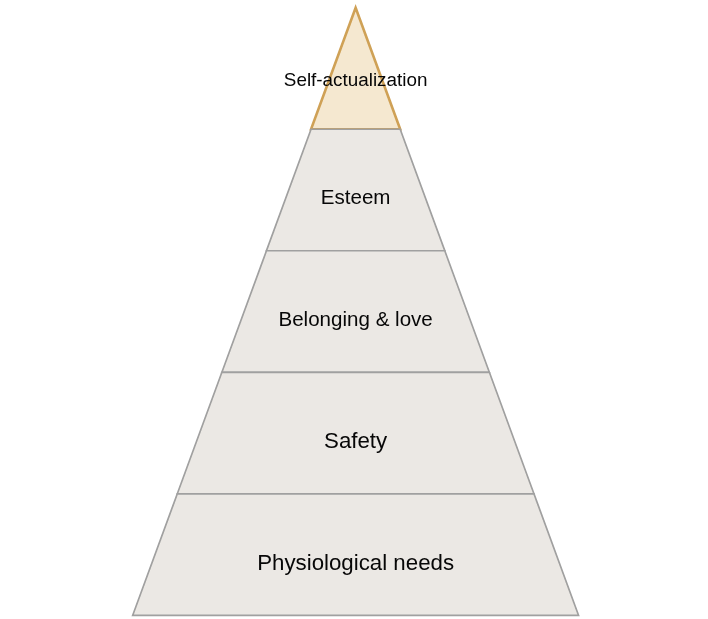
Which is exactly when a lens does the most damage—when it stops looking like a lens and starts looking like the world. It doesn’t have to be wrong. You just forget you’re wearing it.
Five years after standing on Siksika land with data he couldn’t explain, Maslow published the model we’re all familiar with—but still couldn’t hold the difference of what he experienced. His model wasn’t dishonest. It just lacked a variable for what his eyes had seen.
This is the story of what that absence cost us, and what becomes visible—possible, even—when you look at the same pyramid through a different lens.
What the Blackfoot already knew
Return to 1938. The Blackfoot didn’t theorize about how potential works. They were living inside structures that happened to match something real about how possibility emerges in organized systems: that it’s not inside individuals, but in the conditions between them. They didn’t get everything right—no culture does. But they got the foundational variable right, and the results were measurable.
Consider Teddy Yellow Fly, a respected Siksika man who assisted Maslow. Yellow Fly freely loaned his automobile to community members without asking why they needed it, what they needed it for, or when they would return it. Maslow saw the act and struggled to understand it as generosity. A remarkable individual trait. Look at this unusually generous man.
The Elders correct the frame. In interviews with Bear Chief, Choate, and Lindstrom, those who knew the culture describe something different entirely: this wasn’t generosity—it was “more about the nature of the relationships of support.”
Getting something back wasn’t an essential component of relationships as the Siksika understand them. Elder Breaker says it plainly: “Growing up, you give, you don’t hoard, you try to give whatever you can. They talk about the leaders of the day were the ones that gave up everything, horses... they gave up even their children to their clan to raise.” First-born children given to the grandparents—“a sign of reciprocity. That’s not in Maslow’s work.”
Maslow saw a man lending a car. The Blackfoot lived inside a system where resources, attention, and care flowed through relational boundaries between people. This was not because of anyone’s exceptional character, but because their way of life demanded it.
This pattern repeats throughout his visit. He saw the output and continued to miscategorize it. Here’s another. The Siksikaitsitapi developmental model doesn’t treat self-actualization as the pinnacle of human development. It treats it as the starting condition.
Elder Stuart Breaker explains that in Blackfoot belief, the newborn child already sits at the top of the hierarchy—a self-actualized human being. The Elders describe children as sacred from conception. Parents don’t raise a child toward self-actualization. They raise a being who already arrives whole. Development moves from that wholeness, through deepening responsibility toward others, toward the apex: cultural perpetuity—transferring knowledge to the next generation. Outward and generational, not upward and individual.
You might be tempted to compare using the same hierarchical visual system (the pyramid) like this:
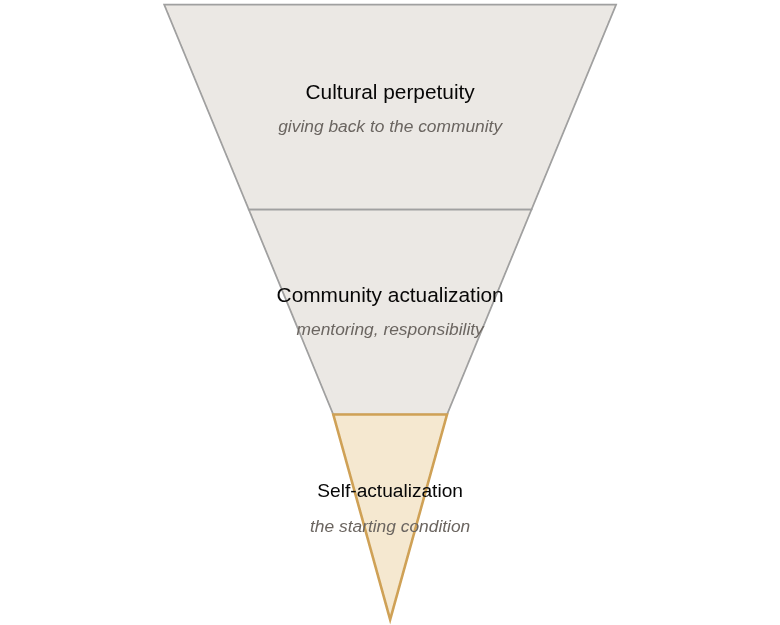
Elder Hayden Melting Tallow says the Siksika model isn’t a triangle. It is “a circle that surrounds the person, family, community.” It doesn’t begin with “me” or “mine,” but with “us” and “we.”
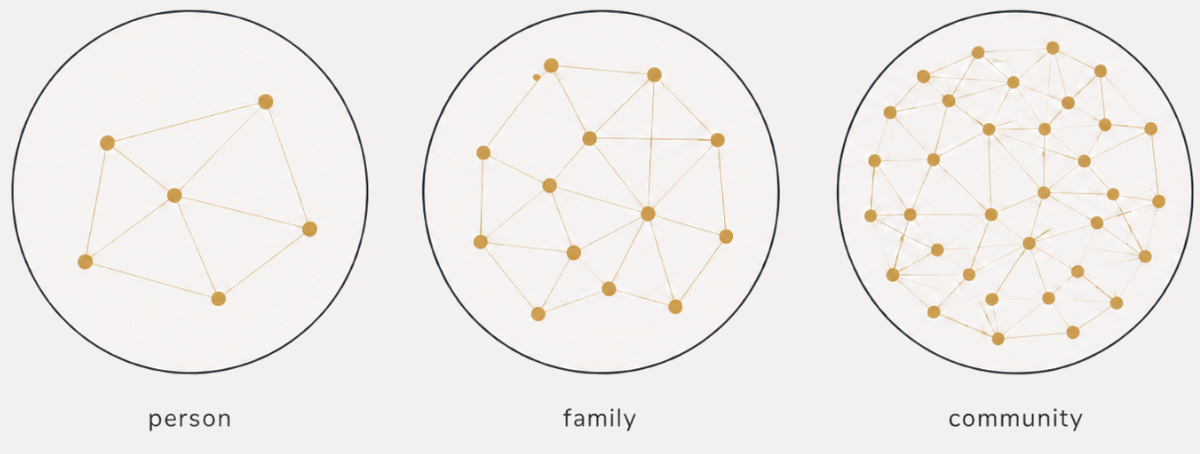
That changes the developmental logic. Needs aren’t stacked one at a time, as if a child must climb from survival to belonging to esteem. They are held together. Safety, belonging, identity, responsibility, and meaning form around the child simultaneously. The child doesn’t have to become connected later. Connection is a condition they begin inside.
Narcisse Blood, in his recordings, describes what Maslow couldn’t grasp: “the non-egoic nature of relationship in which actions are solely undertaken to enhance the collective.” In Western frameworks, relationships serve the individual—you form them because they benefit you. In Siksika ontology, the direction runs the other way. The individual serves the relational web. And that web, in turn, generates the conditions under which every person survives and thrives.
Elder Roy Bear Chief describes all lives in the community as interrelated like a spider web—Ani to Pisi. “When one part of the web is disturbed, then the whole of the web is vibrating.” He’s not describing a ladder to climb or some hierarchy to navigate. It’s a web where disturbances at any point propagate through the entire structure.
Ryan Heavy Head puts it plainly: Maslow “overlooked the context of living in an Indigenous community where you know everybody, and you’re going to know everybody forever, your whole life.”
This describes a permanent, stable, high-density relational structure. The boundaries between people in this system—family, ceremony, land, story, responsibility—run dense, endure across generations, and operate at multiple layers at once. When the relational web around a person runs that dense and that healthy, self-actualization isn’t rare. It’s expected.
The difference between Maslow’s Western samples and the Blackfoot wasn’t a difference in individuals. It was a difference in what existed between individuals—the conditions, the encounters, the structures connecting people to each other and to place.
The Blackfoot built conditions that generate human capacity. Maslow’s measurement instruments registered the capacity but had no mental model for what produced it.
The compression
Five years later. 1943. Maslow published “A Theory of Human Motivation” in Psychological Review. The hierarchy enters Western psychology and never leaves.
What happened between Siksika and the hierarchy?
Ryan Heavy Head offers one reconstruction: Maslow returned to New York and began studying Western individuals whose psychological profile seemed to resemble what he had seen at Siksika. Notice—he did not study the conditions that produced the Siksika norm. He looked for individual analogues inside Western culture.
A community-level phenomenon became an individual comparison problem.
The framework Maslow carried couldn’t see another move. His instruments measured individuals. His comparison groups were individuals. His categories registered traits, scores, motives, and characteristics located inside the person. So when he tried to make sense of what he had witnessed, the relational architecture had nowhere to go. His model had no variable for it.
What Siksika life organized as outward, relational, and simultaneous, Maslow’s framework rendered as inward, individual, and sequential.
The communal baseline collapsed into a rare pinnacle. The circle of care became a ladder of needs. The relational field became a path of personal ascent. Cultural perpetuity—the responsibility to carry knowledge forward for future generations—disappeared from the model entirely. And the individual was separated from the conditions that produced the results Maslow found so remarkable.
Whether Maslow consciously suppressed what he saw or simply couldn’t integrate it remains contested. Bear Chief, Choate, and Lindstrom argue that the influence question may matter less than the mismatch itself: “Maslow’s construct does not represent Blackfoot philosophy,” and “Maslow’s own writings do not support the notion that Blackfoot knowledge influenced him greatly in respect of the construct.”
Their reading is probably sharper than the popular story. These were not two versions of the same model. They were two totally different ontologies of human development.
Elder Hayden Melting Tallow says it plainly: “The triangle does not reflect Siksika knowledge.” Lawrence offers the gentler reading: what Maslow saw “stuck with him,” but he lacked the conceptual language to hold it. Elder Bear Chief adds the linguistic piece: “constructs around relationships do not have equal or parallel meaning in English and Blackfoot.”
So it wasn’t just a conceptual compression—it was linguistic.
Maslow said it was “impossible to rate members of both groups on the same continuum.” Read once, that sounds like a methodological caveat. Read twice, in context, it reveals the deeper problem. He knew the categories didn’t translate. But the model he later published used the categories he had.
The incommensurability Maslow registered in 1939 became a lost variable inside his now famous 1943 model.
The hierarchy could describe what people experienced: safety, belonging, esteem, self-actualization. But it could not describe what produced those experiences. It had categories for needs inside the person. It had no category for the architecture around the person.
A surrounding relational system became an individual motivational sequence. What the Siksika organized through kinship, ceremony, land, story, obligation, and belonging became something a person climbs through internally.
Fun fact: Maslow never drew the pyramid. That came later, around 1960, when management consultants packaged his ideas for corporate audiences. So the model most people carry in their heads is twice removed from what Maslow encountered: first, the relational architecture became individual motivation; then individual motivation became a corporate diagram.
The hierarchy gives us only one direction to look—and perhaps one direction of blame.
When safety is missing, look at the person.
When belonging is missing, look at the person.
When esteem is missing, look at the person.
When self-actualization is missing, look at the person.
But if that’s wholly wrong and does not align with actual physics, then where does that leave us? And if the opposite is true, and those experiences are produced by the conditions between people, then a person is often the wrong unit of diagnosis.
Maslow witnessed a culture where the conditions around people generated extraordinary human outcomes. He registered the outcomes, sure, but couldn’t name the conditions that produced them.
Then we inherited a diagnosis the model made visible: When something goes wrong, look inside the person.
The most personal need is the least personal one
Of all Maslow’s needs, which one looks most internal? Most primitive? Most obviously inside the person?
Safety.
You’re either safe or you aren’t. The word feels bodily. Immediate. And quite personal. Before belonging, before esteem, before self-actualization, there is the basic question: am I safe?
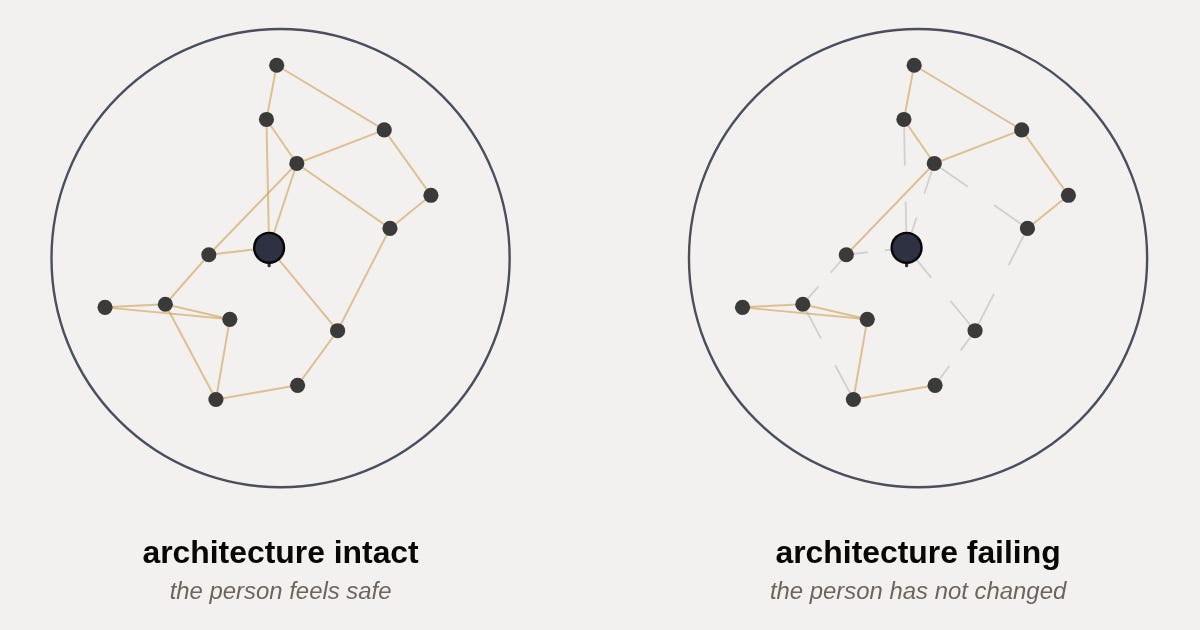
If the relational model is the correct one, then safety is not inside the person, is it? Then safety becomes architectural.
Think about it. A child’s safety does not come from their personality or some innate trait. It comes from the structures around them: family, neighborhood, school, housing, law, money, adults who can be trusted, institutions that either protect or fail.
The same child, with the same temperament and the same inner life, can be safe in one setting and unsafe in another. What changed was not the child. What changed was the architecture surrounding them.
Let’s test it.
Financial safety means savings, employment, insurance, debt levels, family backup, and social safety nets.
Physical safety means locks, lighting, distance from threat, who is nearby, what the community tolerates, what enforcement will actually protect.
Emotional safety means someone will listen, repair, tell the truth, stay regulated, and protect you when you cannot protect yourself.
The “feeling” of safety happens in the body. But what the body feels is tied to the surrounding architecture. When the architecture supports, the feeling tends to appear. When it breaks, no amount of internal work changes what the body registers.
The need Maslow placed near the bottom of the pyramid—the need that looks most basic, personal, and individual—turns out to depend on what exists around the person. The feeling of safety is real. But the source of safety is not primarily internal.
And if that’s true for safety, what about belonging? What about esteem? What about self-actualization?
We’ll come back to those. But first we need to ask a stranger question: if Maslow’s model missed the correct model, why did the wrong version win?
Why the compressed version won
So if even safety depends on surrounding architecture, why did a model with no relational architecture become the dominant model of human development?
Simple: architecture is hard to see.
People are visible. You can test them, grade them, hire them, promote them, diagnose them, even punish them. The conditions between people are harder to hold in view: the encounters, bonds, rituals, expectations, trust patterns, and institutional structures that generate capacity over time.
Attribution defaults to what it can see and measure cleanly.
When two people have a conversation and one leaves changed, what caused the change? Was it in that individual? Was it the other person? The trust between them? The timing? The room? The years of relationship that made the words land? We don’t have a good attribution model for what happens between people. So we point at the person and call it their talent, grit, intelligence, personality—potential.
The visible gets credit. The invisible gets backgrounded.
That helps explain Maslow’s misread—if it indeed was a misread. He could watch Teddy Yellow Fly lending his car and see an unusually generous man. What he could not see was the relational ecology that made the act ordinary. It also helps explain why Maslow returned home and studied biographies of remarkable individuals rather than the architecture of a remarkable community.
Individuals are visible. Architecture is not.
From there, the more compressed model gets every advantage.
First: no one had the mechanism.
Maslow observed that the Siksika exhibited unusually high levels of security. He could not explain why their way of life generated secure, actualized people with such consistency.
Ruth Benedict came closer with her concept of synergy: societies where the structure channels individual benefit toward collective benefit and collective benefit back toward the individual. But she died in 1948, before fully formalizing it. Maslow inherited the observation without the mechanism. And an observation of something invisible, without a mechanism to make it legible, does not travel well.
Second, the model fits institutions.
Institutions produced the data. The data appeared to confirm the model.
Schools grade individual students and rank them against each other. The students who thrive get labeled “high potential.” Hiring systems evaluate individual résumés, individual achievements, and individual performance. Performance reviews rate individual outputs. The whole apparatus assumes potential lives inside people.
And because it measures only what it already assumes, it naturally finds evidence in the same place.
Third: the model protects architects.
A model that locates potential inside individuals assigns failure to individuals. The kid who failed “lacked grit.” The employee who underperformed lacked “cultural fit.” The community that declined “lost its values.” Every diagnosis points at the person.
A model that locates potential in the conditions between people points somewhere more threatening. It asks, who designed these conditions? Who benefits from them? Who gets to build more capacity—and who gets starved of it?
Individual diagnosis protects institutions. Architectural diagnosis implicates them.
Fourth: Maslow’s later work did not recover what the early model erased.
Yes, Maslow kept revising. Theory Z, eupsychian management, transcendence, and his dissatisfaction with rigid versions of the hierarchy—all of it matters. But it does not solve the central problem.
Later on, Maslow expanded the model upward. Still, the unit of analysis didn’t budge.
Transcendence still sits above self-actualization. Eupsychian management still imagines the workplace as an environment for the self-actualizing individual. The model becomes richer, but the person remains the primary container.
The Blackfoot model required you to evaluate the architecture, see a completely different view. The Maslow model still requires you to evaluate a single person.
One was visible, convenient, measurable, and institutionally safe. The other was distributed, ecological, hard to translate, and hard to blame on any one person.
So it stayed buried.
But buried doesn’t mean absent. Gravity was buried for a long time, but was never absent. The physics doesn’t care whether the model can see it.
The splat
I wrote about this in the civilizational splat: what happens when a wrong model fails so slowly that every consequence gets explained as a separate individual problem?
This is the same pattern at the level of human development.
Gravity doesn’t negotiate. You can deny it, legislate against it, or build a whole culture that says “humans can fly.” The moment you step off the roof, the physics responds.
The splat on the ground isn’t punishment. It’s simply what happens when you build on a model that doesn’t match reality.
Human potential has a slower version of the same problem.
If potential actually generates in the conditions between people, then systems built around the individual model will keep accumulating stress in places they don’t know how to see. The correction—the splat—won’t arrive all at once. It will arrive slowly, across years, wearing the clothes of individual failure.
A child stops performing in school. The intrinsic model says: motivation problem. An employee who thrived elsewhere flatlines at a new company. The model says: bad fit.
A community loses the relational structures that generated trust, apprenticeship, identity, and shared responsibility. Years later, addiction rises, school performance drops, families fracture, and civic life decays. The intrinsic model says: personal choices, weak values, and low resilience.
Each diagnosis carries truth. That’s what makes the error hard to catch.
The child may have stopped trying. The employee may not fit. The person may have made a destructive choice. But if we stop there, we close the case at the last visible step in the chain. We diagnose the landing and never ask what edge people stepped off years earlier.
Maslow’s pyramid didn’t create that reflex, to be clear. But it helped make the reflex feel a little more natural.
If the model says development happens from within the person, then failure must be found inside the person too. C’mon—more discipline. More confidence. More resilience. More self-esteem. More grit. More growth mindset. More therapy. More coaching. We need more internal work.
It helps. But internal work cannot replace missing architecture. A person can become more ready, more aware, more disciplined, more emotionally regulated—and still remain stuck if the encounters that would generate new capacity never arrive.
The kid who changes schools and goes from gifted to average did not become a different person overnight. The employee who leaves one team and loses their spark did not misplace their potential in the parking lot. The same person, moved into different conditions, can generate different outcomes.
The model might call that inconsistency.
The physics calls it evidence.
What the physics reveals
I’ve spent the past two years formalizing this into testable claims and falsifiable predictions. This post isn’t about the math. It’s what the math reveals when you point it at one of psychology’s most famous ideas.
The core claim is simple: Potential emerges at boundaries between organized systems, not inside them.
As a real mechanism. If this lens is correct, that changes how we read the pyramid.
The hierarchy isn’t necessarily wrong. The needs it describes are real: safety, belonging, esteem, self-actualization. People do experience them. People do pursue them. People suffer when they’re missing.
But the hierarchy mislocates the source. It describes an experience inside the person without naming the conditions that produce the experience around the person.
Safety is the clearest example. A person does not generate safety from within. Safety appears when the surrounding architecture holds: trusted people, stable shelter, reliable protection, enough resources, and institutions that do not abandon you when things break.
Belonging works the same way. It’s not a tank you fill by adding more social contact. You can know many people and still not belong. Belonging emerges when the quality of contact at relational boundaries reaches a threshold: trust, recognition, shared history, mutual obligation, and repair.
Esteem is not simply self-esteem. It emerges where contribution meets recognition. The same person, doing the same work, can be invisible in one ecosystem and deeply valued in another.
Even self-actualization changes. Maslow treated it as the rare pinnacle of individual development. But his own Siksika observations suggest something different: when the surrounding architecture is dense, stable, relational, and generative enough, what looks rare in one culture becomes quite ordinary in another.
The Blackfoot simply built conditions that made security, belonging, responsibility, and wholeness more likely to emerge.
The highest Siksika stage, cultural perpetuity, points even further. The goal was not only individual fulfillment. It was maintaining the generative architecture itself so future generations could enter it. A thriving person was not the end of the model.
A world that could keep producing thriving people was.
What this changes
The pyramid isn’t going anywhere—and it probably shouldn’t. The needs it names are real.
People need safety. We need belonging. We need esteem. We need room to become what we can become.
The problem isn’t that Maslow named the wrong experiences. It’s that his model never named the conditions that generate safety, belonging, or esteem.
What we’ve been calling “potential”—the thing we test for, hire for, grade for, praise for, and blame people for lacking—doesn’t live where we’ve been looking.
It emerges in the conditions between people. Between a child and a teacher. Between a worker and a team. Between a family and a community. Between a person and a world that either meets them under the right conditions or doesn’t.
The pyramid changes when our lens changes.
Safety isn’t solely an internal state. It’s just the body reading its surrounding architecture and registering safety or threat.
Belonging isn’t just a need inside the person. It’s what happens when contact becomes trustworthy enough to hold.
Esteem is not merely self-esteem. It emerges where contribution meets recognition.
Even self-actualization is not a private peak you summit. It also depends on the supports, responsibilities, encounters, and conditions that let a person’s capacity become real.
But a lens doesn’t just help you see. It tells you where to look, what counts as evidence, who gets credit, who gets blamed, and what kinds of solutions feel reasonable.
The inward lens is older than Maslow. Older than psychology. Humans have always searched the inner world—soul, sin, virtue, desire, character, consciousness, mindset, identity. And for good reason. The inner world matters. It dreams, justifies, perceives, chooses, suffers, loves, and builds.
Maslow didn’t invent that lens. He inherited it. Then his hierarchy helped bring it into the institutions that now measure, sort, treat, hire, punish, coach, and explain us.
When people don’t thrive, the inherited reflex says: look inside the person.
Get more motivation. Be more confident. Be resilient. More discipline. More therapy. More coaching. More grit. More self-esteem.
It helps. It’s not irrelevant. But internal work can’t replace missing architecture.
That’s the cost of the wrong lens. It turns architectural absence into private failure. It turns missing conditions into personal deficiency, blame even. Thriving looks like individual achievement when the conditions work, and individual failure when they don’t.
A child gets labeled “low potential” when the ecosystem around them doesn’t support them. An employee gets labeled “not a fit” when the system around them can’t meaningfully convert their potential. A community gets written off as declining when the structures that once generated its vitality were destroyed and never rebuilt.
See the challenge? The architecture remains invisible. The person is not.
So the person takes the blame—or the praise.
Maslow stood at the boundary between two ways of understanding human potential. One Western culture could measure—the actor or individual unit. And one the model couldn’t yet see—relational architecture that actually converts.
But the question Maslow’s Siksika encounter raised remains open… can we build systems where thriving becomes the expected output, not the rare exception?
Only when we stop looking for potential inside the person and start looking at what exists between them.
You can’t see gravity. But we found a way to read it, measure it, and build with it.
We can do the same with potential.
The Blackfoot scholars whose work informed this post—Ryan Heavy Head, Narcisse Blood, Cindy Blackstock, Gabrielle Lindstrom, Peter Choate, Adrea Lawrence, Elder Roy Bear Chief (Oom Kapisi), and the Elders who shared their knowledge—deserve the primary citation. Their work corrects the record. I’m attempting to formalize the mechanism they’ve been describing all along.
This post belongs to a series exploring a physics-based hypothesis about how potential actually works—where it comes from, why it appears and disappears, and what changes when you look at it differently. The claims here remain testable and falsifiable. If the evidence breaks them, we’ll report that too. The formal hypothesis lives as a preprint.
Footnotes
Lawrence, A. (2025). Blackfoot Education: What Abraham Maslow Glimpsed in 1938. History of Education Quarterly (History of Education Society Presidential Address).
Bear Chief, R. (Oom Kapisi), Choate, P., & Lindstrom, G. (2022). Reconsidering Maslow and the hierarchy of needs from a First Nations’ perspective. Aotearoa New Zealand Social Work, 34(2), 95–108. Source for Maslow’s 1939 manuscript quotations on “dominant feeling” and ego-security, and for Elder interviews throughout.
Blood, N., & Heavy Head, R. Blackfoot Influence on Abraham Maslow (video series). Primary source for the reconstruction of Maslow’s Siksika visit and his subsequent notebook research methodology. The “dominant feeling” and ego-security claims appear in Video 7, approximately 13:45–14:15. See also Ravilochan, T. (2021). “The Blackfoot Wisdom that Inspired Maslow’s Hierarchy.” Resilience.org—accessible public summary citing the same source material.