


I’m exploring a physics-based hypothesis about how potential actually works—where it comes from, why it appears and disappears, and what changes when you look at it differently. The claims here are testable and falsifiable. If the evidence breaks them, we’ll report that too. The formal hypothesis is published as a preprint.

You know how we talk about mindset, effort, and willpower as if they explain why some lives go one way, and others go another?
Here’s the question this post grapples with: Is there an architecture to becoming? Or really, is there a specific kind of architecture that generates potential—and a specific kind that extracts, degrades, or dissipates it?
…
I once read that structure determines behavior. We don’t choose doors over walls because we’re visionary. We do it because there’s space, an opening. The door is there, so we use it. The wall isn’t, so we don’t. And most of the time, we never stop to ask who put the door where it is—or why.
So? Is there something even more foundational than mindset or effort, and something we could actually track, that decides whether a person or a company can become more than where it began?
I think there is. And it isn’t built by belief or willed into being. It’s arranged.
And it’s usually not arranged intentionally by anyone. Someone just happened to be there when the walls went up. But this arrangement—the one that shapes how things become—isn't fixed. Once you learn to read it, you can reshape it.
And if there is an underlying structure that determines whether people, places, or things become something more—or don’t—surely there must be clues, right?
The first clue comes from one of my favorite movies.
…
Ever watch Trading Places? The Eddie Murphy / Dan Aykroyd film from 1983?
In it, two rich brothers make a bet about nature and nurture. They take Aykroyd’s character—Winthorpe, a polished Wall Street guy—and ruin his life overnight. They take Murphy’s character—Valentine, a street hustler—and hand him Winthorpe’s job, house, and car.
Then we all wait to see what happens.
It’s a comedy. But when I think about it now, I notice something I think most people miss about the movie: neither of them changes from the inside out.
Did you catch that? Valentine doesn’t all of a sudden become a commodities broker through years of study. Winthorpe doesn’t all of a sudden become a criminal. Neither of them wakes up one morning having reinvented themselves from scratch.
So what’s going on?
Because of the brothers’ shenanigans, they give Valentine Winthorpe’s home. He walks into rooms his old life never had access to, and once he’s inside them, he starts picking things up—knowledge, language, the way the people around him see the world. And Winthorpe goes the other way and picks up his own set of things.
Both of them are changing, but the change isn’t coming from inside.
The movie makes its point. But there’s a real mechanism here, one worth paying attention to.
Most of the lasting change in a person’s life isn’t happening inside them at all. It’s happening at encounters—and what crosses between them and other people. Things like knowledge, access, trust, and a glimpse of a different life.
Four conditions that generate something
Not every encounter has to do something. Most don’t generate new potential. You stand next to someone in an elevator for thirty seconds and nothing passes between you—you both walk out pretty much the way you walked in. You go to a dinner party, have good conversations, and wake up the next day unchanged.
Most contact between people is inert. That matters because if every meeting did something, there’d be nothing to explain. The real question is: what separates the encounters that do something from the ones that don’t?
That’s been the focal point of my research. The core insight is: potential emerges from boundary encounters. Not ALL encounters obviously—most encounters don’t launch a thousand ships or get somebody to say, “I do.” But what about the ones that do?
The encounters that become new potential tend to share a shape, or architecture. There are four core conditions.
First, one side has something the other doesn’t—or difference (or ‘gradient’ if you’re a physicist). And not just any difference, but a difference that one (or both) sides can actually use—complementarity. The signal has to get through clearly enough to register—this is bandwidth (signal clarity). And the receiving side can take it in and process it—or readiness. 1
At least four conditions, all at once. Miss any of them and nothing moves. Hit all four, and something new comes into being that neither side could have produced alone.
All four are in this clip:
Notice any of them?
The Dukes have something Valentine doesn’t: the vocabulary and mechanics of commodities. And Valentine has something the Dukes don’t: himself—the unknown quantity at the center of their bet. That’s difference, flowing in both directions.
The Dukes explain commodities in concrete terms—pork bellies, bacon, breakfast—instead of abstract finance jargon, so the signal lands clearly enough to register (bandwidth).
And when it lands, Valentine has somewhere to put it—his street life already gave him a frame that fits (complementarity). And he sits there—not forced but compelled enough to stay, letting it register (readiness).
“Sounds to me like you guys are a couple of bookies.”
Notice that the two Dukes read Valentine very differently. Mortimer thinks he’s convertible—that’s the whole reason he made the bet. Randolph doesn’t, but he plays along. Same Valentine, two different Duke POVs, and only one of them is actually working with what Valentine brings.
That matters, because two of those four conditions—difference and bandwidth—are properties of the situation. They exist whether Valentine does anything or not. The other two are what the receiver side brings.
And Valentine brought both. He sat for the lesson—he could have walked, could have taken the house and run, but he stayed and paid attention. That’s readiness—not willpower, not belief, a structural stance toward what might cross. And when they asked if he was following, he didn’t repeat what they said—he translated it. “Bookies.” He matched the new thing to life experience. That’s complementarity doing its work. He engaged and picked up what they were putting down.
…
Most of what we measure about organizations, cities, schools, and lives happens inside people—their effort, their traits, their outcomes.
For example, education still says that potential lies inside the student as if learning were a matter of effort, mindset, and drawing out what was already there. But lasting change mostly happens in the encounters between a student and a teacher, a peer, a text, a challenge, a different way of seeing the world.
Mindset and effort matter. But never encountering the right person, the right knowledge, the right challenge—that constrains more lives than any lack of effort ever will.
And no, environment is not the same as having quality encounters.
Let me show you what I mean.
Exposure isn’t enough
In 2016, three researchers at Harvard—Raj Chetty, Nathaniel Hendren, Lawrence Katz—looked at a program from the 1990s called Moving to Opportunity (MTO for short).
The federal government gave housing vouchers to families in high-poverty neighborhoods so they could move to better ones. For years the results looked like nothing—small effects, lots of arguing about whether neighborhoods even mattered.
Then Chetty and his team did something the earlier analyses hadn’t. They split the data by how old the child was when the family moved.
Kids who moved before they turned thirteen earned about 31% more as adults than the ones who stayed.2 More likely to attend college. Less likely to become single parents. That’s a massive effect from a housing voucher.
Kids who moved after thirteen? Nothing. Adults? Nada. But… mental health improved for the adults—the new surroundings did something. Still their economic trajectory didn’t budge.
Same program. Same neighborhoods. Same vouchers. Same better schools, same better streets, same better everything.
The standard takeaway from this study is that neighborhoods matter. And they do—but not in the way it usually means.
The same environment can surround two people and change one far more than the other. What matters isn’t just the container. It’s whether the structure inside it produces the right encounters, early enough and long enough, for something durable to form.
The child who converted had an immersion advantage3—they weren’t just in a new neighborhood; they were within a new encounter architecture during the years when it could still become part of them.
Not all encounters are equal
And the pattern isn’t just in neighborhoods. Tourists spend a week inside a foreign city and none of it touches them—they see it, photograph it, leave pretty much the same people they were. Office workers share a building for years without ever really encountering what the person two desks over actually thinks about. People spend hours inside a feed and walk away with less agency than they came in with.
Most meetings are contact. Very few are encounters in the sense I mean here. You pass people in hallways, sit through calls, shake hands at conferences, and almost none of it leaves anything structural behind. An encounter—the kind the commodities clip showed—is a meeting where those four conditions actually land long enough to matter.
Exposure without encounter turns out to be the default failure mode of almost every major system we’ve built. Think about suburban design—not exactly the bastion of potential generation, is it?
I’m not making a moral argument. Not yet. But it’s more of a structural note: we’ve gotten very good at putting bodies in the same surroundings, and almost no better at making what happens between them actually matter.
It might sound like a sociological analysis. But these roots run billions of years.
Et tu, nature?
In 1967, a biologist named Lynn Margulis—publishing under Lynn Sagan at the time (Carl’s ex-wife)—wrote a paper arguing that the complex cells that make up all plants, animals, and fungi didn’t get their complexity by slowly optimizing themselves. They got it through symbiosis.
She proposed that one kind of ancient cell engulfed another, and instead of digesting it, the two cells began living together. Over time, the inner cell turned into what we now call a mitochondrion—the part of your cells that produces energy. A similar event later on gave plant cells their chloroplasts.
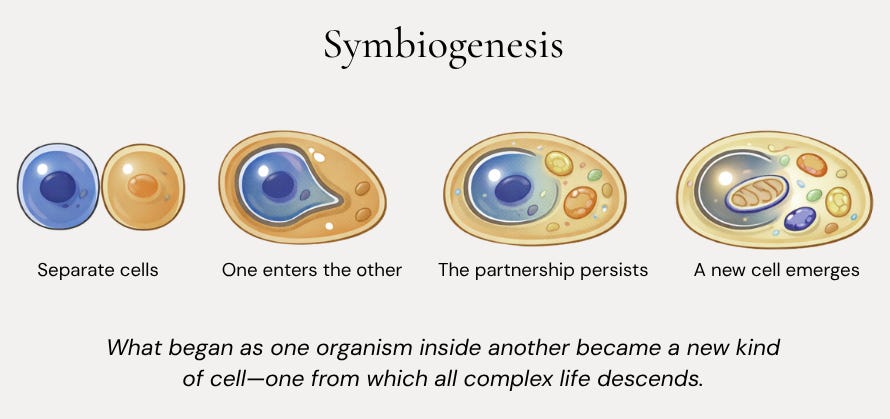
Fifteen journals rejected her paper. The idea sounded ridiculous. By the time it was finally published, the mechanism had already been confirmed in other labs. Today, her theory of endosymbiosis is in every introductory biology textbook. Margulis was right.
Think about that. The most consequential event in the history of complex life on Earth wasn’t an individual organism getting better at what it was already doing. It was two different organisms finding a way to live together without collapsing into each other.
And two billion years later, here we are—the descendants of that crossing—with our nervous systems, our cities, our commodities, and comedies about Eddie Murphy trading places with Dan Aykroyd.
Encounter architecture
Nature has been running on this mechanism for a very long time. Again and again, it selects through what happens between things, not just what happens inside them. We, humans, are a strange case because we’re not passive inhabitants. We inherit, reshape, and—more and more—get to design it. But we’ve barely noticed the layer is there.
Encounter architecture. The conditions under which a meeting actually does something generative instead of nothing. The shape of the place where two different things can exchange something that changes both of them.
The pattern itself is not new. Jane Jacobs glimpsed it in sidewalks. Granovetter in weak ties. Margulis in cells.4 Each field has built local vocabulary for something that kept turning out to be the same thing across substrates.5 Naming the layer was missing—naming it plainly, in its own terms, rather than letting each domain rediscover it in dialect.
Encounter architecture names the specific conditions—physical, temporal, social, structural—that make contact consequential. When those conditions are there, something crosses. When they aren’t, bodies and buildings and algorithms do what they do and nothing moves.
The myth of individualism
So, let me come back to what I said at the start.
When I said that a lot of what we credit to mindset, effort, and willpower is actually architecture, this is what I meant. Not that the work doesn’t matter. But the work walks through doors that were already either open or closed before anyone showed up.
The architecture decides which doors, for whom, how wide, and for how long. You built the capacity to use an opportunity, and that’s real. But the opportunity was encounter architecture somebody else ran (nature runs her own), and if that structure had been different, your capacity could have walked into a different room or no room at all.
I don’t know about you, but I find my research a bit disorienting. We’d love to say that so-and-so made it happen, fulfilled their potential, thrived all on their own, and all that. And I lived this belief with every fiber of my being. But I can’t anymore, not with a straight face.
The myth of the solo actor—the builder, the do-everything human—isn’t just wrong. It holds this erroneous narrative in place. As long as we keep telling the story that way, the architecture that actually shapes outcomes stays invisible—which means the “suboptimal” ones keep getting reproduced by the people best positioned to change them. Imagine. The potential we could generate staying locked behind somebody else’s “best practices.”
We’re building blind
Take the one encounter architecture most of us spend hours inside every day: the algorithmic feed.
Run it through the four conditions.
Difference—there’s plenty, every post is from someone whose life looks unlike yours.
Bandwidth—high, the signal lands clean, the platform optimizes for that.
Complementarity—low. What arrives isn’t matched to what you can use; it’s matched to what holds your attention.
Readiness—actively degraded. The architecture trains you into a stance that can’t be changed by what it delivers, because staying the same (and scrolling) is what the system is optimizing you toward.
Two of four conditions present. The other two structurally blocked. Something is crossing the boundary—your attention, in one direction, but nothing durable is forming on your side. That’s extraction dressed as connection.
Now notice what the standard metrics measure. Engagement. Time-on-platform. Revenue. Notice what they don’t measure. Whether anything generative came out of the encounter. Whether you walked away more capable than you walked in. Whether the next encounter this architecture produces is going to leave someone—anyone—better equipped than the last one did.
That’s a huge gap—and an opportunity. The instruments we use to tell whether these systems are working measure flow, not generation. They count that contact happened. They can’t see whether the contact produced anything. You can optimize engagement for a decade and never notice that the layer underneath generates nothing for the end user.
That’s what I mean by “building blind.” And this generation is building the next set of these systems—platforms, algorithms, AI—faster than any generation before us. All of it sits between people and reaches deeper into how they meet, who they meet, and what passes between them when they do.
The encounter architecture we inherit becomes the one we build into the next thing. If we can’t read the layer, we reproduce the same extractive patterns whether we mean to or not.
There’s a joke about two fish. One's swimming along, and an older fish swims by and says, "Enjoy the water, boys." They nod, say thanks. Then one turns to the other and says, "What's water?"
I’ll keep working through this. Next time, let’s talk about the consequences of current encounter architectures. They’re all around us. We experience them all the time but are oblivious to them, like water to fish. But if we can read its shape, then we can begin to change things.
Footnotes:
Readiness, as I’m using it, is narrower than the three adjacent constructs it will remind people of. It’s not Prochaska and DiClemente’s stages of change, which describe intentional behavior change in a single agent over time. It’s not Cohen and Levinthal’s absorptive capacity, which is organizational rather than encounter-local and is about accumulated prior knowledge rather than structural stance. And it’s not Big Five openness, which is a trait. Readiness here is a structural property of the receiver at the moment of encounter—whether the shape of what it already is can be changed by the shape of what it meets. Traits and histories feed into it; they don’t constitute it.
Chetty, Hendren, and Katz, “The Effects of Exposure to Better Neighborhoods on Children: New Evidence from the Moving to Opportunity Experiment,” American Economic Review 106(4), 2016.
Two things worth naming that I’m not walking through in the main text: the effect is specific to children who moved before roughly age thirteen. Older children showed smaller effects and adults showed none on earnings. And adults in the program did show meaningful improvements in mental health and self-reported wellbeing, which the original MTO evaluations (Kling, Liebman, Katz 2007) had already documented.
The claim here is narrower than “MTO did nothing for adults.” It’s that adult relocation did not translate into the developmental outcomes that children did, which is exactly what a readiness-feedback account would predict.
Per-encounter quality Q(B) is a snapshot. What actually determines how much potential a system makes available is the integral of encounter quality over the field the system lives in:
where μ carries the immersion dimensions—multiplicity (how many encounters), duration (over how long), density (how close in space and time), and inside-ness (whether the receiver is exposed to the architecture or embedded in it). Readiness is not static across the integral; it updates:
This is the loop that makes the MTO age gradient stop looking like a curiosity. A thirteen-year-old integrated over six or seven years of a different architecture is not "exposed longer"—they are inside a feedback loop in which each encounter shifts the readiness that the next encounter meets. Whether this loop runs at all depends on substrate plasticity, which is why the same integral applied to an adult produces a much smaller ΔR.
Jane Jacobs, The Death and Life of Great American Cities (1961); Mark Granovetter, “The Strength of Weak Ties,” American Journal of Sociology 78(6), 1973; Lynn Sagan [Margulis], “On the Origin of Mitosing Cells,” Journal of Theoretical Biology 14(3), 1967. Each describes a system where the arrangement of encounters does the generative work that the standard explanations attribute to the encountering parts themselves.
The four conditions aren’t specific to humans. A beaver meeting a cottonwood is an encounter architecture: difference (the tree holds structural potential the beaver can release), complementarity (teeth that cut, a stream that needs damming), bandwidth (the tree is reachable, the wood is workable), readiness (the beaver knows what to do with it, and the dam it builds reshapes the stream so that the next encounter—water meeting timber—can do work too).
A rock meeting water is the limit case: difference and bandwidth are present, but the rock has no complementarity to liquid and no readiness to be changed by it, so the encounter produces only slow erosion rather than anything we’d call generation.
The instantiation is substrate-specific; the structure is not. This is why niche-construction theorists (Odling-Smee, Laland, Feldman) end up describing something that rhymes with what I’m describing here, from a different direction.
Thanks! Great article. Thanks for sharing.
Blessings
John harris