


The treadmill
Running on a treadmill is motion. Running toward a destination is movement.
Both involve effort. Both produce sweat. Both feel like something is happening.
Only one changes where you are.
Most “transformation” is treadmill running, motion that produces the feeling of progress without the reality of change.
Work doesn’t equal change
In post 3.6 we covered C and E—configuration selected, energy flowing. You committed to the new bar and resources are moving toward it.
But energy flow doesn’t guarantee change. That’s the gap between E and Δ in the chain:
You can pour energy into something and end up exactly where you started. The activity happened. Nothing changed. This post explains why and how to tell the difference.
Activity vs. change
Energy flowed. Work happened. The E stage occurred.
But did Δ (change) really occur? Did state or capacity actually change?
Keep in mind, in this model, Δ comes in two flavors:
ΔX (state change)
ΔΨ (capacity change)
This is the difference between motion and movement.
Motion is activity—things happening, effort expended, sweat produced.
Movement is change—things becoming different, positions shifting, capacity building.
Organizations are full of motion that produces no movement:
Meetings that discuss but don’t decide
Initiatives that launch but don’t land
Plans that get made but never become defaults
Transformations that announce but don’t transform
So are lives:
The gym membership used for the first two weeks of January
The course started, but never completed—or completed, but never applied
The self-help book that felt great reading it
If you can’t point to evidence of ΔX or ΔΨ, you’re probably looking at change theater.
Two types of real change
Let’s break down those two types of change.
ΔX: State change
Something observable shifted. The world is different. You can point to it.
Revenue increased (and stayed that way)
The product shipped (and people use it)
You moved to a new city (and you live there now)
The skill developed (and you can demonstrate it)
The weight came off (and it stayed off)
ΔΨ: Capacity change
The system can do more than before. Future capability increased. SIRF improved:
F improved: more reserves, better resource management, financial cushion built
S improved: better structure, clearer processes, systems that run without heroics
I improved: better sensing, sharper awareness, models that predict accurately
R improved: stronger relationships, expanded network, trust established
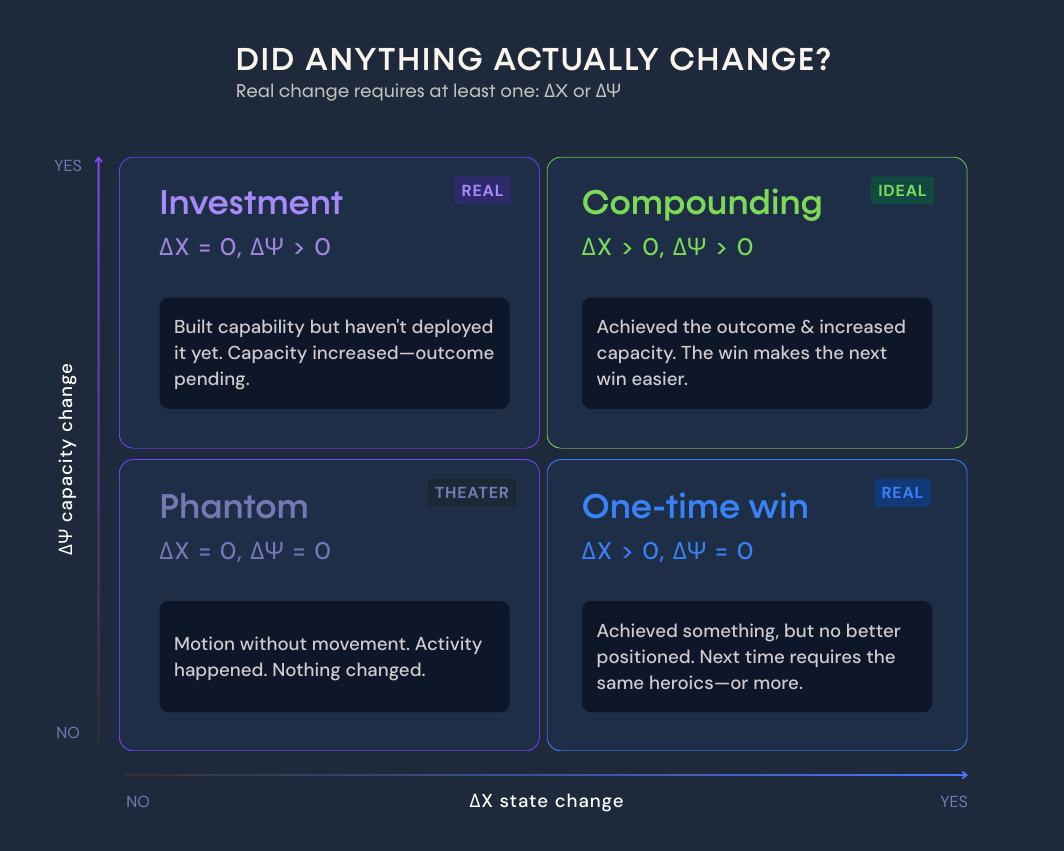
Real change requires at least one: ΔX or ΔΨ. The best involves both.
Four outcomes
There are generally four outcomes. The one-time win. The investment that hasn’t panned out yet. A compounding change (ideal). And the ghost.
All from a mix of state and capacity change:
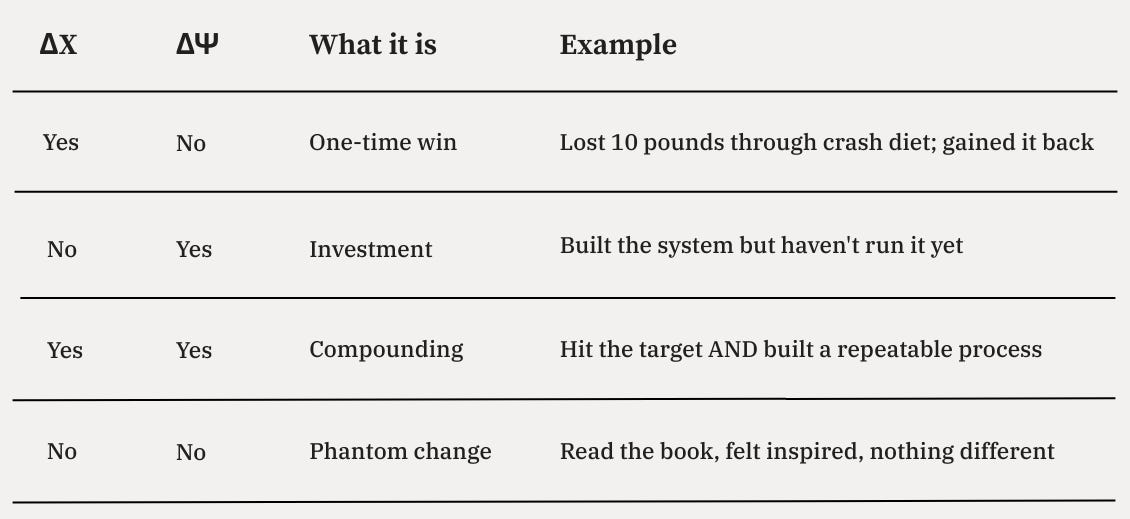
One-time win (ΔX only): You achieved something, but you’re not better positioned for next time. You hit the sales target through heroics. You lost the weight through willpower alone. The state changed, but capacity didn’t. Next time requires the same heroics—or more.
Investment (ΔΨ only): You built capability but haven’t deployed it yet. You learned the skill but haven’t used it. You built the system but haven’t run it. This is real—capacity genuinely increased—but incomplete until ΔX follows. The tell: you can demonstrate the capability on demand, even if the outcome hasn’t shown up yet.
Compounding (both): The ideal. You achieved the outcome AND increased capacity. You hit the target AND built a process that makes it repeatable. You lost the weight AND changed the habits that maintain it. The win makes the next win easier.
Phantom change (neither): Motion without movement. The activity happened. Nothing changed. You read the productivity book, felt motivated for a week, and your systems are identical. The transformation that wasn’t.
Why phantom change persists
Phantom change survives because we measure activity, not change.
Effort feels like progress. You worked hard. You’re exhausted. Something must have happened, right? But effort is input. Change is output. They’re not the same.
Output vs. outcome confusion. We shipped the thing. Did shipping change anything? Output is what you produce. Outcome is what changes as a result.
A report produced ≠ decision changed
A book read ≠ behavior shifted
Short feedback loops. The metrics improved this quarter. Did they stay improved? Quarterly results can mask regression. The change looks real until you check down the road six months later.
Narrative over evidence. We tell the transformation story. We believe the transformation story. The story replaces the assessment. “I’m really changing” becomes true because we feel it, not because we can point to evidence.
Phantom change gives comfort. It provides the feeling of progress without the risk of genuine commitment. You can always be “working on yourself” without ever being different.
The regression test
Here’s the test that separates real from theater:
Is the change still true six months later?
Six months isn’t magic—it’s long enough for novelty and willpower to wear off and the old regime to pull back.
Many “transformations” don’t pass. The initiative launched, metrics improved briefly, then regressed. The diet worked, then didn’t. The new habit stuck for a month and faded.
Why does regression happen?
The old regime wasn’t fully released (Γ_fail incomplete—the shell never cracked)
The new configuration never stabilized (the pattern didn’t lock in)
The change was forced by heroics, not enabled by capacity
The underlying conditions (SIRF) didn’t support the new state
Regression isn’t random. It’s the old regime reasserting when the new stabilizing structure didn’t change. The system returns to its actual equilibrium.
Real change occurs when emergence stabilizes. New order that holds because it’s structurally supported. Phantom change is motion that creates the appearance of change, then fades back to baseline.
Why this matters
If you’ve ever wondered why change is so hard—why you keep ending up back where you started despite genuine effort—this is the physics.
Motion isn’t movement. Energy flow doesn’t equate to change. Activity without real Δ is theater, no matter how exhausting.
The good news is that once you can see the distinction, you can stop spending months or even years on treadmills. The question shifts from “am I working hard enough?” to “is anything actually different?”
ΔX or ΔΨ. State change or capacity change. At least one, or it wasn’t real.
What comes next
Suppose you achieve real change—ΔX, ΔΨ, or both. One question remains: did the change expand future potential? Or did it merely achieve an outcome without improving your position?
That’s the difference between compounding and extracting. The next post covers:
and whether change builds toward something or just consumes what you had.
Application
Notice: Think of the last “transformation” you celebrated.
Name: Was there ΔX (observable state change), ΔΨ (capacity increase), both, or neither?
Test: Apply the regression test. Six months later, is it still true? If you can’t point to something durably different—a sustained outcome (ΔX) or a capability you can still use (ΔΨ)—it was probably theater.
Remember: Real change requires at least one: ΔX (state change) or ΔΨ (capacity change). Activity without either is phantom change—motion without movement. Regression is the old regime reasserting; real change is emergence stabilizing. The six-month test separates transformation from theater.
The science
Established:
Output differs from outcome (basic program evaluation)
Activity metrics can mask stagnation (performance measurement research)
Regression to mean is a statistical reality (any temporary distortion tends to revert)
Genesis claim:
Δ as formal stage with ΔX/ΔΨ decomposition. Real change requires at least one; compounding requires both.
Falsification:
ΔX + ΔΨ measurement should predict sustained outcomes. If phantom change and real change produce equal long-term results, the distinction doesn’t matter.