



Firewood or orchards
Cut down a tree, and you get firewood. Once.
Plant a seed, and you get fruit. And seeds for more trees. And more fruit. And more seeds, until you get an orchard.
One transaction versus one trajectory that keeps giving.
Some transformations are firewood: you achieved something, consumed resources, done. Other transformations are orchards: you achieved something, and now you’re better positioned to achieve more.
What’s the difference?
After real change, then what?
In post 3.7, we established what real change looks like:
ΔX (state change)
ΔΨ (capacity change)
or both
You achieved something, and it passed the six-month test.
Now the question shifts: did that change expand what’s possible next, or just check a box?
The chain ends with:
After change happens (Δ), what new potential emerges (Π_{t+1})?
This is the compounding question. Does transformation expand what’s reachable? Or did it merely achieve a specific outcome without changing the possibility space?
Three trajectories
Transformation can leave you better, equally, or worse positioned. Three trajectories:
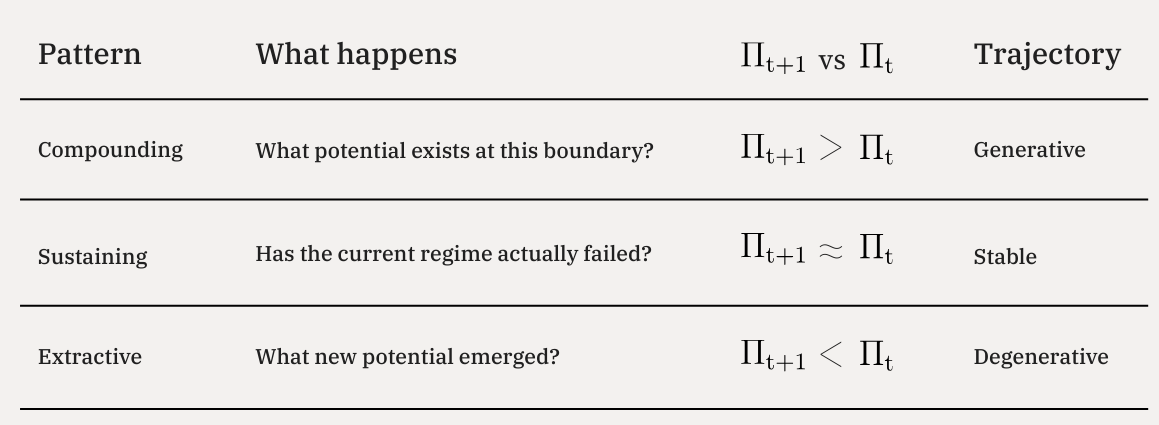
Compounding (generative): The transformation not only changed things—it expanded what’s reachable next. New boundaries became accessible. New capabilities emerged. The adjacent possible grew.
A startup ships its first product. In doing so, it builds engineering capability, establishes customer relationships, learns about the market, and creates a platform for future products.
The next transformation is easier.
A person learns a new skill AND builds a practice routine to maintain it. The skill is real (ΔX), the routine is capacity (ΔΨ), and both together open doors that were previously closed. That’s the orchard—fruit plus seeds.
Sustaining (stable): The transformation maintained position. You’re not worse off, but you’re not better positioned. You did what was required to stay in place.
A company hits its quarterly targets through standard execution. Nothing new was built. No new capabilities emerged. They survived another quarter. Necessary, but not generative.
A person maintains their fitness level—same weight, same strength, same routine. Real, but static. The work prevents decline without creating new possibility.
Extractive (degenerative): The transformation depleted capacity. You achieved the outcome, but at the cost of future potential. You’re worse positioned after the “success.”
A team ships through crunch. They hit the deadline. But relationships fracture, talent burns out, and technical debt accumulates. They’re weaker than before.
A student crams for certification, passes the exam, and forgets everything within weeks. The credential is real (ΔX), but no lasting capability was built. The next certification will require the same desperate effort—or more. More firewood—warmth now, nothing left for later.
The physics of trajectories
Extractive transformation accelerates entropy. You’re burning order faster than you’re building it. Each cycle leaves less to work with. The system winds down.
Compounding transformation sustains emergence. Each cycle creates conditions for the next. New order builds on top of new order. The system winds up.
Sustaining holds position, entropy and emergence roughly balanced. Not growing, not shrinking. Stable, but static.
The trajectory isn’t determined by how hard you work. It’s determined by whether the work builds capacity or consumes it.
When compounding occurs
Compounding isn’t automatic. Certain conditions make it more likely:
Capacity built alongside outcome. When transformation produces both ΔX and ΔΨ, future potential expands. Ship the product AND build the process. Hit the target AND develop the skill. The “AND” is what compounds.
SIRF preserved during transformation. Transformations that deplete SIRF can achieve outcomes, but can’t compound. When the crunch ships the feature but burns out the team, new potential drops. The capacity that enables future transformation was consumed.
Systems, not just results. A result is a one-time change. A system is a capacity for repeated change. Results deplete; systems compound. The person who builds a writing habit compounds. The person who forces out one essay through willpower extracts.
New boundaries accessed. Each transformation can open new boundaries—new relationships, new capabilities, new access. When these accumulate, new potential expands. When they don’t, each transformation stands alone.
Some get stronger, others get weaker
This explains a puzzle: why do some people, teams, or organizations get stronger with a challenge while others get weaker?
Same challenge. Same transformation required. Different trajectories.
The compounders navigate challenge in a way that builds capacity. Each difficulty, once overcome, leaves them more capable. Their confidence develops from evidence. They’ve done hard things and gotten stronger.
The extractors navigate challenge in a way that depletes capacity. Each difficulty, even when overcome, leaves them weaker. They survive through heroics, borrowing from future capacity. Each success is harder than the last.
The difference isn’t resilience as some mystical trait. It’s diagnosable, measurable transformation architecture. Converting in ways that expand potential versus converting in ways that deplete it.
The long game
Compounding is the long game. Extractive wins borrow from the future. Compounding wins build the future.
Short-term, extractive transformation looks efficient.
“You got the result!”
“You did it faster!”
“The quarter looks great.”
Short-term success is often extraction masked by temporary gains:
Long-term, compounding dominates. Each cycle builds on the last. The compounder’s tenth transformation is easier than their first. The extractor’s tenth transformation is harder—if they make it that far.
This is why sustainable success looks different from short-term success. Sustainable success is compounding, repeatedly:
Establishing an orchard takes longer than cutting a tree. But the orchard keeps giving.
The chain complete
We’ve now covered the full expanded pattern:
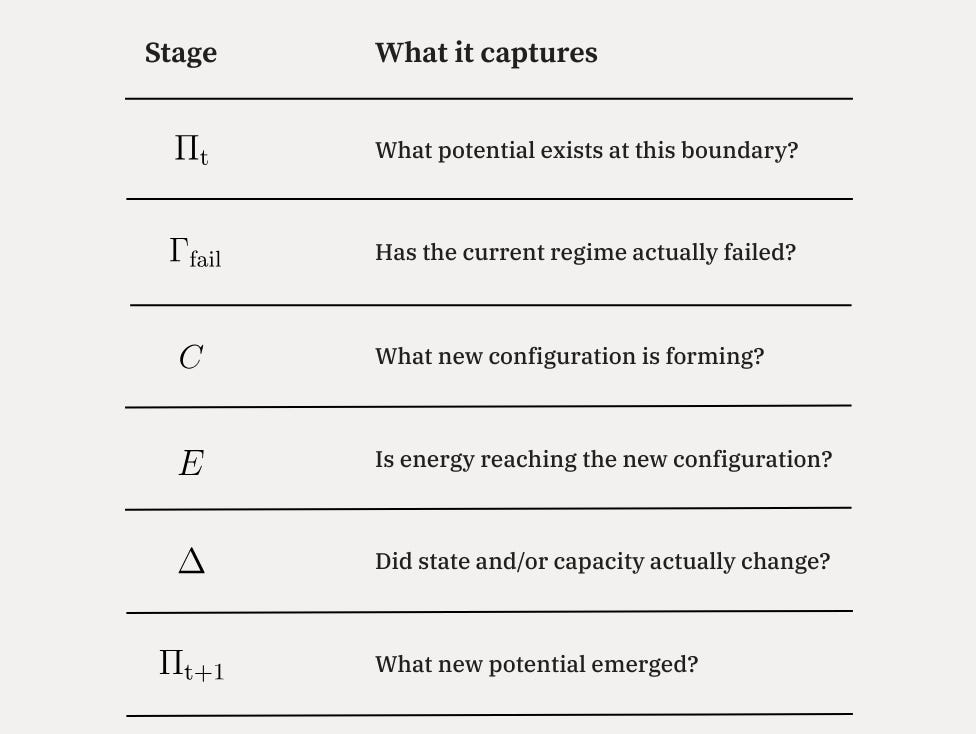
At any stage, transformation can stall. The next post maps those stall points systematically—where conversions fail and why.
Application
Notice: After your last significant effort, are you stronger or just relieved?
Name: Which trajectory fits?
Compounding: More capable, new possibilities opened
Sustaining: Same position, maintained but didn’t build
Extractive: Depleted, weaker than before, dreading the next one
Test: If it compounded, the next similar challenge should require fewer heroics and produce better outcomes. If it extracted, the next similar challenge will be harder.
Keep in mind: Transformation has three trajectories: compounding (>), sustaining (≈), or extractive (<). The difference isn’t resilience—it’s transformation architecture. Extractive wins borrow from the future; compounding wins build it.
The science
Established:
Compound growth follows consistent mathematical patterns
Dynamic capabilities predict sustained advantage (organizational strategy research)
Resource depletion predicts system failure (ecology, economics)
Genesis claim:
Π_{t+1} as explicit stage. Compounding as identifiable pattern, not just happy accident.
Falsification:
Π_{t+1} measurement should predict future conversion rate. Systems with higher Π_{t+1} after transformation should transform more easily next time.
Next: 3.9 — Where conversions stall