


The trapeze
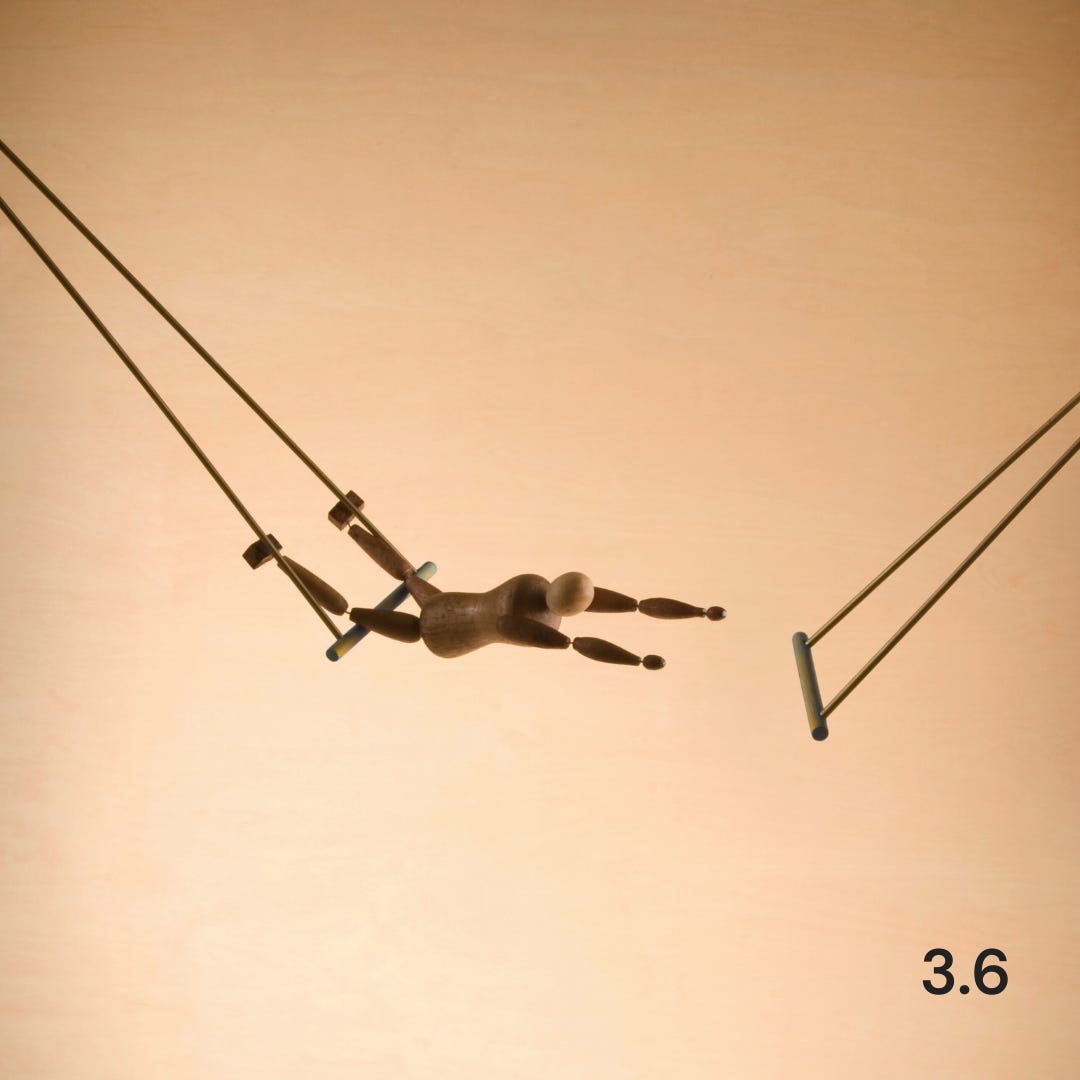
A trapeze artist lets go of one bar. For a moment, she’s in the air—the old bar released, the new bar not yet caught.
That’s the middle.
Gravity is pulling down. The next bar is within reach—but not guaranteed. Everything depends on what happens in the gap.
Most transformations die in the gap.
Not in the beginning (there’s gradient, there’s recognition something must change, some momentum built). And not in the end (if you truly lock in a new pattern, stabilization is the easy part).
In the middle, after the old releases, things get stuck before a new regime locks in.
The transition zone
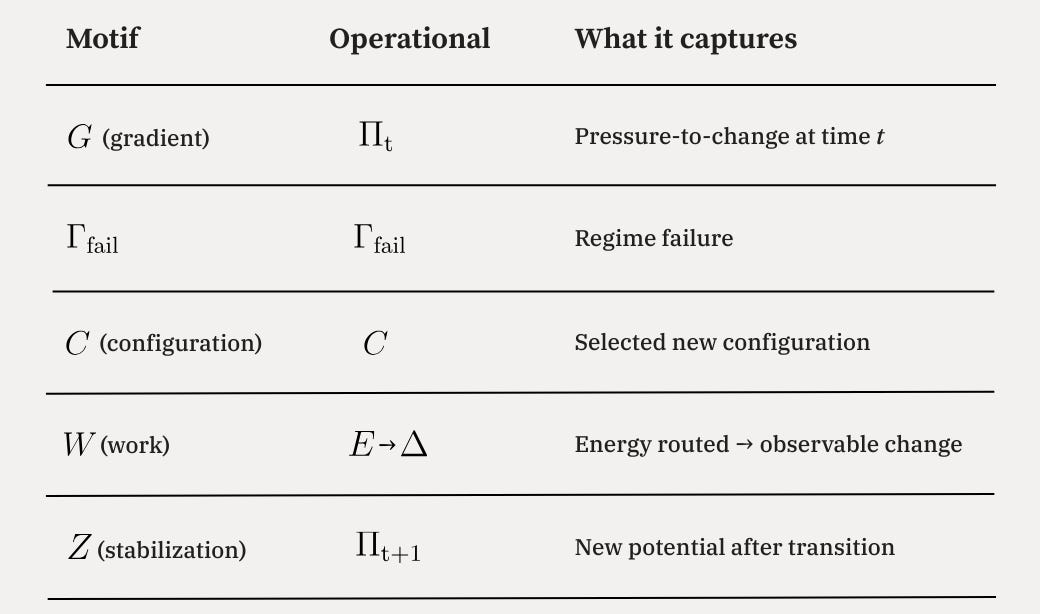
In post 3.5 we introduced the transformation motif:
Five stages that every transformation goes through. That’s the shape—and knowing the shape matters. Skip any stage, and conversion fails.
But here’s the problem: knowing the shape doesn’t tell you where you’re stuck.
When transformation stalls, “It failed somewhere in the sequence” doesn’t help. You need to see where, because different failure points break for different reasons.
That’s what the operational version provides:
Same motif, just finer resolution.
The key move is splitting W (work) into E (energy flowing) and Δ (change occurring). Why? Because energy can flow without change happening. (That’s the entire premise of post 3.7—that most change is theater.)
Why does this matter?
Without the finer resolution, transformation feels like weather forecasting—it works, or it doesn’t, and you can’t tell why.
Some people seem “good at change.” Others aren’t. When you’re stuck, you try harder. When others succeed, you can’t learn from it.
With the handles, you can see what’s actually happening.
Not “my change effort failed” but “I selected a configuration and never resourced it.”
Not “I lack willpower” but “I’m oscillating—I haven’t committed to a pattern.”
Not “that company is just better at transformation” but “they moved through C faster and didn’t starve E.”
The motif tells you transformation has a shape.
The operational version lets you see where the physics is breaking down.
And when you can see the physics, transformation becomes something you can get better at—not just something that happens to you.
In this post, we focus on the middle: C (configuration) and E (energy). The next post handles Δ and whether anything actually changed.
Where entropy and emergence compete
The middle is contested territory.
The old pattern has released, and entropy pulls toward dissolution. The new pattern takes shape, and emergence pulls toward a new order. No outcome is guaranteed.
C: Has a new configuration been selected? Has the system committed to a pattern to move toward?
E: Is energy reaching that configuration? By “energy,” I mean time, attention, money, labor, and enforcement—the resources required to actually build the new pattern.
Both stages can fail independently. And their failures look different.
Three ways to die in the middle
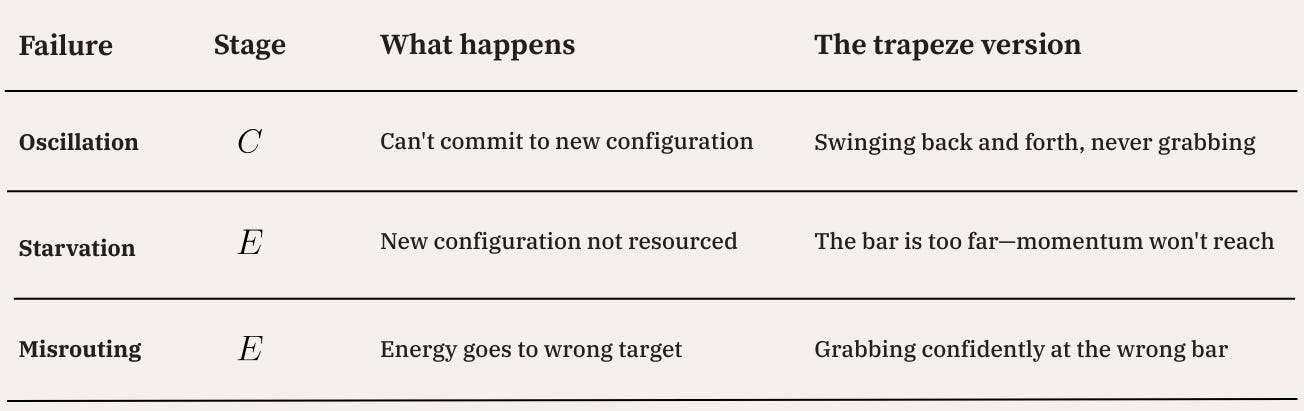
A trapeze artist who hesitates falls. You release, you commit, you catch. But what happens when you can’t choose which bar? When you can’t reach the one you’ve chosen? When you grab the wrong one?
These are the same questions behind every transformation. You commit and move through—or you don’t. Maybe you oscillate, never choosing which direction to go. Or you starve, having chosen but lacking the resources to get there. Or you misroute, pouring energy into the wrong target entirely.
Let’s explore each.
1. Oscillation (C failure)
The system can’t settle on a new pattern. It tries one configuration, then another, then another, but never commits. The middle becomes permanent.
The team that reorgs every six months. They try a matrix, then pods, then squads, then back to matrix.
Or the person who starts a new habit every month—this diet, that system, this method, or a new planner every week.
Or the company in perpetual “strategic planning,” always about to commit, never committing.
Oscillation happens when:
The old regime failed, but no viable alternative is clear
Too many options compete without selection criteria
Fear of commitment to any configuration (what if it’s wrong?)
The transition zone feels safer than risking execution
2. Starvation (E failure)
A configuration exists, but no resources reach it. The new approach is articulated, even announced—but nothing changes in how time, money, or attention actually flows.
It’s the “strategic priority” with no budget. The new initiative that gets people’s third-tier attention. The transformation plan exists in slide decks but not in calendars. The person who joined the gym, bought the shoes, but never protected the calendar.
Starvation happens when:
Stated priorities and actual allocation diverge (the alignment gap from Series 2)
The old regime still controls resource flows
Transition costs exceed available reserves
The urgency of current operations crowds out investment in new configuration
Misrouting (E failure): Energy flows—but to the wrong place. Resources deploy, work happens, but it’s not reaching the configuration that would actually produce transformation.
This is subtler than starvation. In starvation, nothing happens. In misrouting, lots happen but it doesn’t build the new pattern. Activity creates an illusion of progress.
The person “working on health” by buying supplements and reading articles, but not sleeping or exercising. The company runs transformation workshops while actual work stays unchanged. Movement without substance.
Misrouting happens when:
The configuration is unclear (what exactly are we building toward?)
Political forces redirect resources to pet projects
Metrics measure activity rather than progress toward configuration
Work feels transformative, but doesn’t build the new pattern
The comfort of the middle
The middle can get very comfortable.
The old regime failed so there’s no pressure to maintain it. But the new regime hasn’t formed yet so there’s no accountability to produce it. You’re floating in space.
This might sound uncomfortable, but it can be strangely appealing:
No one expects the old performance (it failed)
No one can measure against the new standard (it doesn’t exist yet)
“We’re in transition,” explains everything
Endless planning feels productive without risking execution
Organizations stay in the middle for years. People do, too. Transition becomes an identity. “We’re transforming,” but nothing changes.
If “we’re in transition” has been true long enough that it’s become your identity, assume you’re in oscillation or starvation mode.
The trapeze artist can’t hang in the air forever. Neither can you.
What comes next
Suppose energy flows to the right configuration. Suppose you get past C and E. Does anything actually change?
The next post addresses Δ: is the change real?
Application
Notice: Are you in a transition right now, post-failure but not yet stabilized?
Name: Which failure mode fits?
Oscillation: Can’t select, keep switching approaches
Starvation: Selected but not resourced, no budget/time/attention flowing
Misrouting: Resourced but wrong target, lots of activity without progress
Test: Check calendars and budgets. If resources aren’t moving toward the new configuration, it’s starvation. If resources are moving but outcomes don’t track the configuration, it’s misrouting.
Keep in mind: The middle (C + E) is where most transformations die. Three failure modes: oscillation (can’t commit), starvation (committed but not resourced), misrouting (resourced but wrong target). Think of the middle as where entropy and emergence compete, where the outcome still isn’t guaranteed.
The science
Established:
Transition periods are high-failure zones (organizational change research)
Resource allocation predicts outcomes better than strategy statements (revealed preference in action)
Selection pressure drives commitment (evolutionary dynamics)
Genesis claim:
C and E as distinct stages with specific failure modes. Oscillation, starvation, and misrouting as the three middle failures.
Falsification:
If these failure modes are real, then (1) independent raters should classify cases consistently, and (2) targeted interventions should work selectively—selection pressure helps oscillation, resourcing helps starvation, routing correction helps misrouting. If interventions work equally well regardless of classification, the distinction doesn’t matter.