


The shape you’ve known
Ever watch a team “do everything right” and still stall?
Hiring. Roadmap. Rituals. Metrics. More process.
Then one week—something breaks—and three months later the whole org is running on a new operating system.
You’ve lived this pattern. Probably more than once.
Something builds. Pressure accumulates. The old way stops working. Things get unstable, maybe even a little chaotic, but then a new configuration emerges. Eventually, it stabilizes. Until the next cycle, that is.
Career transitions follow this arc. So do relationship evolutions. So do organizational transformations. So do ecosystems recovering from fire.
Multiple scientific traditions have mapped this same sequence—each with rigor, data, and math—without treating it as one shared, cross-scale pattern.
Same mountain, different languages
Japanese, English, Nepali, and scientific Latin all have words for “mountain.” Different sounds, different etymologies, different contexts. But they all point at the same peak.
The ecologist, the physicist, the organizational theorist, the learning scientist—they each mapped transformation in their domain. Each got it right. Each thought they were describing something specific to their field.
But they’re all pointing at the same mountain.
The problem isn’t that we lack models or frameworks. It’s that we don’t have a shared map.
And without that, we can’t reliably diagnose where change is failing, or what to do about it.
Four traditions, one arc
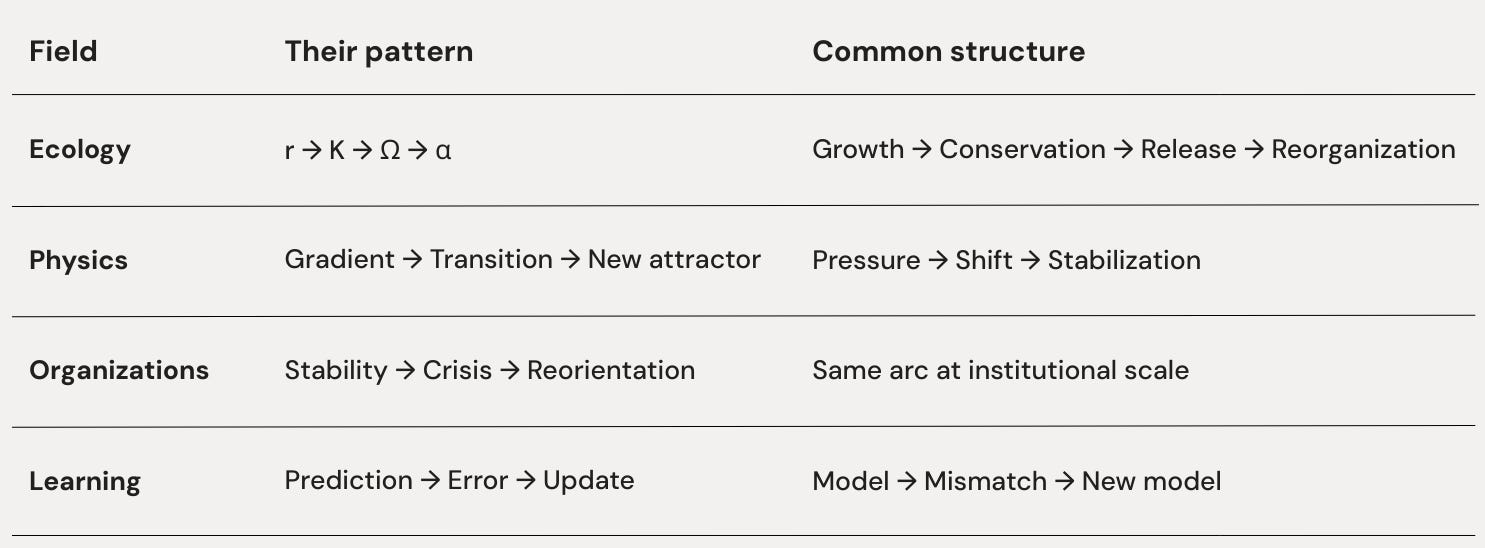
Look at the structure:
Build-up: the system loads energy/resources/expectations
Break: the current pattern can’t hold (regime failure, critical point, or error signal)
Reform: a new configuration assembles (reorganization, new attractor, updated model)
Lock-in: the new pattern stabilizes—becoming the next default
If you’ve ever outgrown a life phase, you already know what regime failure feels like.
What each tradition provides
Ecology (Holling, panarchy theory)
The adaptive cycle framework (mentioned in post 3.2):
The crucial insight: release is often necessary, not aberrant. In other words, forests need fire. Seen in ecosystems across scales.
Physics (Prigogine, dissipative structures)
Thermodynamic grounding: order through instability. Far-from-equilibrium mathematics. Hard constraints, falsifiable models, Nobel-level foundations.
Organizational theory (Tushman, punctuated equilibrium)
The human-institution version: long periods of incremental change punctuated by rapid reorientation. Explains why some organizations pivot and others collapse.
Learning theory (prediction error, Bayesian updating)
The cognitive parallel: models make predictions; a mismatch produces an error signal; an update follows. Backed by how minds and brains actually change.
Each field describes the arc in its own vocabulary, with its own methods, and each validates it locally.
What each tradition doesn’t provide
Even with all that rigor, there are four gaps that show up over and over:
1) The universality hypothesis
Almost none of these traditions says: “This is the same pattern across all scales.”
Ecologists don’t claim this describes neural learning. Physicists don’t claim dissipative structures explain institutional change. Each stays in its lane.
2) The integration
Because no one makes the universality claim, no one integrates each vocabulary.
The physicist, ecologist, and organizational theorist aren’t building a shared diagnostic language—they’re at different conferences, publishing in different journals, pointing at the same mountain.
3) The falsification criteria for the sequence itself
Each tradition validates its version. Few ask: If this is universal, what would disprove it? The claim isn’t tested because it’s rarely made.
4) The operationalization for intervention
Knowing the arc exists doesn’t tell you where your transformation is stuck or what to do next. It’s like knowing “injuries heal in stages” but not knowing whether you have a sprain, a tear, or an infection.
Descriptive insight isn’t the same thing as a diagnostic framework.
The synthesis opportunity
To be clear: this isn’t a discovery claim. It’s a coordination claim.
The pieces exist. They’re well-validated within their domains. The synthesis brings them together and asks:
Is this actually the same pattern? (If so, what’s the common structure?)
Is it universal across scales? (If so, what would falsify that?)
Can we operationalize it? (If so, how do we diagnose and intervene?)
We did something similar in Series 1 with boundary-emergence. Multiple fields have discovered that potential appears at boundaries—thermodynamics, economics, ecology, and psychology. The synthesis claimed universality and asked what would disprove it.
We’ll do the same for transformation dynamics.
The invariance claim
Here’s the claim we’re building toward:
Transformation follows an invariant causal pattern:
It usually unfolds in that order, but the stages can overlap, loop, or recur across nested scales.
The functional roles are the same. If a role is missing—no real failure signal, no genuine reconfiguration—durable change usually doesn’t hold.
This is testable.
If transformation at different scales follows different sequences, the claim is wrong.
If stages can be skipped without failure, the claim is wrong.
If the physics grounding is incorrect, the claim is wrong.
More concretely: if you can get durable change without an error signal, without instability, without reconfiguration—then this sequence isn’t fundamental.
If we’re wrong, we’ll learn exactly where the mapping breaks.
Example: Trying to “get in shape” never sticks
What to change: “I want to exercise consistently.”
What’s building up?
Low energy after work, minor aches, decision fatigue, a schedule that leaves no slack, guilt from inconsistency, unrealistic expectations (“I need to do a full workout or it doesn’t count”).Which system refuses to admit failure?
You keep treating the problem as “motivation” even though the real signal is: the plan doesn’t match your life. You rationalize, “I just need discipline,” but the error signal is consistent: you’re still not doing the thing.What would “reorganization” look like in behavior, not intention?
Change the structure so the behavior becomes the default:shoes by the door + 10-minute walk immediately after a daily anchor (coffee, lunch, after work)
minimum viable workout (2 exercises, 8 minutes) on “bad days”
remove friction (gym bag packed, playlist ready, route chosen)
If you can’t answer question 2, you’ll keep moralizing (“I’m lazy”) instead of noticing the mismatch (“my routine is unworkable”).
Why now?
The pieces matured.
Prigogine’s work is from the 1970s-80s.
Holling’s adaptive cycles from the 1980s-90s.
Tushman’s punctuated equilibrium from the 1990s to 2000s.
Prediction error frameworks from the 2000s-2010s.
The foundation is solid.
The need is acute. The rate of change has accelerated. Transformation isn’t occasional anymore—it’s continuous. Understanding how it actually works has become practical, not just academic.
If the synthesis is valid, it’s useful. If not, the falsification criteria will reveal that. Either way, making the claim explicit and testable moves things forward.
The next post specifies the sequence precisely. Then we’ll walk through each stage, showing where conversions stall and what to do about it.
Application
Notice: Think of a transformation you’ve experienced—habit change, career shift, relationship evolution, team reorganization.
Name: Can you map it to the shared arc? Build-up → pattern-can’t-hold → new-pattern-forms → stabilization?
Test: If you can’t map it without forcing, that’s evidence against universality (or evidence that the definitions need refinement).
Remember: Multiple fields have independently discovered the same transformation arc. The synthesis adds: a universality claim, falsification criteria, and operationalization. The pieces exist; now we’re connecting them.
The science
Established:
Each field’s pattern is independently validated. Adaptive cycles (ecology), dissipative structures (physics), punctuated equilibrium (organizations), prediction error (learning)—all have strong empirical support.
Known but contested:
Whether these are the same underlying pattern. Some researchers see parallels; others are skeptical of cross-domain claims.
Genesis claim:
Universal sequence across scales. Same physics, same stages, same failure modes.
Falsification:
Different sequences at different scales would falsify. If ecological cycles don’t map to organizational change, or learning dynamics don’t map to institutional dynamics, the universality fails.
Next: 3.5 — The five-stage sequence behind every transformation