


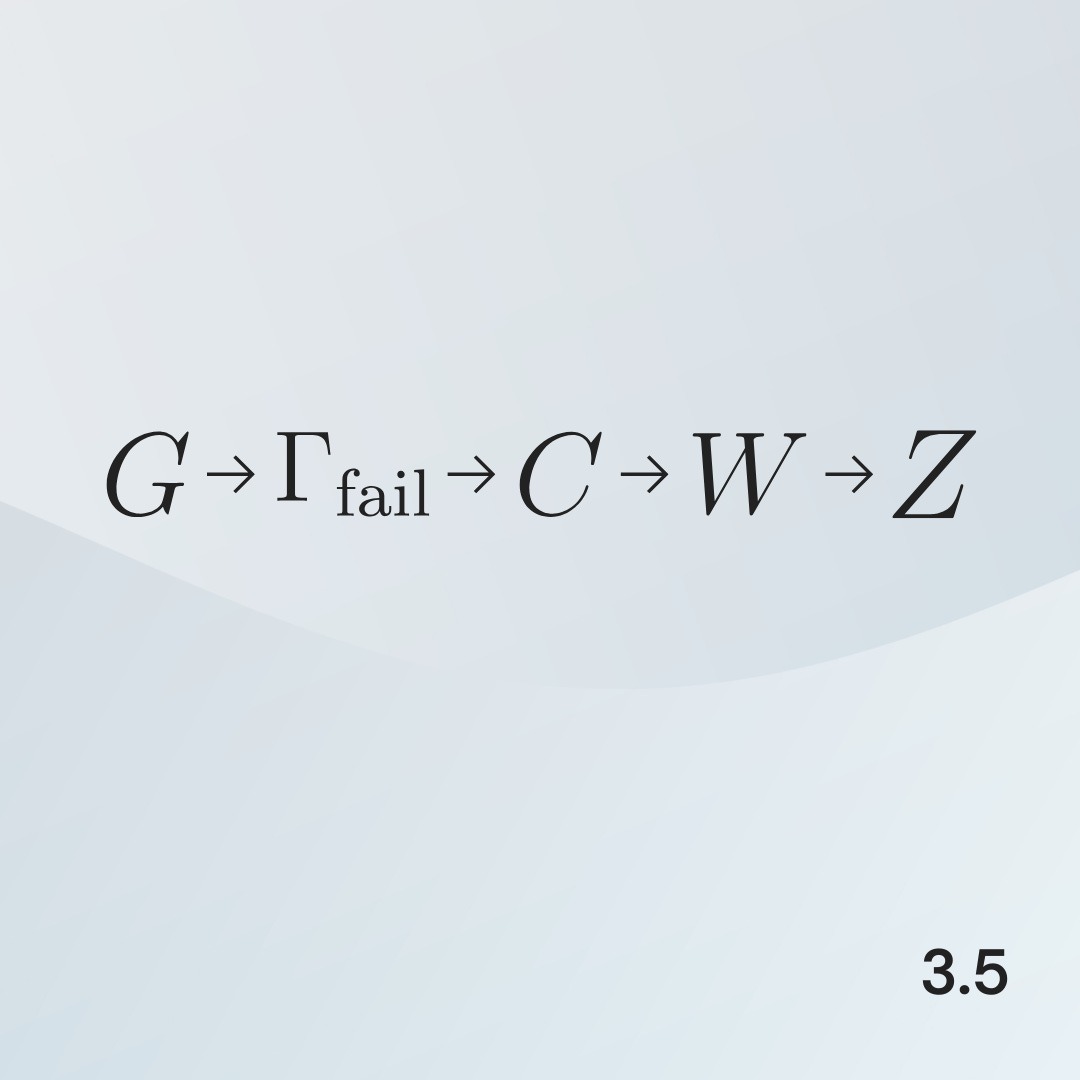
Watch transformation happen
A seed becomes a tree.
First, there’s potential—the seed carries genetic possibility, but it needs soil, water, light. Without those boundaries, it’s just a shell with latent code. Gradient exists—difference between what the seed is and what it could become.
Then the shell cracks. The structure that protected the seed has to break for growth to happen. The old regime fails—the shell-as-container no longer serves.
A new configuration emerges—root goes down, shoot goes up. The pattern organizes. New structure forms—not random growth, but directed architecture.
Energy flows—nutrients move, cells divide, sunlight converts. Work happens—the configuration gets built.
Finally, stabilization—the sapling becomes a tree, holding its new form against wind and weather. The new pattern locks in—until the next cycle.
It’s a repeatable causal pattern.
When transformation succeeds, these roles show up—sometimes cleanly, sometimes overlapping, often recursively.
The five stages
(Arrows mean requires, not sequence.)
Here’s a breakdown of each stage:
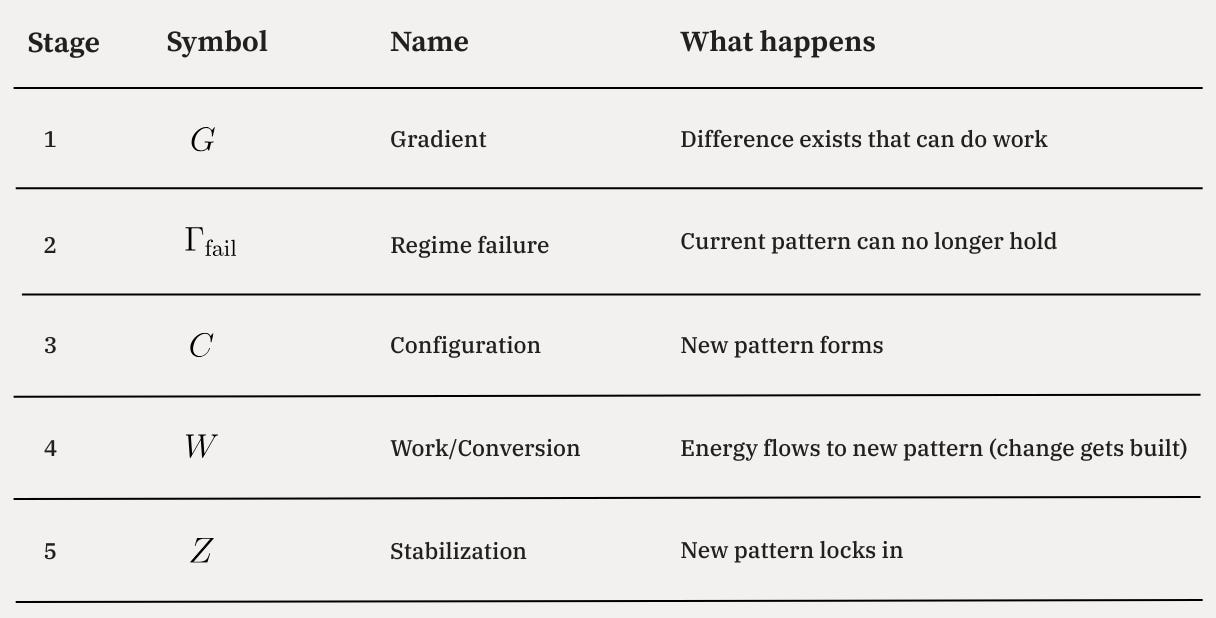
G (Gradient): Transformation requires difference—a gap between where you are and somewhere else. This could be a gap between performance and goal, between current approach and better approach, between what you have and what you need. Without gradient, there’s no drive for change. No slope, no flow.
In human terms: a felt or measurable mismatch that could be converted—if the system can access the right boundary conditions.
Γ_fail (Regime failure): The current regime must actually fail. Not just struggle—fail. Its regulatory capacity must be exceeded by demand. The shell must crack.
We established this in posts 3.1-3.3: regimes lock in, breakdown can be generative, failure is detectable before collapse.
C (Configuration): A new pattern must form. Not chaos—a specific configuration that the system can organize around. This is the selection of a new regime, the emergence of a new attractor. Root goes down, shoot goes up.
W (Work): Energy must flow to the new configuration. Configuration without resources is a blueprint that never gets built. Work is the actual transformation—the movement from old pattern to new.
Z (Stabilization): The new pattern must lock in and become the new regime. Without stabilization, the system oscillates—never completing the transition. The sapling that never becomes a tree. Stabilization is the new regime becoming the default.
The physics grounding
Each stage corresponds to established physics:
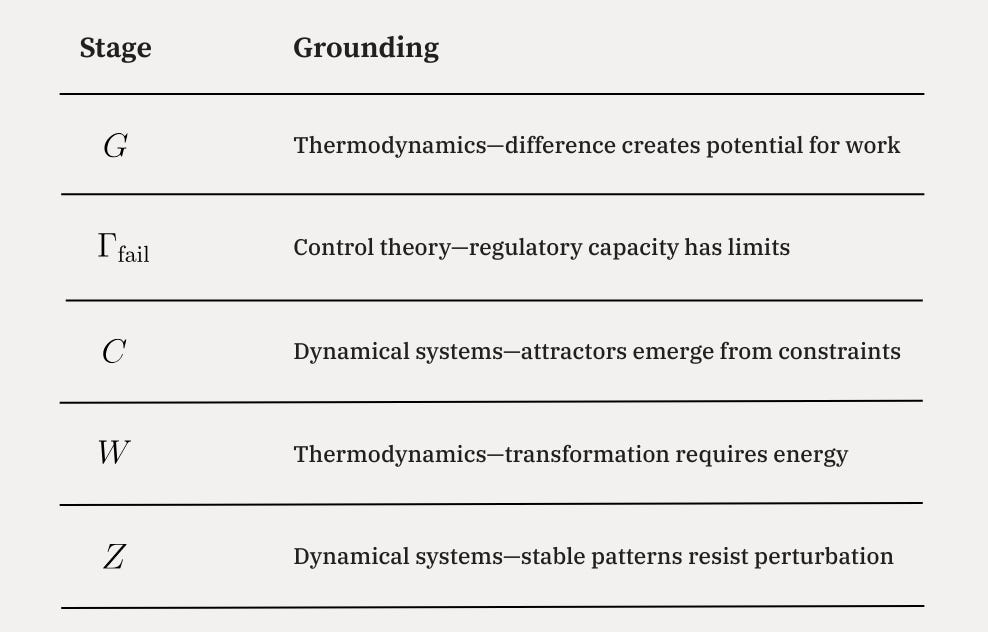
Each stage has a physics grounding that can be operationalized and tested.
The expanded view
For diagnostic purposes, we can expand the sequence:
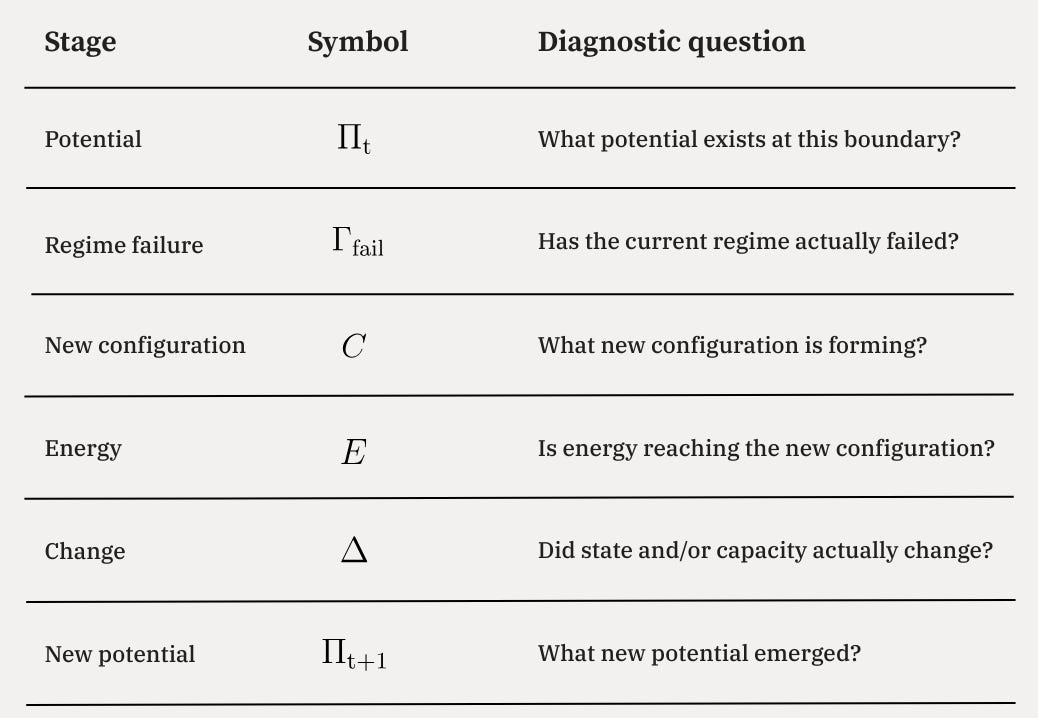
This gives us six checkpoints for diagnosing transformation—so we can locate bottlenecks instead of guessing. The expanded view separates:
Gradient (G) into Potential (Π_t): What’s actually available at the boundary?
Work (W) into Energy (E) + Change (Δ): Did resources flow into new Configuration? Did something actually change?
Adds New potential (Π_{t+1}): Did the change create new possibility?
Without handles, “transformation” remains in the vibes category—you know it’s happening (or not), but you can’t say why.
Causal, not temporal
Important: the sequence is causal, not strictly temporal.
The stages don’t always happen in clean order. In practice:
Configuration and work might overlap—you discover the new pattern while doing the work
Regime failure might be gradual—spreading over time as parts fail at different rates
Stabilization and new gradient might coexist—the new pattern is locking in while new possibilities emerge
The arrows mean: each stage requires the previous one.
You can’t have real work (W) without a configuration to work toward (C).
You can’t get a durable new configuration without enough release from the old regime—whether that release is abrupt (failure) or gradual (capacity exceeded over time).
You can’t have regime failure without gradient (G). Without difference, there’s nothing driving the transition.
Skip a stage and conversion fails:
Gradient without regime failure = pressure without release (the locked regime from 3.1)
Regime failure without configuration = chaos (oscillation from 3.6)
Configuration without work = planning without execution (starvation from 3.6)
Work without stabilization = change that doesn’t stick (regression from 3.7)
Scale invariance
The same pattern at different scales:
Cell: Chemical gradient → receptor response fails → new gene expression pattern → metabolic work → new cellular state
Individual: Gap between reality and goal → old approach fails → new approach selected → effort invested → new habit stabilized
Household: Routine mismatch → old division of labor fails → new roles/rituals form → effort redistributed → new household equilibrium
Community: Resource/coordination gradient → existing norms fail → new norms/groups emerge → collective work → stable new pattern
Organization: Competitive gradient → strategy fails → new strategy forms → capital deployed → new market position
Ecosystem: Resource gradient → old configuration can’t hold → new species composition → energy flows through new food web → new equilibrium
Civilization: Systemic gradient (inequality, climate, technology) → institutions fail → new institutions form → collective work → new equilibrium
Same structure. Different implementations. The physics is scale-invariant.
What this gives us
If the pattern is universal:
Diagnosis becomes portable. Learn to identify G, Γ_fail, C, W, Z once, then apply at any scale. The vocabulary transfers. A stuck team and a stuck career follow the same diagnostic.
Stall points are predictable. If we know the sequence, we know where things can go wrong. Each stage has characteristic failure modes. We’ll map these systematically in 3.9.
Interventions can be targeted. Instead of “change isn’t working,” we can say “change is stuck at stage X.” Different stages need different interventions. Pushing harder at the wrong stage wastes energy.
Cross-domain learning is possible. Insights from ecological transitions can inform organizational transitions. How ecosystems navigate release can teach us how teams navigate disruption. The pattern bridges disciplines.
What we haven’t covered
The pattern tells us the sequence. It doesn’t tell us the details:
What happens in the middle stages? (3.6)
How do you know if change was real? (3.7)
Does change compound? (3.8)
Where exactly do transformations stall? (3.9)
The next four posts fill in the details. By the end, you’ll have a complete diagnostic framework for any transformation.
Application
Notice: Name a change that “should be happening” but isn’t.
Name: Where is it stuck in the sequence?
G: No real gradient (not enough difference/pressure)
Γ_fail: Old regime hasn’t actually failed (still propped up)
C: No viable new pattern forming (just chaos or vague ideas)
W: Energy isn’t reaching the new pattern (no resources/attention)
Z: Change isn’t stabilizing (reverting/oscillating)
Test: If your stage diagnosis is right, a stage-matched intervention should produce visible progress within weeks—not just more activity, but movement through the sequence.
Keep in mind: All transformation follows the same sequence. Skip a stage and conversion fails. The physics is scale-invariant—learn it once, apply it anywhere.
The science
Established:
Each stage is individually grounded. Gradients (thermodynamics), regime failure (control theory), configuration (dynamical systems), work (thermodynamics), stabilization (dynamical systems).
Genesis claim:
The integrated sequence as invariant across scales. Same pattern, same physics, every transformation.
Falsification:
Transformations that reliably skip stages would falsify. If you can achieve stable change without regime failure, or configuration without gradient, the sequence isn’t universal.