



A broken bone heals stronger
A bone that breaks and heals properly comes back stronger than before. The body doesn’t just repair—it reinforces. Scar tissue is tougher than original skin.
But only if there’s enough capacity to rebuild.
This isn’t just biology. It’s physics. And it applies to systems far beyond bodies.
The enemy we need
We treat instability as the enemy. Risk management. Crisis prevention. Change control. The entire apparatus of organizational life exists to prevent breakdown.
But consider:
Ecosystems need fire. Without periodic burns, deadwood accumulates, invasive species dominate, and when fire finally comes, it’s catastrophic rather than renewing.
Fevers fight infection. The body destabilizes itself—raises its temperature and feels crummy—as part of the immune response. Suppress every fever, and we don’t get healthier.
“Burning platforms” enable change. Organizations that couldn’t move for years suddenly transform—or die—when a crisis removes the option of staying put. A relationship crisis forces truths that politeness concealed.
What if breakdown isn’t always the enemy? What if sometimes it’s a door to something more generative?
Order through instability
Think about water heated from below.
At low heat, it sits still—stable, uniform, nothing happening. Increase the heat, and something strange occurs: the water destabilizes, but instead of chaos, you get pattern.
Convection cells form—beautiful, organized loops of circulation. The instability didn’t destroy order. It created order that stability never could.
Ilya Prigogine won the Nobel Prize for showing this wasn’t a fluke. Far from equilibrium, instability can be generative. The system breaks its current configuration not to fall apart, but to find a better one.
What this means is: the wobble before a breakthrough isn’t a sign something’s wrong. It’s often how systems find their next configuration. The chaos you feel during a major transition—career change, organizational restructure, belief revision—isn’t necessarily failure. It might be the system doing exactly what it needs to do.
This connects to what we established in 3.0: regimes fight entropy—that’s their job. But fighting entropy isn’t the same as holding still. Sometimes the stable state is a trap. The old pattern has to release for the new pattern to form.
Generative breakdown isn’t entropy winning. It’s emergence getting a chance.
Adaptive cycles
Ecologist C.S. Holling saw the same pattern in ecosystems. He called it the adaptive cycle:
r (Growth): Resources abundant, rapid expansion. A forest grows.
K (Conservation): Resources locked up, stability, efficiency. The mature forest.
Ω (Release): Disturbance—fire, disease, disruption. Stored resources released.
α (Reorganization): New configuration forms from released resources.
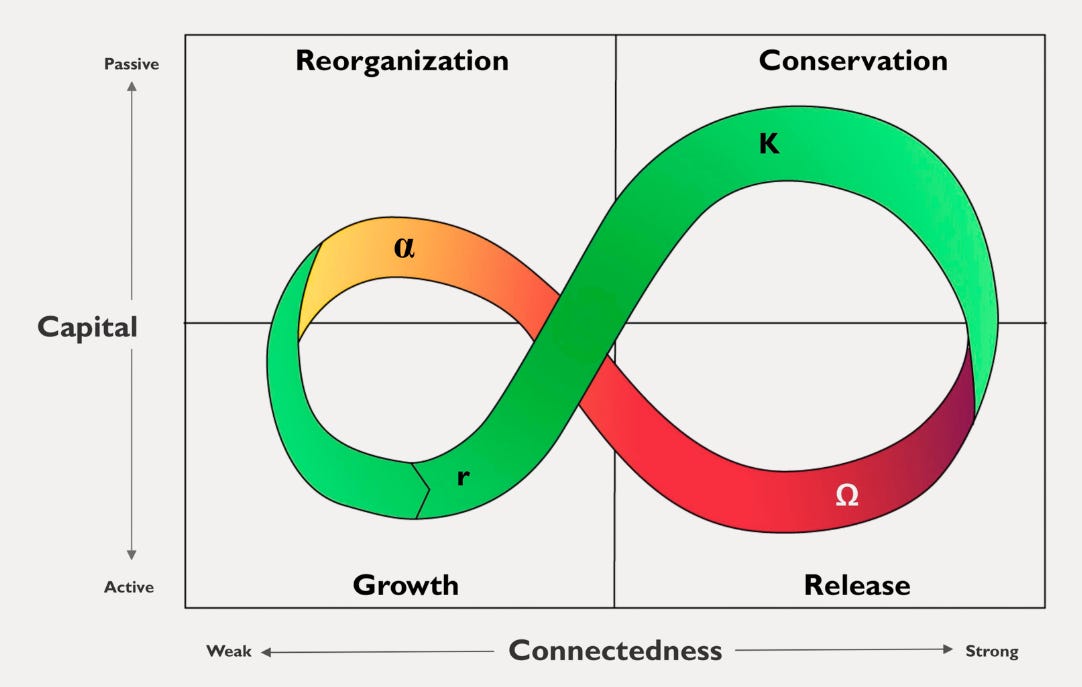
The cycle isn’t r → K → forever stable. It’s r → K → Ω → α → r again.
Release is part of the cycle, not a failure of the cycle.
Forests that never burn don’t stay healthy forever. They accumulate deadwood, lose diversity, and become brittle. When fire finally comes—and it always comes—the forest doesn’t renew. It collapses.
The Ω phase (release) isn’t optional. It’s necessary. The question isn’t whether it comes, but whether the system can use it.
Generative vs. destructive
Two companies face the same disruption: their core product becomes obsolete.
One restructures—painful, chaotic, but eighteen months later they’ve found a new market position. The other collapses. Same shock. Different outcomes.
Not all breakdown is generative. Some is simply destructive. What separates them?
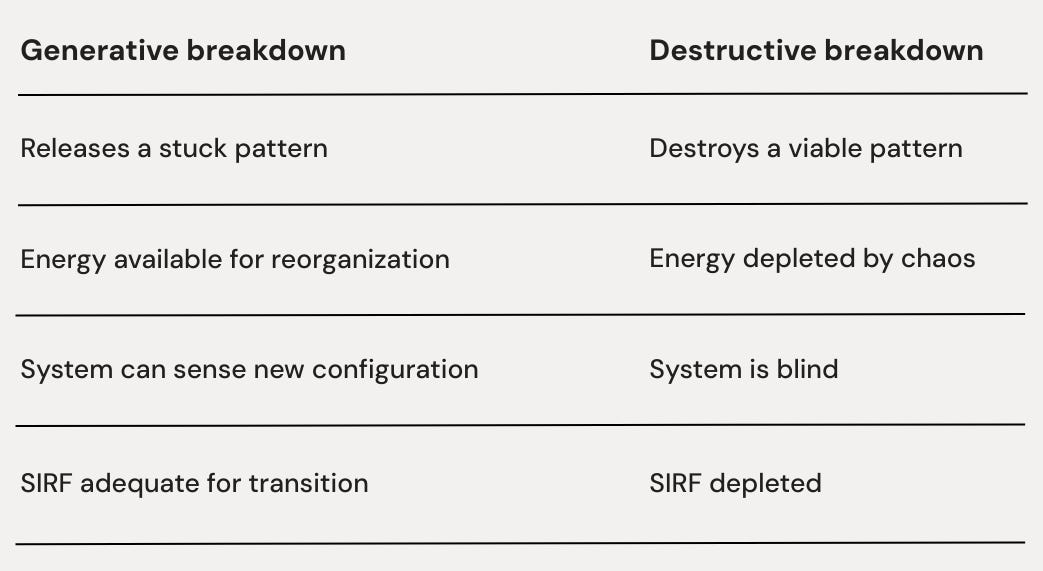
Let’s unpack each:
Releases stuckness vs. destroys viable
Generative breakdown releases a pattern that stopped serving the system—a regime being artificially sustained past its usefulness.
Destructive breakdown kills a pattern that still worked. Premature disruption, like clear-cutting a healthy forest to plant something “better.”
Energy available vs. depleted
Generative breakdown happens when the system still has reserves. The old pattern releases; energy flows toward the new.
A destructive breakdown occurs when reserves are gone—F, the foundational channel, has been drained, as it props up the old regime. Nothing left to fund what comes next.
Can sense vs. blind
Generative breakdown occurs when the system can still perceive possibilities—the I-function, your sensing apparatus, remains intact.
Destructive breakdown occurs when sensing is lost. The system can't find a new configuration because it can't see one.
SIRF adequate vs. depleted
Notice the pattern? Each row points back to the same thing. Reserves to fund transition: that’s F. Ability to sense what’s next: that’s I. Structure to hold the new configuration: that’s S. Relationships to coordinate the shift: that’s R.
SIRF isn’t one factor among four. It’s the underlying condition that determines whether breakdown builds or buries.
Same event. Different capacity at the moment it hits. That’s what separates transformation from collapse.
The SIRF threshold
This raises a practical question: how do you know if a system’s SIRF is adequate for the transition you’re facing?
You can’t measure it precisely. But you can probe it:
F: Do you have reserves, or are you already running on fumes?
S: Is there enough structure to hold things together while you reorganize, or will one shock scatter everything?
I: Can you still sense possibilities, or has exhaustion narrowed your vision to survival mode?
R: Are relationships strong enough to coordinate through chaos, or has trust already frayed?
If most answers point to depletion, breakdown is likely to destroy rather than transform. The disruption isn’t the problem. The timing is.
The change management trap
Most “change management” tries to prevent breakdown. Smooth transitions. Controlled rollouts. Minimize disruption.
This approach usually fails. The physics explains why.
Transformation requires the old regime to actually release. But change management tries to introduce the new while keeping the old running. The old regime never fully fails. So the new can never fully form.
It’s like trying to grow a new plant without clearing the ground. The old roots still occupy the soil. The new plant can’t establish.
Result: both patterns coexist awkwardly. The old regime, still operational, gradually reasserts itself. The change fails not because of resistance, but because the transition never finished.
This is why “managed change” so often reverts. The release phase was skipped. Without Ω, there’s no α.
Making instability generative
Not all breakdowns transform. What separates generative instability from destructive instability?
Four conditions show up consistently:
Maintenance was funded before crisis.
Systems that invest in maintenance during stable periods have capacity to navigate instability. Systems that run pure growth—all building, no upkeep—arrive at breakdown already depleted. The transition fund was never funded.
Failure was recognized before collapse.
When systems acknowledge regime failure early—maintenance costs exceeding returns, symptoms migrating faster than fixes—they enter breakdown with SIRF still intact.
When they deny failure until collapse forces the issue, SIRF is already exhausted from propping up the dead.
The old regime was allowed to die.
Systems that stop sustaining failed regimes free up energy for reorganization. Systems that keep holding things together delay transition without preventing it—and deplete the reserves that would have funded what comes next.
A direction existed.
Systems that enter breakdown with even an approximate sense of the new configuration can reorganize toward something. Systems that enter breakdown with no orientation experience chaos without resolution—release without reorganization.
These aren’t recommendations. They’re the variables that predict outcomes.
When researchers study post-crisis trajectories—companies after disruption, ecosystems after fire, individuals after trauma—these four factors keep showing up. The event doesn’t determine the outcome. The conditions (and capacity) at the moment of the event do.
What comes next
If breakdown can be generative, we need better tools for detecting when it’s happening. How do you recognize regime failure before collapse? What signals distinguish “struggling but viable” from “failed and extracting”?
That’s the next post.
Application
Notice: Is something in your life currently destabilizing? Rising variance, conflict, surprises, things not working like they used to?
Name: Is this the release of a dead pattern or damage to a viable one? Check your SIRF—do you have reserves, structure, sensing, and relationships to navigate what’s coming?
Test: If SIRF is adequate, instability should produce new patterns within weeks or months. If SIRF is depleted, instability produces dissolution—loss without reorganization.
Remember: SIRF health at the moment of breakdown determines whether breakdown transforms or destroys. The same disruption can renew one system and end another. Build SIRF before you need it.
The science
Established:
Dissipative structures emerge through instability (Prigogine, Nobel Prize)
Adaptive cycles include release phase (Holling’s panarchy framework, validated in ecology)
Post-traumatic growth is real (psychology—some people emerge from crisis stronger)
Genesis claim:
SIRF health predicts whether breakdown is generative or destructive
Falsification:
Systems with adequate SIRF at breakdown should transform; systems with depleted SIRF should collapse. If SIRF at transition doesn’t predict outcome, the framework fails.