



The stakes
If potential is boundary-emergent, then every institution, market, school, and city is doing one thing underneath its stated purpose: generating potential—or failing to.
Education generates potential when students encounter ideas and mentors that expand what’s reachable. Markets generate potential when buyers meet sellers, problems meet solutions, ideas meet capital. Cities generate potential through collision density—diverse people in high-frequency contact.
Everything we build is encounter architecture. And encounter architecture determines how much potential emerges at scale.
Here’s what’s at stake: we’ve been building civilization’s encounter architecture for millennia. We optimized for survival, efficiency, control. We didn’t optimize for potential generation—because we didn’t know that’s what we were doing.
The result: unrealized potential at every scale. Not because people lack capacity, but because the architecture blocks, hoards, or wastes the boundaries that would generate it.
What structures actually do
Beyond their stated purposes, human structures are potential generator machines. Or they’re supposed to be.
Education shouldn’t be primarily about content delivery. To generate more student potential, they should engineer encounters—shaping which minds meet which ideas, which students meet which mentors, which collaborations form.
The content is almost beside the point; it’s available in libraries and online. What schools provide are structured encounters: gradient (challenge calibrated to capability), complementarity (teachers matched to students), and bandwidth (sustained, high-trust interaction).
When education generates potential, students leave with expanded possibility spaces—not just new capabilities and new connections. Most importantly, students gain futures that weren’t available before.
When education fails: students acquire credentials, maybe some capacity. They pass through the system without boundary encounters that actually expand what’s possible. The architecture processed them without generating potential.
Markets aren’t primarily resource allocators. They’re boundary creation engines. Markets generate encounters that wouldn’t otherwise happen: buyer meets seller, problem meets solution, idea meets capital. The price mechanism is an encounter quality filter—it surfaces complementarities and enables high-bandwidth transactions.
When markets generate potential: new value emerges that neither party could create alone. Exchange creates more than it consumes.
When markets fail: monopolies kill gradients. Information asymmetry destroys complementarity. Transaction costs strangle bandwidth. The architecture extracts rather than generates.
Cities aren’t primarily infrastructure. They’re encounter density engines. Cities work because they concentrate diverse people in high-frequency collision.
The coffee shop, the conference, the chance meeting—cities generate gradient (different kinds of people), complementarity (specialization enables exchange), and bandwidth (proximity enables frequency).
When cities generate potential, innovation clusters form. Ideas collide. Careers launch. The density creates more possibilities than any individual could access alone.
When cities fail, they become sorting machines—separating people into homogeneous pockets where everyone already thinks alike. Gated communities. Echo chambers. Boundary starvation disguised as order and safety.
Organizations aren’t primarily capability containers. They’re encounter architectures that determine whether the people inside access boundaries that generate potential—or get trapped in reconfiguration loops with the same colleagues, same problems, same thinking.
When organizations generate potential, people grow. Teams develop capabilities they didn’t have. The whole becomes more than the sum.
When organizations fail, people plateau. Talent stagnates. The architecture maintains itself while the humans inside slowly starve for boundaries.
The frame shift
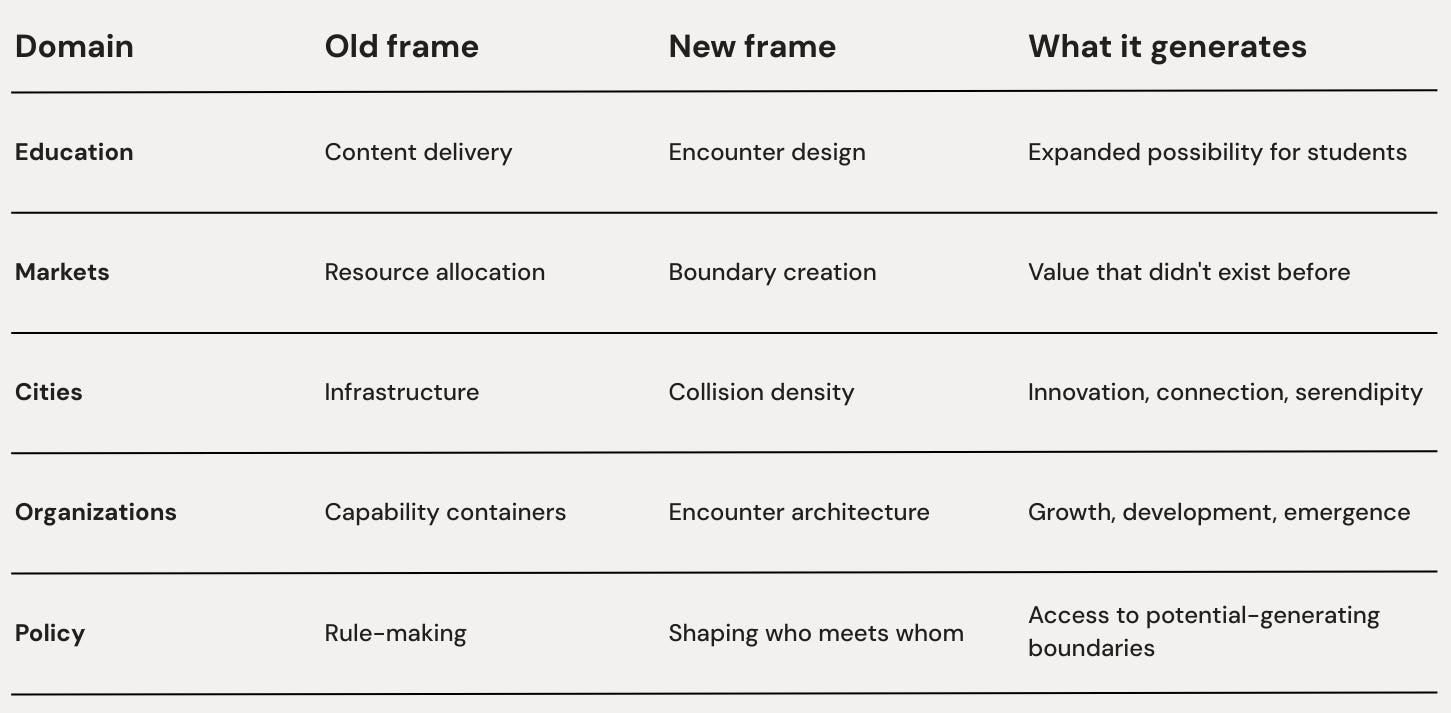
In every case, the question isn’t: “Is this efficient?”
It’s: “Is this generating potential?”
What we’ve been getting wrong
We’ve been measuring the wrong things.
In education: We measure content mastery—test scores, grades, credentials. We should measure potential generation: did this student’s possibility space expand? Can they reach futures they couldn’t reach before?
In markets: We measure efficiency—price discovery, transaction volume, GDP. We should measure boundary creation: is the market enabling encounters that generate new value? Or just redistributing existing value?
In cities: We measure infrastructure and services. We should measure encounter quality: how many potential-generating collisions happen per unit of time and space? Is density creating boundaries or walls?
In organizations: We measure output and efficiency. We should measure potential generation: are people in this organization accessing boundaries that expand what’s possible? Or are they boundary-starved, recycling the same inputs?
We’ve been building encounter architecture without knowing what we’re building. And because we don’t see it, we optimize for the wrong thing—and waste potential at scale.
The unrealized potential crisis
This isn’t just inefficiency. It’s a crisis.
Every blocked boundary becomes potential that never emerges.
Every sorting mechanism that separates people into homogeneous groups destroys collision density.
Every institution that processes people without expanding their possibility space is a generation engine running empty.
The scale is staggering.
How many breakthroughs never happened because the people who could have collaborated never met? How many capabilities never developed because the encounters that would have generated them were blocked by geography, economics, or institutional design? How many lives plateaued not for lack of capacity, but for lack of boundaries?
We can’t count the counterfactuals. But we can see, even feel, its shadow: talent clusters in a few cities while regions starve. Innovation concentrates in elite networks while the rest recycle. Capacity exists everywhere; potential-generating boundaries don’t.
Unrealized potential isn’t just sad. It’s the central problem.
The destabilization physics
There’s a harder edge to this.
When you create pockets of high encounter density—elite institutions, innovation clusters, wealthy networks—surrounded by boundary-starved regions, you create steep gradients at the edges.
Physics predicts what happens next:
Brain drain: Talent migrates toward the pockets. Boundary-starved regions lose capacity, reducing their ability to generate potential and accelerating the drain.
Capital concentration: Resources follow talent. Gradients steepen. The pockets get richer in boundaries; the surroundings get poorer.
Pressure buildup: Blocked gradients don’t disappear. They build pressure. If generative encounters aren’t available, extractive ones emerge. Informal economies, black markets, substitute pathways—the energy has to go somewhere.
Systems that block potential generation don’t just fail to thrive. They generate instability.
This isn’t just a moral argument. It’s physics. And predictable with right measures.
The opportunity
Survival got us here. We built institutions that fed billions, connected continents, and extended lifespans. If the goal was survival, job done.
But survival isn’t thriving.
Thriving requires the generation of potential—at scale, sustainably, without destroying the field. And now that we can see civilization as encounter architecture, we can finally ask the right questions:
Is this institution generating potential or wasting it? Not “is it efficient?” Not “is it compliant?” Is it creating boundaries that expand what’s possible for its citizens?
Is this policy creating boundaries or blocking them? Every regulation, every incentive, every rule shapes who encounters whom. What encounters does this policy enable? What encounters does it prevent?
Is this city a collision field or a sorting machine? Density alone isn’t enough. Is the density creating a gradient, complementarity, or bandwidth? Or is it creating walls?
Is this organization developing its people or starving them? High performers can plateau in boundary-poor environments. The architecture determines whether capacity finds the encounters that generate potential.
We can design for encounter quality. We can measure what matters. We can intervene at the right level.
The crisis is unrealized potential—capacity that never met the right encounters.
We can build for thriving. Not just surviving. Not just efficient. Generative.
The handoff
This completes Series 1.
You now know where potential comes from: boundaries.
You know that access isn’t enough—boundaries need gradient, complementarity, and bandwidth. You know the physics underneath each factor.
You know that civilization is encounter architecture, and encounter architecture determines potential generation at scale.
But there’s something we haven’t addressed. Even a perfect boundary—optimal gradient, ideal complementarity, high bandwidth—can fail to convert. The potential emerges, but you can’t metabolize it. You lack the capacity, like a 4-year-old trying to understand physics.
What determines whether you can show up at a boundary ready to convert?
That’s Series 2: The physics of existence.
Application
Notice: Pick one system you’re inside—workplace, community, city, or a school.
Name: Is it generating potential (expanding what’s possible for people inside) or wasting it (processing people without boundary encounters)?
Test: If you redesigned for encounter quality—gradient, complementarity, bandwidth—would you predict step-change improvement in outcomes, independent of resources or effort?
The claim: Civilization is encounter architecture. Encounter architecture determines how potential is generated at scale. We’ve built it blind—optimizing for survival and efficiency—not for thriving. The crisis is unrealized potential. The opportunity is building for generation.
The science
Established:
Network structure affects outcomes. This is established in network science.
Social capital predicts development. Access to high-quality relationships predicts life outcomes across domains.
Agglomeration effects drive innovation. Cities and clusters outperform dispersed populations.
Genesis claim:
“Encounter architecture” as the unifying frame. Everything we build shapes potential generation—and we should design, measure, and optimize for it.
Falsification:
Encounter quality variables should predict development outcomes after controlling for resource inputs. If resources alone predict, and encounter structure adds nothing, the frame is unnecessary.
Series 1 complete.
Next: Series 2 — The physics of work