



Where we are
Series 1 established something counterintuitive: potential doesn’t live inside you; it emerges at boundaries, generating new reachable futures.
We mapped what makes boundaries generative:
Gradient: difference that can do work
Complementarity: fit that enables exchange
Bandwidth: channel capacity for the exchange
Then we landed on a big claim: civilization is encounter architecture.
Everything we build—schools, markets, cities, organizations—shapes who encounters whom. That architecture determines how much potential gets generated or wasted at scale.
But there’s a gap in the picture.
The conversion problem
Potential emerges at boundaries. Great. But emergence isn’t conversion.
You’ve experienced this. The opportunity appeared—the right mentor, the perfect collaboration, the door that opened. And somehow, you couldn’t convert it. The potential was real. It emerged. And it passed you by.
Or the opposite: someone else faced the same boundary and transformed. Same opportunity, different outcome.
What’s the difference?
The difference is what you brought to the boundary.
Boundaries offer. You convert.
Series 1 covered what boundaries provide: gradient, complementarity, bandwidth. That’s the supply side—what’s available at the encounter.
Series 2 covers the demand side: what you bring. Your ability to show up at a boundary and actually convert what it offers.
This isn’t motivation or mindset. It’s physics. Conversion requires work—thermodynamic work. And work requires a system capable of doing it.
What kind of system? What does it need to show up ready? What determines whether potential converts or passes by?
That’s what we’re building now.
The question Series 2 answers
What does organized complexity require to exist—and to show up at boundaries capable of converting?
We’ll find that organized systems need four types of work, always:
F (Foundational): Energy to power everything else
S (Structural): Boundaries that hold the pattern together
I (Informational): Sensing, processing, modeling, updating
R (Relational): Exchange channels across boundaries
These four—SIRF—are what you bring to encounters. They determine your conversion capacity.
We’ll also find:
Your weakest function sets your ceiling (bottleneck principle)
Energy flows in three directions: growth, maintenance, clearing
What you say you’re doing often isn’t what you’re actually doing (alignment)
Each function requires all four to operate (recursive depth)
By the end of Series 2, you’ll have a diagnostic frame: when conversion fails, which function failed? When you’re stuck, what’s actually the constraint?
The map so far
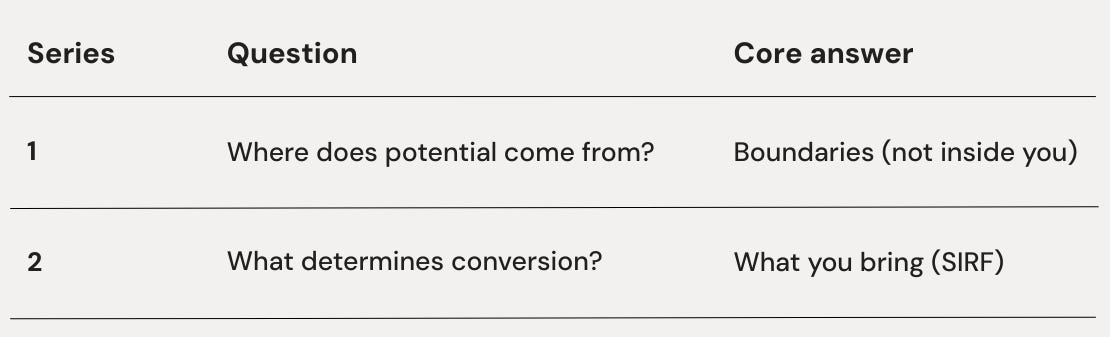
Series 1 was about supply: what boundaries offer.
Series 2 is about demand: what you bring to convert it.
Together, they explain why high-potential situations sometimes produce nothing (you lacked conversion capacity) and why capable people sometimes stagnate (they’re boundary-starved).
Let’s build the demand side.