


The ship of Theseus, everywhere
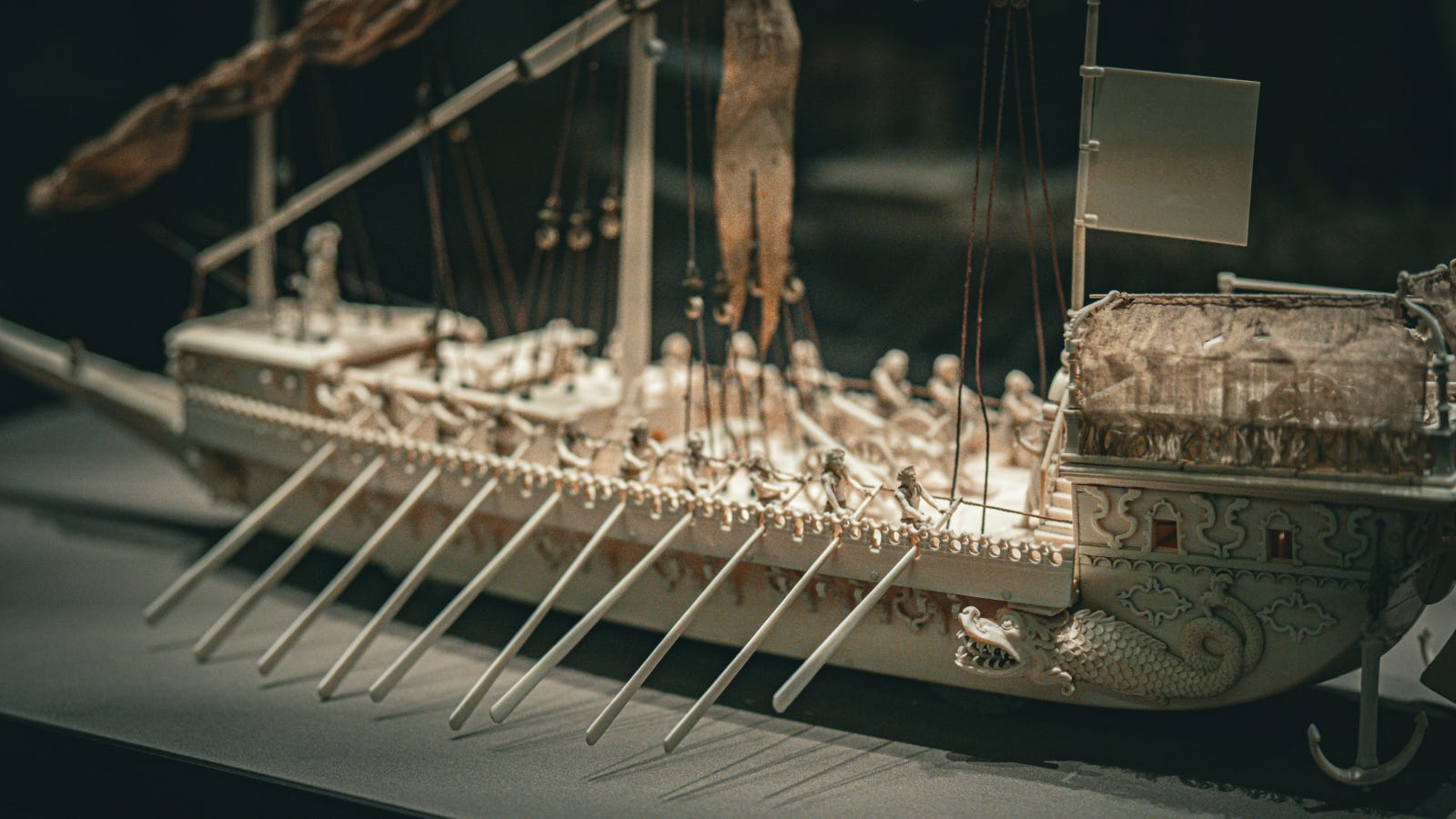
Ancient Greeks preserved a famous ship in harbor. Over time, each plank rotted and got replaced. Eventually, every single plank had been swapped out.
Is it still the same ship?
If someone collected all the old planks and rebuilt the original configuration—which one is the “real” Ship of Theseus?
This is Theseus’s Paradox. Philosophers have debated this for millennia. But it’s not just a thought experiment. It’s happening to you right now.
Your body replaces most of its atoms every few years. Red blood cells last about four months. Skin cells, a few weeks. The atoms in your bones swap out over a decade. By any material measure, you’re not the same stuff you were ten years ago.
Yet something persists. You’re still you.
A company is even more dramatic. Employees leave and join. Products change. Strategies pivot. The office moves. Revenue fluctuates. Over twenty years, nearly everything that constitutes the company has turned over.
Yet something persists. The company is still there.
How? What holds organized things together when their material keeps changing?
This isn’t a philosophical puzzle. It’s a physics question. And it has an answer.
Schrödinger’s question
In 1944, the physicist Erwin Schrödinger asked: How does life resist entropy?
The second law of thermodynamics says that disorder increases. Systems tend toward equilibrium—toward maximum entropy, maximum randomness, the even distribution of energy. A cup of hot coffee cools. A sandcastle erodes. A corpse decays.
Living things do the opposite. They maintain low entropy. They stay organized. They resist dissolution.
How?
Schrödinger’s answer: by eating order.
Living systems aren’t closed. They’re open. They take in low-entropy inputs (food, sunlight) and expel high-entropy outputs (heat, waste). They maintain internal order by exporting disorder to their environment.
If we persist by eating order, we persist by excreting disorder. Block either end—intake or output—and the system dies. This isn’t just about getting energy in. It’s about maintaining the gradient: order in, disorder out.
This isn’t magic. It’s thermodynamics. You stay organized by continuous throughput. Stop the flow, and you dissolve. The second law wins eventually—but life delays it through continuous exchange.
The F function
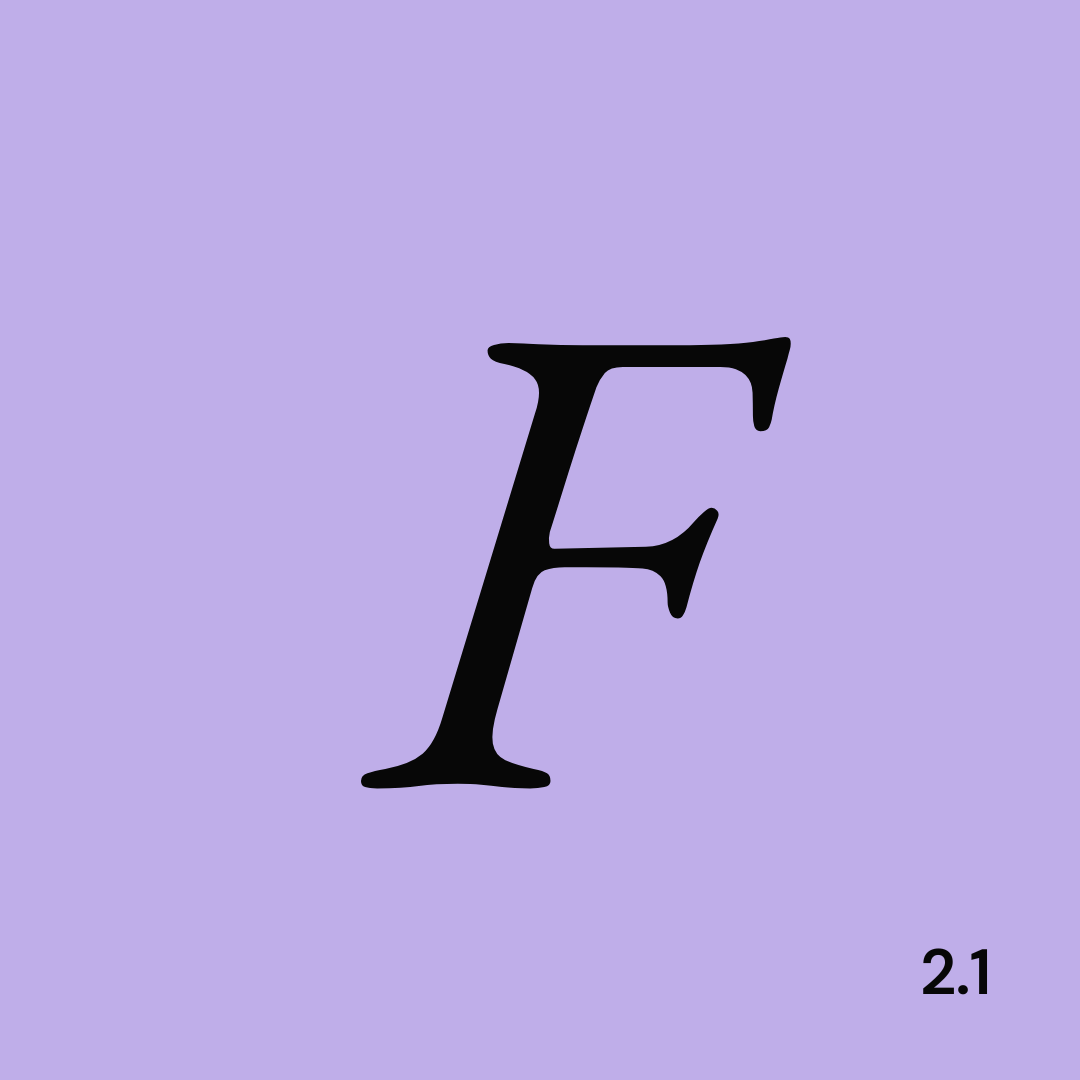
This is the first of four types of work that organized systems must do. We’ll call it F—Foundational work.
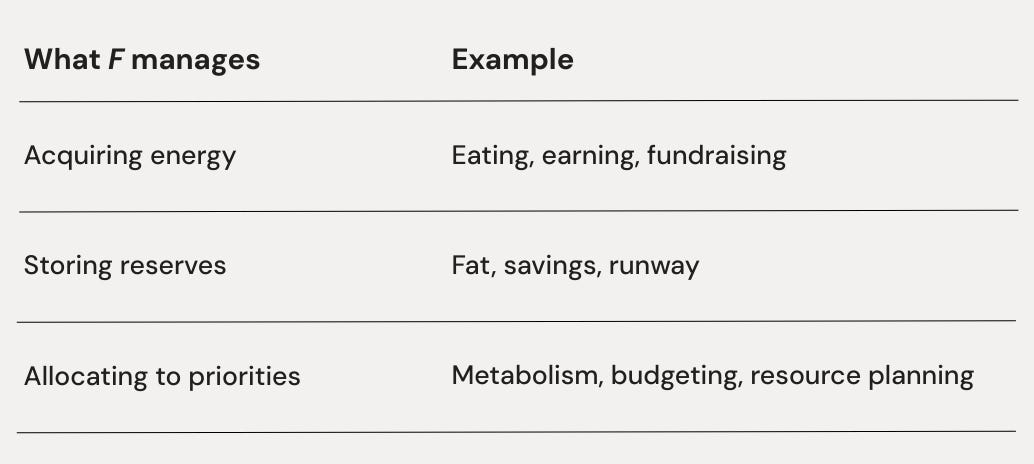
F is the substrate everything else runs on. It manages energy throughput: acquiring, storing, and allocating the free energy that powers all other work.
Not all energy is usable.
Gibbs distinguished between total energy and free energy—the portion available to do work. A system might have plenty of energy in some form but lack enough free energy to actually use it. (This is why you can be surrounded by food but starve if you can’t metabolize it. A company can have “energy” in assets but no usable free energy in cashflow.)
F-work is about free energy: acquiring it, storing it, allocating it. Without adequate F, a system dissolves. Not immediately—reserves can buffer for a while—but inevitably, it fails.
Lineage
Gibbs: Free energy determines work capacity. Not all energy is usable—only energy available under constraints.
Schrödinger: Life is far-from-equilibrium, maintained by continuous throughput. Stop the throughput, system returns to equilibrium (death).
Prigogine: Dissipative structures—hurricanes, cells, companies—are organized patterns maintained by energy flow.
Pattern: organized complexity requires continuous energy throughput. No free lunch.
Across scales
F-work looks different at different scales, but the function is the same:
Cell: ATP synthesis, metabolic reserves. The cell acquires energy through respiration or photosynthesis, stores it in molecular bonds, allocates it to cellular processes. Starve a cell of nutrients, and it dies.
Individual: Sleep, nutrition, financial reserves. You acquire energy through eating and rest, store it in body fat and bank accounts, allocate it through metabolism and spending. Run out of either biological or financial F, and you dissolve as an organized system.
Team: Budget, time allocation, capacity planning. The team needs resources—money, attention, hours—acquired from somewhere, stored against fluctuation, allocated to priorities.
Organization: Cash flow, capital reserves, resource planning. Companies that run out of F go bankrupt. It doesn’t matter how good their strategy is or how talented their people are. No F, no company.
Civilization: Energy infrastructure, economic reserves. Civilizations run on energy—calories, then coal, then oil, then whatever comes next. The collapse of civilizations often traces to energy constraints: soil exhaustion, resource depletion, infrastructure failure.
Same function, different implementations. F is universal.
What F is not
F is necessary but not sufficient.
What I mean is, energy keeps things from dissolving, but energy alone doesn’t determine what persists.
A pile of money without organization is merely a pile.
Calories without structure produce chaos, not life.
Think about a hurricane. It’s a dissipative structure—organized by energy flow. But the organization isn’t just energy. It’s a pattern that maintains itself through that energy flow.
What maintains the pattern? We’ll cover that in 2.2.
Here’s what matters. F provides the substrate—the energy flow that powers persistence. Something else provides the form.
The first constraint
Here’s what we can say so far:
Organized systems require continuous F (Foundational work). Without acquiring, storing, and allocating free energy, systems dissolve. This is thermodynamics, not opinion.
But this raises a question. Energy keeps things going—but going as what?
A hurricane and a human both require energy throughput. But they’re organized very differently. What determines the structure that energy maintains?
That’s the subject of the next post.
Application
Notice: What resource keeps your system alive right now—sleep, food, cashflow, attention, bandwidth?
Name: Are you throughput-stable (inputs cover outputs) or reserve-burning (surviving on stored energy)?
Test: If inputs stopped for 30 days, what fails first? That’s your F bottleneck.
Remember: Organized systems require continuous free-energy throughput. Without Foundational work (F), systems dissolve—not immediately, but inevitably.
The science
Established:
Life requires continuous energy throughput. This is Schrödinger’s insight, validated across all living systems.
Free energy determines work capacity. This is Gibbs’s contribution, foundational to thermodynamics.
Genesis claim:
F is one of four necessary work functions for organized complexity.
Falsification:
F-deprivation should predict dissolution rate. Systems losing F should dissolve faster than systems maintaining F, controlling for other factors.