


The hurricane and the company
A hurricane is organized chaos. Energy flows in from warm ocean water. A pattern forms—the spiral, the eye, the rotation. The pattern persists through continuous energy flow.
A company is similar. Resources flow in. A pattern forms—hierarchy, departments, processes, roles. The pattern maintains itself through continuous resource throughput.
Both are dissipative structures. Both require energy to exist. But here’s the question: energy keeps the system going, but what keeps it organized?
Pump energy into a random system, and you get chaos, not a hurricane. Give money to a random group of people, and you get spending, not a company.
Something else determines the structure that energy maintains.
Structure isn’t free
We tend to think of structure as static—once built, it stays. A building doesn’t need constant attention to remain a building. A rule, once established, persists.
But that’s an illusion created by slow decay.
Buildings require maintenance. Leave one alone for fifty years and watch what happens. The roof leaks. The foundation cracks. Plants invade. Eventually, the building is gone.
Rules require enforcement. A rule that’s never applied isn’t really a rule. Stop paying attention, and exceptions multiply until the rule exists only on paper.
Organizations require constant structural work. Roles need to be defined and defended. Processes need to be maintained. Boundaries between departments must be enforced.
Structure isn’t static. It’s actively maintained. The moment you stop doing structure-work, structure begins to dissolve.
The S function
This is the second type of work organized systems must do. We’ll call it S—structural work.
S-work is everything involved in maintaining organization:
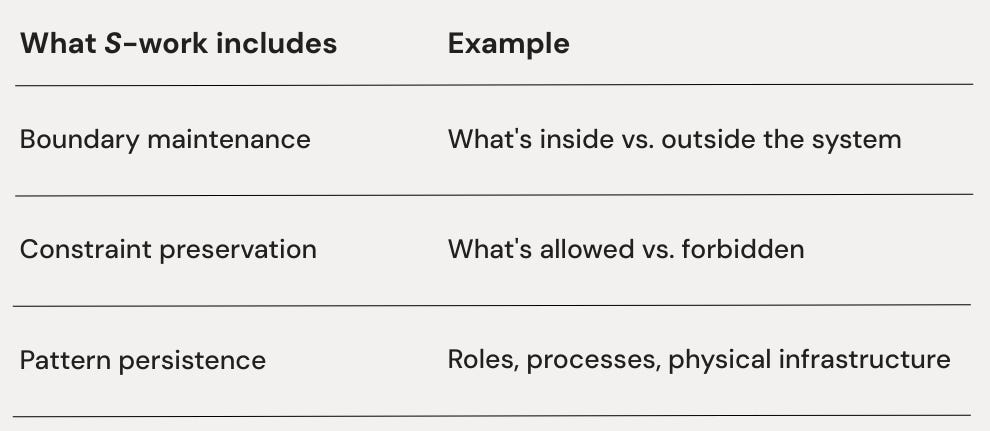
S-work isn’t “more rules.” It maintains clarity—sometimes by removing rules that create confusion. Structural work can mean clearing as much as adding.
F provides energy. S determines what that energy maintains.
Think of S as the skeleton that energy flows through. Without S, energy dissipates randomly. With S, energy maintains a specific pattern.
Lineage
Bertalanffy: Open systems maintain organization through exchange, but organization itself requires active maintenance.
Simon: Hierarchy enables complexity. Complex systems are modular—but modularity must be maintained.
Prigogine: Dissipative structures are patterns of flow, not static things. The pattern must be preserved against perturbation.
Pattern: organized complexity requires continuous structural maintenance.
S vs. F: the difference
F and S are both necessary. They’re not the same thing.
F is about energy throughput—acquiring, storing, allocating resources.
S is about what those resources maintain—boundaries, constraints, patterns.
You can have plenty of F and lose S. A company with money but no organizational structure—no clear roles, no processes, no boundaries—will dissolve into chaos despite adequate resources.
You can have strong S and lose F. An organization with beautiful structure but no funding will collapse just as surely—but it collapses in an orderly way, like a skeleton without muscles.
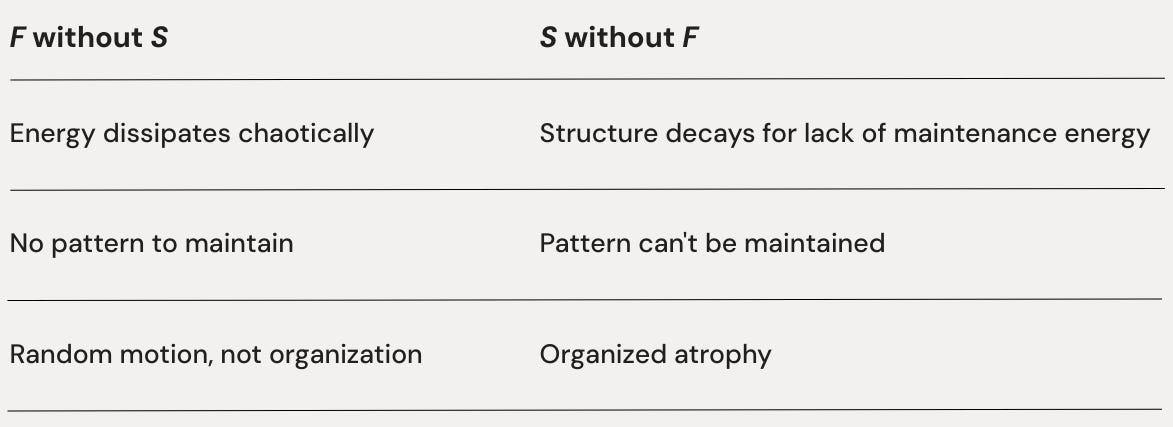
Both fail. The failure modes are different. Money can’t compensate for structural ambiguity. It just funds faster confusion.
Across scales
S-work looks different at different scales:
Cell: Membrane integrity, cytoskeleton. The cell maintains a boundary (what’s inside vs. outside), internal structure (organelles in their places), and functional constraints (what molecules can go where). Lose membrane integrity and the cell dies—even with plenty of ATP (Adenosine triphosphate (ATP) is the source of energy for use and storage at the cellular level.)
Individual: Habits, routines, physical health. You maintain boundaries (what’s you vs. not-you), patterns (daily routines, behavioral habits), and constraints (what you will and won’t do). Chronic structural neglect—no routines, no boundaries, no constraints—produces chaos even with adequate energy.
Team: Roles, processes, decision rights. The team maintains who does what, how work flows, and who decides. Ambiguous roles, undefined processes, unclear decision rights—these are S-failures. The team has energy but doesn’t know what to do with it.
Organization: Hierarchy, departments, policies. The organization maintains reporting structures, functional boundaries, and procedural rules. Reorgs are S-work. Policy enforcement is S-work. Most “management” is S-work.
Civilization: Institutions, laws, infrastructure. Civilizations maintain legal structures, political boundaries, and physical infrastructure. When institutions weaken, laws go unenforced, infrastructure crumbles—that’s S-failure at civilizational scale.
The invisible load
Here’s the trap: S-work is invisible when it’s working.
When roles are clear, you don’t notice them. When processes work, you just do them. When infrastructure functions, you take it for granted. S-work only becomes visible when it fails—when confusion erupts, when systems break, when the structure that held things together suddenly doesn’t.
This makes S-work chronically underfunded. It produces no visible output. It just prevents bad things from happening. And humans are terrible at valuing prevention.
We’ll return to this in Post 2.7 (Where Your Energy Goes). For now, notice: structural maintenance is real work, it costs real energy, and it’s systematically undervalued because its product is invisible.
Two functions down
We now have:
F-work: Energy throughput—acquiring, storing, allocating resources
S-work: Structural maintenance—boundaries, constraints, patterns
F keeps things from dissolving. S determines what stays organized.
But something’s missing. A system can have energy (F) and structure (S) and still fail catastrophically. Why? Because it didn’t see the cliff coming.
What lets a system know what’s happening?
Application
Notice: Where do you see recurring confusion—roles, priorities, decision rights, boundaries?
Name: Is it a boundary failure (unclear inside/outside), a constraint failure (unclear what’s allowed), or a pattern decay (processes breaking down)?
Test: If you clarified one boundary or constraint this week, would it reduce friction more than adding effort or resources?
Remember: Structure isn’t static—it’s actively maintained. The moment you stop doing structure-work, structure begins to dissolve.
The science
Established:
Dissipative structures require continuous maintenance. This is Prigogine, validated across physics, chemistry, and biology.
Hierarchy enables complexity. This is Simon, foundational to organizational theory.
Genesis claim:
S is one of four necessary work functions for organized complexity.
Falsification:
S-work reduction should predict structural dissolution independent of F. Systems maintaining F but neglecting S should lose organization.