



I’m scrolling LinkedIn the week after the 2026 Winter Olympics. Eileen Gu just took three medals at Milano-Cortina: silver in slopestyle, silver in big air, and gold in the halfpipe.
Six Olympic medals total. The most decorated freestyle skier in history. Oh, and by the way, she’s 22.
Everybody’s talking about this video:
As usual, my feed does what my feed always does and here comes the ‘mindset’ barrage.
That’s why you have to believe in yourself.
This is what a growth mindset looks like.
She visualized this moment.
Post after post. Everyone races to extract the lesson, and the lesson is always, plus or minus, the same. She believed, and therefore she became.
Here’s the thing—what Gu actually said was more interesting than what anyone posted about her.
She’s not saying believe in yourself. She’s describing something far more specific.
“Yes, I think a lot. But it’s not really in an egotistical way. It’s in a tinkering, like a scientist way. I’m always trying to modify. I’m trying to think, how can I be better? How can I approach my own brain the way that I approach my craft of free skiing? So that I can be better tomorrow than I was today.”
Then Fortune ran: “She rewires her brain daily to be more successful.” Arianna Huffington endorsed the framing. Coaching accounts repackaged the quote with sunrise backgrounds and the implicit promise: you can do this too.
And look—neuroplasticity is real. Journaling works. Nothing Gu said was wrong.
But not one of those posts or headlines asked how she learned to think that way. Or who built the conditions that made that kind of thinking possible, long before she could choose any of it.
Potential doesn’t live inside people
There’s an assumption underneath almost every one of those LinkedIn posts:
Potential lives inside people.
Talent, drive, mindset sit dormant within us, waiting for the right moment to be unlocked.
But there's a different premise—one grounded in thermodynamics, information theory, and dynamical systems that doesn’t get much attention:
Potential is generated at boundaries, where organized systems meet. It’s not unlocked, unleashed, or released because it’s not inside systems. 1
For example, a rock alone doesn’t become a tool, a weapon, or a home’s foundation. But the moment a human picks it up, something appears that neither carried alone—a new set of reachable futures. Things that could now happen that couldn’t before.
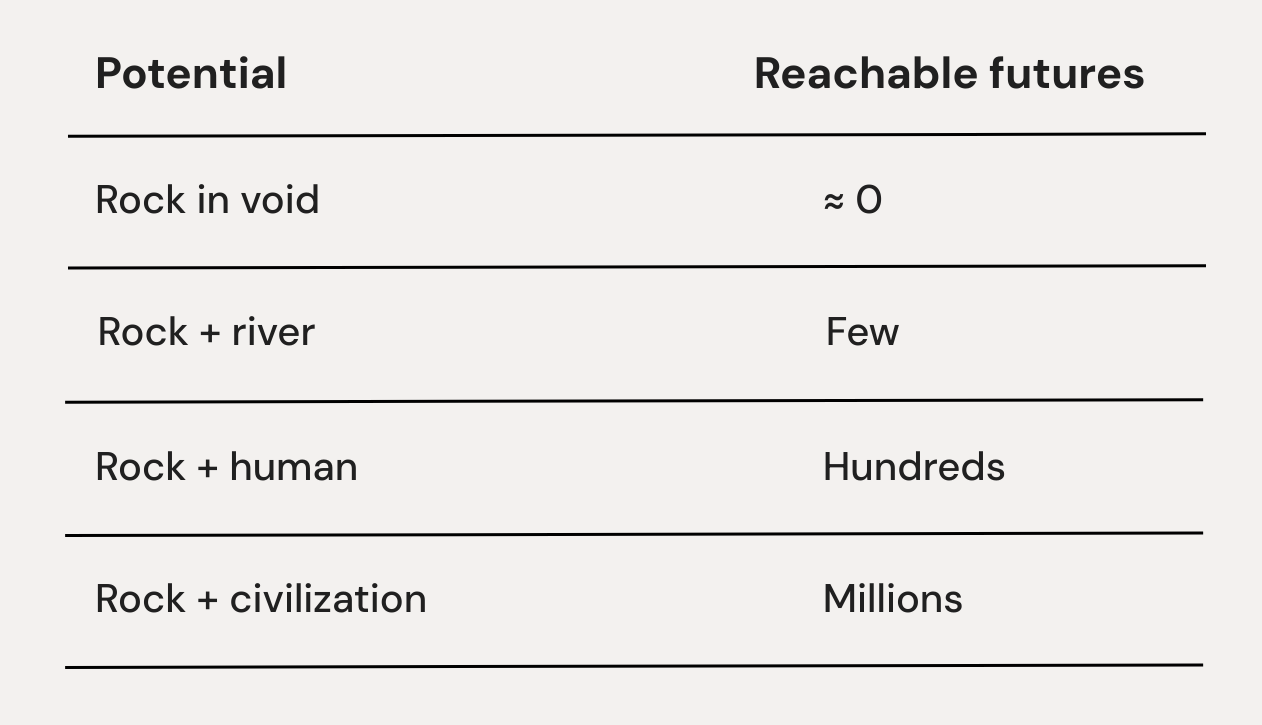
The potential didn’t hide inside the rock, waiting. It didn’t hide inside the human either. It shows up at the contact between them.
That rock in the hands of a toddler and that same rock in the hands of a mason don’t generate the same reachable futures. Why?
Because each brings a different gradient to the encounter.
The mason brings trained hands, a mental model of what the rock could become, and decades of stone experience that reveal what works. The toddler carries curiosity and grip strength.
It’s the same rock, but the mason meets it carrying a steeper gradient—and that steeper gradient generates more potential at the contact.
The physics puts it simply: available potential is a function of what meets, not what sits sealed inside.
Π — available potential
B — the boundary encounter
Φ — what the surrounding environment permits.
Every term in that equation requires contact.2
So the question changes. Not what did Eileen Gu have inside her? But what and who did she encounter?
The macro architect
If potential gets generated at encounters, then someone has to make the encounter happen. If you want to become fluent in Chinese, you either seek those encounters yourself—you fire up Duolingo, sign up for a class, or move to a country where the gradient swallows you whole—or someone else architects it on your behalf. They connect you to the right teacher, place you in the right environment, or build the bridge long before you need to cross it.
When you’re three years old, only one of those options exists.
Years later, Eileen described her mother this way: “My mom really inspired me growing up, mostly in her capacity to make things happen. It’s something I carry with me to this day.”
Capacity to make things happen. If potential appears at boundaries, then Mom, who “makes things happen,” isn’t just cheering from the sidelines. She’s built the encounters herself.
…
Yan Gu holds a chemistry degree from Peking University, a biochemistry master’s from Auburn, and an MBA from Stanford. She also competed on Peking University’s speed skating team. She worked in venture capital. She also holds a ski instructor certification.
That’s not a résumé. It’s a gradient inventory. Let’s take stock:
A scientist’s mind and method
An athlete’s training instincts
A venture capitalist’s nose for asymmetric bets
And the money, the credentials, and the contacts to run the experiment for a decade.
In 2003, she drove her three-year-old daughter four hours each way to a ski slope near Lake Tahoe. Then she did it again the following weekend. And the one after that.
Yan didn’t discover Eileen’s passion. She simply engineered a boundary encounter—placed a developing system (Eileen) in contact with a mountain, coaching, and a sport where feedback runs at the speed of impact. Three years old. She can’t choose or even consent. And yet the encounter that generated an Olympic champion had begun.

But here’s what separates Yan from a wealthy parent writing checks. She didn't just build one encounter. She watched what happened and when the architecture needed to change, she changed it.
The drive to Tahoe became unsustainable. Four hours each way taxes even the most dedicated mother. So she bought property near Tahoe. Then coaching hit a local ceiling. She put Eileen in the orbit of her Chinese professional network where Lu Jian, founder of Beijing's Nanshan Ski Resort, encountered her at nine and began sponsoring training trips to China. By her first Olympics, her coaching roster spanned three continents.
The financial architecture ran underneath all of it—coaching, travel, equipment, private school near $45,000 a year. Every door Eileen walked through had a price—and Yan kept them open for a decade.
Persistent proximity. Steep gradient. Feedback-responsive adaptation. Physics-y terms. Yet that’s what “capacity to make things happen” actually describes.
A quick note: I’m not making a “better parenting” or privilege argument. Privilege describes what someone has. What I’m describing is what happens when two systems meet. Plenty of wealthy parents write checks and produce no Olympians. Gradients don’t sit in bank accounts.
The micro architect
A machine that only runs on weekends doesn’t explain Eileen’s fluent Mandarin. Doesn’t explain the Beijing identity. Doesn’t explain the competitive philosophy Eileen carries in her language years later.
That gradient came from someone who showed up not on weekends but every morning.
Her grandmother.
…
Feng Guozhen. Born 1936, Nanjing. Jiaotong University engineering degree, 1955. She was among the first female engineering graduates in the People’s Republic. She participated in three varsity sports: basketball, soccer, and long-distance running. She retired, flew to San Francisco, and became Eileen’s daily caregiver from birth.
Yan built the macro architecture: encounters, funding, networks. Weekend-scale.
Feng built the micro architecture: language, meals, rhythm, and philosophy.
The machine needed both clocks running.
…
Feng insisted on Mandarin from birth. Taught Tang Dynasty poetry before Eileen could walk. Took her to Beijing every summer. In kindergarten, she taught her third-grade multiplication and told her, “Go compete with your classmates.”
Eileen grew up fluent in Mandarin with a Beijing accent, calling herself a “Beijing hutong girl.” That identity became the bridge she would eventually cross in 2019. Without it, Eileen arrives at her China decision as a monolingual American skier—and perhaps the state funding, the 23 brand partnerships, and the dual-market architecture don’t exist.
Did Feng understand the bridge she was building for Eileen? Maybe she was just speaking her language and raising her granddaughter the best way she knew how? But the yield was undeniable—even if it took fifteen years to reveal itself.
Don’t be second
Eileen’s competitive fire also traces closer to daily contact with her grandmother, who demonstrated it for twenty-two years.
Even past 86, Feng ran a kilometer daily and lifted Eileen’s Olympic medal as a dumbbell at 88. She didn’t describe competitiveness. She demonstrated it — and a three-year-old absorbs demonstrations the way a riverbed absorbs water. Not by deciding to. By being shaped through contact.
“Don’t be second.”
Seventh grade. Cross-country race. Eileen hears “Eileen Number One!”—even though she’s in second place. She turns around: her four-foot-eleven grandmother, standing among American parents, cheering her on in a language she barely speaks.
“I still don’t know how she did that.
But she planted a seed in me—wanting to be the best.”
Feng showed up as herself. Eileen didn’t expect what happened next. But a four-foot-eleven grandmother shouting her name from a crowd of American parents in a language she barely spoke shifted something in a twelve-year-old’s sense of what she could demand from the world. That shift didn’t exist until that moment created it.
A note: Eileen’s mother had a younger sister, Gu Ling, who died in a car accident shortly before Eileen’s birth. Eileen’s Chinese name—爱凌, or “love Ling”—memorializes the aunt she never met.
Eileen’s boundary analysis
Let’s watch what happens when you add boundaries—and when you take them away.
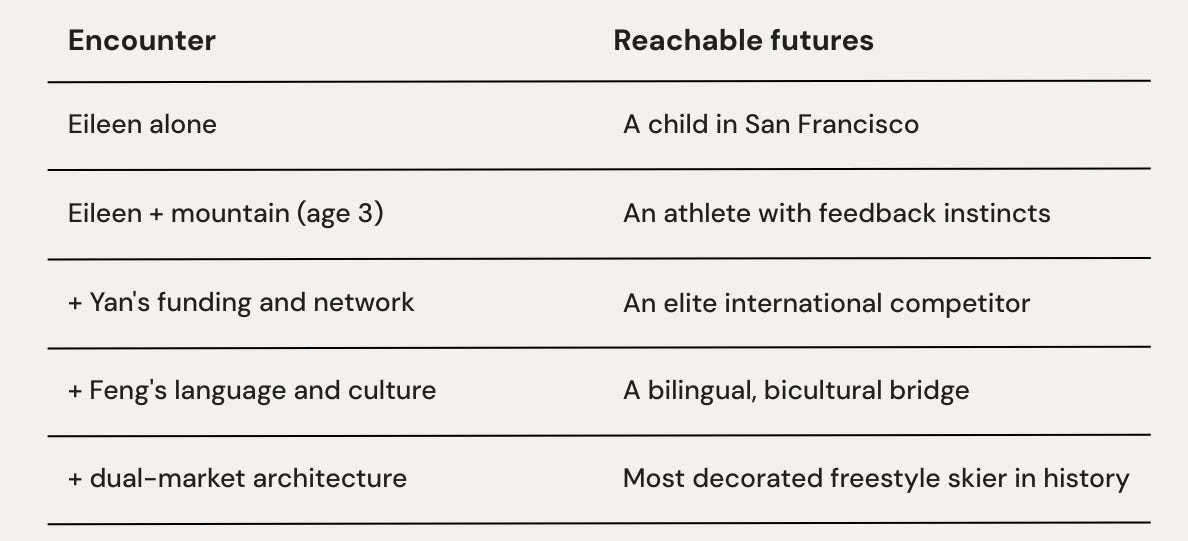
Each row added a boundary. Each boundary generated futures that didn’t exist in the row above. Now let’s reverse it:
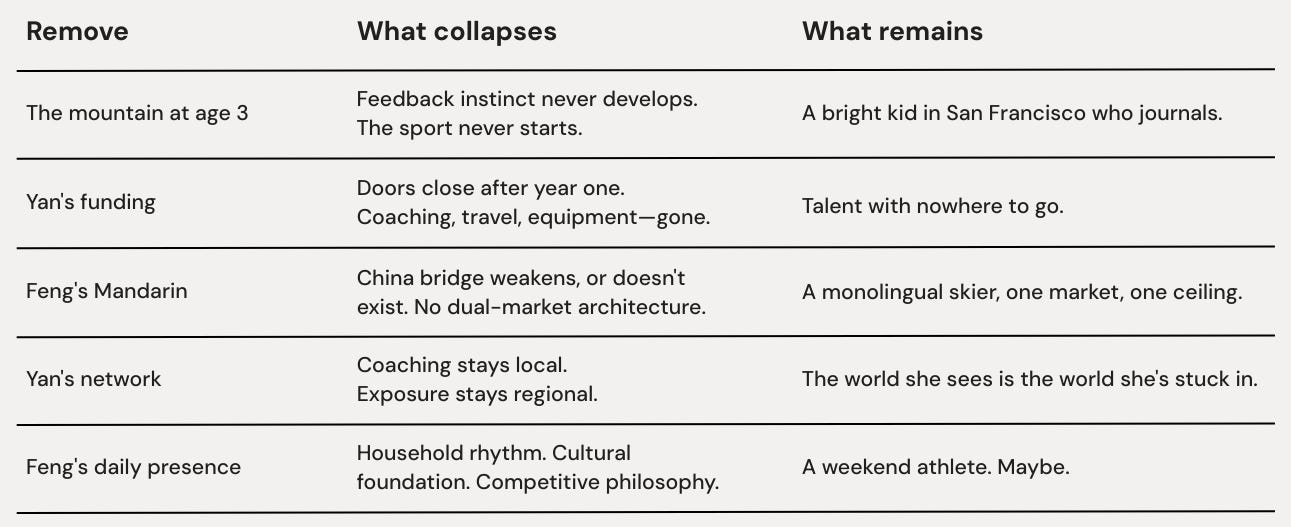
Again, this isn’t about privilege. Richard Williams wrote a 78-page plan for his daughters’ tennis careers before they were born, taught himself the sport, and built the architecture on public courts in Compton. Yes, it’s a much different gradient than Yan’s.
But the same physics applies: a parent engineering encounters on behalf of children who can’t architect their own yet. Futures vanish the moment the encounter breaks because they were never stored inside the person. They’re generated at the contact.
Eileen takes the wheel
For fifteen years, Eileen crossed boundaries that two women built. There’s a difference between the two roles. Crossing a boundary means showing up and converting what the encounter generates—that’s the athlete’s work, and it’s real.
Architecting a boundary means deciding which encounters exist in the first place: who meets what, carrying how much, at what moment. Yan and Feng architected. Eileen crossed. And you can’t architect your own boundaries until someone else has built enough of them for you to develop the capacity to see what’s possible.
Then Eileen started building her own.
In 2019, she switched competitive nationality to China—one of the first major encounters she architected for herself. One country needed a credible star for its home Olympics. One athlete held dual fluency and elite results.
Potential generated:
State funding of roughly $14 million over three years
Twenty-three brand partnerships
Endorsement income estimated at $23 million per year 3
A two-way gradient bridge—valuable to Chinese brands because she read as Western, valuable to Western brands because she opened China.
That $23 million didn’t live inside Eileen. It appeared at the interface between her profile and a market’s appetite for a bilingual, Olympic, Western-legible star. Change either side and those numbers change.
Notice that Eileen’s agency arrived later. Not first. The journaling, the self-modification, the “I can literally become exactly who I want to be”—that’s all real. But came much later. Mindset entered a system that two women had spent fifteen years building up.
What the mindset story can’t see
I’m not trying to disprove the role of mindset. I’m scoping it.
Dweck’s growth mindset research studied populations where funding, structure, and access already ran above threshold. Its primary bottleneck sat in belief, so updating belief to a “growth mindset” should move the needle. Then it generalized into populations where everything else was the bottleneck—and the needle barely even moved. 4
Angela Duckworth's Grit tells the same story sideways. Persistence matters when the path exists. It can't bootstrap a path nobody built.
Adam Grant’s Hidden Potential encodes it in the title. He says it on his book’s page:
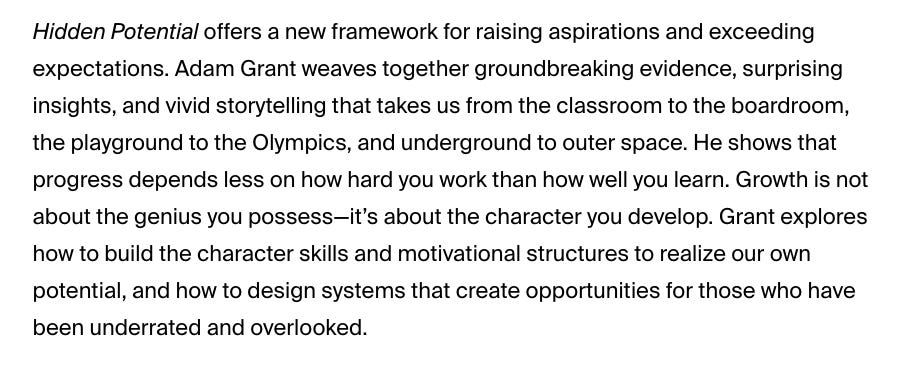
I’m not saying that growth, character, or mindset doesn’t matter. But is the constraint that inhibits potential really inside the person? This physics says no—look at what's missing from the encounter.
When a mindset intervention fails, the diagnosis loops back to mindset. You just didn’t believe hard enough.
If a framework can’t name what’s actually absent, where does the blame go? Usually, back to the person. A child living in a war zone doesn’t need a better mindset. That child needs a boundary architect.
February 22, 2026
Feng died approximately one hour after Eileen won halfpipe gold. Yan withheld the news until her daughter had competed, received her medal, and celebrated.
Eileen arrived late to the press conference:
She was a really big part of my life growing up, and someone I looked up to immensely. She was a fighter. And I think what’s so interesting is that a lot of people just cruise through life, but she was a steamship. Like, this woman commanded life, and she grabbed it by the reins, and she made it into what she wanted it to be.
And she inspired me so much. And that's why I keep referring to this theme of, like, betting on myself and being brave and taking risks. It actually goes back to that promise that I made my grandma. And so I'm really happy that I was able to uphold that, um, and hopefully do her proud.
That steamship co-raised a child for twenty-two years. She taught Eileen Mandarin from birth, cooked her meals, and organized cheering sections in a language she barely spoke.
When that pillar fell during the Olympics, Eileen’s structure held. Twenty years of daily work had already been internalized. The scaffolding could fall without the building collapsing.

…
When Eileen said, “I can literally become exactly who I want to be,” she was right about the mechanism. But who she wants to be was shaped by encounters she didn’t choose. Change those and she could have become a concert pianist or a surgeon—same capacity, different boundary, different person. Her architecture began long before she could want anything at all.
This doesn’t remove credit. Eileen earned everything she won. At some point, she chose the mountain herself. She chose the coaching, the harder trick, and all the future encounters that built on everything before them. That’s all hers. The question is, what made those future wins possible? And that story doesn't begin with her.
It started with a four-hour drive that became a property purchase. With Mandarin at the breakfast table that became a $37 million bridge. With a four-foot-eleven grandmother who organized a cheering section in a language she barely spoke.
If her story reduces to mindset, there’s nothing to learn but “believe harder.”
If it reveals architecture, there’s something we can all build on.
A note on what you just read
This article applies one claim from a physics-based framework: potential is boundary-emergent, not intrinsic.5
Established science referenced: neuroplasticity, early-start advantages, compound returns on early investment, growth mindset replication challenges (Sisk et al. 2018, Burgoyne et al. 2020). The theory is designed to be proven wrong. That’s what makes it science.
Genesis Theory treats transformation and potential as physics rather than psychology. You can learn more about the theory here: genesistheory.org
B encodes encounter quality—what each side carries and how much crosses. Φ encodes field conditions.
Funding sources from The Wall Street Journal. Endorsements from Forbes 2025. These numbers appear because they demonstrate generated measurable potential, not as political commentary.
Read https://pubmed.ncbi.nlm.nih.gov/29505339/
Here’s a more accessible version of the physics of potential.