



The interview you bombed
You prepared for weeks. The company was perfect. The role was exactly what you wanted. The opportunity was real—high gradient, good fit, clear channel.
And you bombed it.
Maybe you were exhausted (low F). Maybe you couldn’t articulate your value (low I). Maybe you couldn’t connect with the interviewer (low R). Maybe you showed up scattered, unclear about your own story (low S).
The boundary was right. What you brought wasn’t.
This is the conversion problem in miniature. Potential emerged at the boundary—and failed to convert because of what you brought to it.
Two sides of the equation
Series 1 established what boundaries provide:
Gradient: A difference that can do work
Complementarity: A fit that makes the difference usable
Bandwidth: A channel that can transfer signal
Series 2 established what you need to function:
F: Energy to persist
S: Structure to organize
I: Information to be aware
R: Relationships to exchange
Now we can connect them.
Boundaries provide potential. Each side provides capacity. Conversion happens where they meet in complementary ways.
When boundary meets capacity
Here’s how the two sides correspond:
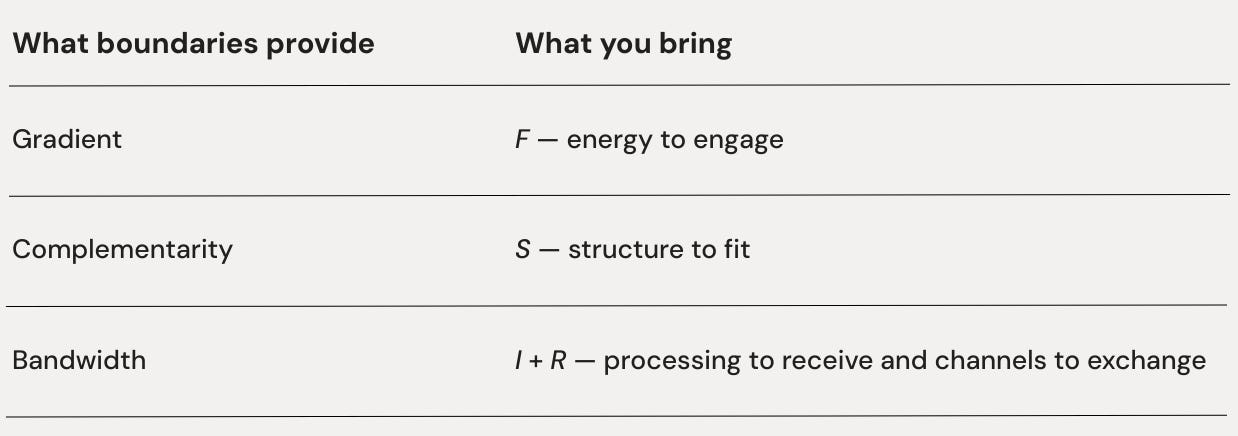
Gradient requires F. A gradient can exist, but engaging it costs energy. You need resources to show up, participate, and do the work of transformation. An exhausted system at a high-gradient boundary can’t exploit the gradient. The energy isn’t there.
Complementarity requires S. For complementarity to produce value, you need structure that can interface with what’s offered. Shape that fits shape. The complementarity exists at the boundary, but your structure determines whether you can connect.
Bandwidth requires I and R. To receive high-bandwidth signal, you need processing capacity (I) to absorb what’s transmitted. To exchange, you need relational capacity (R) to maintain the channel on your end. Bandwidth is a property of the connection; I and R are your contribution to that connection.
(This is primary mapping, not exclusive. The functions interact: complementarity can be blocked by I (misunderstanding what’s offered) or R (lack of trust), not just S. But the primary correspondences hold.)
The conversion equation
Potential emerges at boundaries. Capacity enables conversion. The full picture:
Or more specifically:
Where:
G = gradient
C = complementarity
B = bandwidth
Ψ = capacity (min(SIRF) × A × η)
If any term approaches zero, conversion collapses.
Both sides matter. Neither is sufficient alone.
A depleted system at a rich boundary
Imagine a perfect boundary encounter.
High gradient—real difference that could do work.
Strong complementarity—genuine fit.
High bandwidth—excellent conditions for transfer.
Now imagine you show up depleted in some way:
F is low: no energy to engage. You can see the opportunity, but can’t do anything about it. The gradient exists; you can’t exploit it.
I is low: no capacity to process. The signal is coming through the high-bandwidth channel; you can’t absorb it. Information overwhelms rather than informs.
R is low: no relational capacity. The exchange requires coordination, reciprocity, and trust-building; you can’t sustain your end.
S is low: no structure to fit. The complementarity exists, but you’re not organized in a way that connects.
Result: potential exists at the boundary, no conversion. The boundary did its job. You couldn’t do yours.
A robust system at a sparse boundary
Now imagine the opposite. You’re at peak capacity—high F, strong S, excellent I, robust R. You’re ready to convert.
But the boundary is weak.
Low gradient: you and what you’re encountering are too similar. No difference to drive work. Your capacity sits idle because there’s nothing to convert.
Poor complementarity: the difference exists but doesn’t fit. You can’t use what they offer; they can’t use what you provide. Capacity without material.
Low bandwidth: the channel is noisy, infrequent, low-trust. You’re ready to receive, but signal isn’t getting through.
Result: capacity to convert, yet nothing to convert. You brought everything. The boundary didn’t.
Both sides matter
This is why development is a matching problem.
High capacity with poor boundary access: stagnation. You’re capable, but not encountering anything that generates potential.
Rich boundaries with low capacity: overwhelm. Potential is everywhere, but you can’t convert it.
The questions are always paired:
What boundaries can I access? (Series 1)
What capacity do I bring? (Series 2)
Working on one while neglecting the other produces limited results.
Practical implications
Diagnosing stuck situations:
When transformation isn’t happening, the question is: boundary problem or capacity problem?
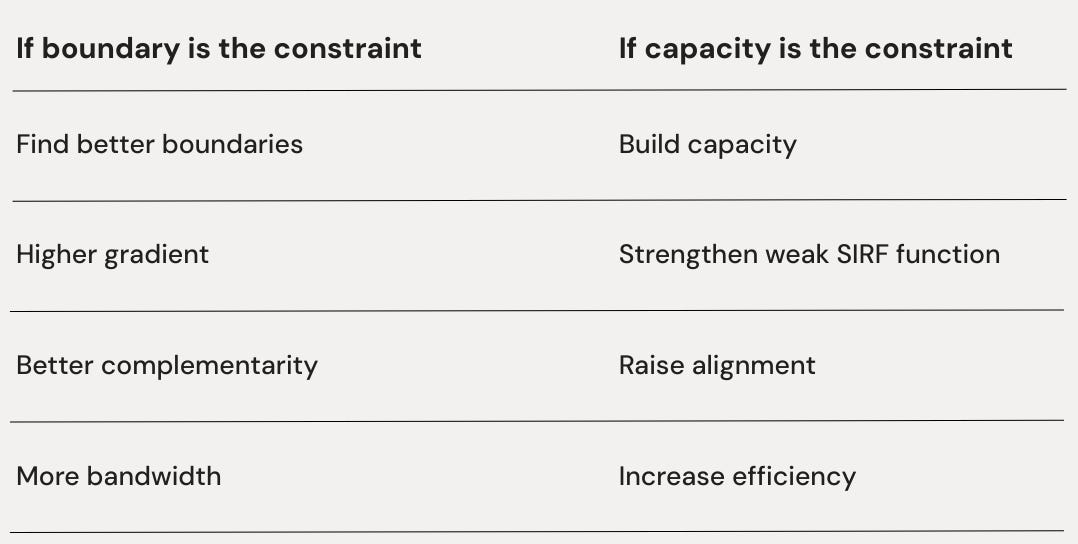
Misdiagnosis wastes effort. If you’re boundary-starved and you’re working on capacity, you’re polishing something that has nothing to convert. If you’re capacity-starved and you’re seeking new boundaries, you’re accessing potential you can’t metabolize.
For individuals: Are you stuck because you’re not encountering the right things, or because you can’t convert what you encounter?
For teams: Is the team lacking good problems/partners/inputs (boundary), or lacking the ability to work with what’s available (capacity)?
For organizations: Is the constraint in the market/partnerships/opportunities (boundary), or in the internal capability to convert (capacity)?
The complete picture
Here’s where we are now:
Series 1: Boundaries generate potential through gradient, complementarity, and bandwidth.
Series 2: Systems maintain capacity through SIRF—constrained by bottleneck, shaped by routing, modified by alignment.
The connection: Conversion happens where boundary quality meets capacity.
This completes the core encounter model. Potential on one side, capacity on the other, conversion in the middle.
But there’s one more layer to explore. SIRF work-functions aren’t simple—they’re recursive. Each function requires SIRF to operate. That depth matters for diagnosis and intervention.
Application
Notice: Pick one “non-conversion” in your life or work—an opportunity that didn’t become transformation.
Name: Was it a boundary-quality failure (low G/C/B) or a capacity failure (weak SIRF/A/η)?
Test: If you replayed the same boundary with higher Ψ (more fuel, better structure, better sensing, stronger exchange capacity), would it convert? If yes, it was capacity-limited.
Remember: Boundaries provide potential; capacity enables conversion. Conversion = f(G × C × B × Ψ). Both sides are required. Zero on either side produces zero.
The science
Established:
Absorptive capacity affects learning. This is Cohen & Levinthal, a foundational work in organizational learning theory.
Readiness moderates intervention effects. This is supported by research across education, clinical, and organizational settings.
Genesis claim:
SIRF as the specific readiness framework that completes the encounter at boundaries.
Falsification:
SIRF health should predict the conversion rate at equivalent boundary encounters. If boundary quality alone predicts conversion, SIRF doesn’t matter.