


Vague prescriptions
“Improve your communication.”
Sounds like good advice, but what does it actually mean?
Communication involves I-work (information function) and R-work (relational function). So “improve communication” means... what? Better sensing? Better processing? Better channels? Better trust?
And here’s the deeper problem: your communication system itself has structure.
The communication processes (S).
The awareness of what’s being communicated (I).
The relationships that enable communication (R).
The resources dedicated to communication (F).
In other words: Communication is a system. And that system has SIRF.
Russian dolls all the way down? Yes. In organized systems, it’s SIRF all the way down.
The recursive structure
Remember, SIRF describes what any organized system needs to persist—the four work-functions that keep complexity from dissolving into entropy. Cells do SIRF. Teams do SIRF. Civilizations do SIRF.
But here’s what’s easy to miss: each SIRF function is itself a system.
Your I-function isn’t a single thing. It’s a collection of processes, structures, relationships, and resources that together produce “information work.”
Your R-function isn’t a single connection—it’s a whole network of relationships, each requiring maintenance.
And if each function is a system, then each function needs SIRF to operate.
This is where diagnosis gets precise. “My I-function is weak” is too vague to fix.
But “my I-function has an R-bottleneck—I can’t access the information that exists because my network is too narrow”—that’s actionable.
Let’s unpack each:
Each SIRF function requires SIRF to operate.
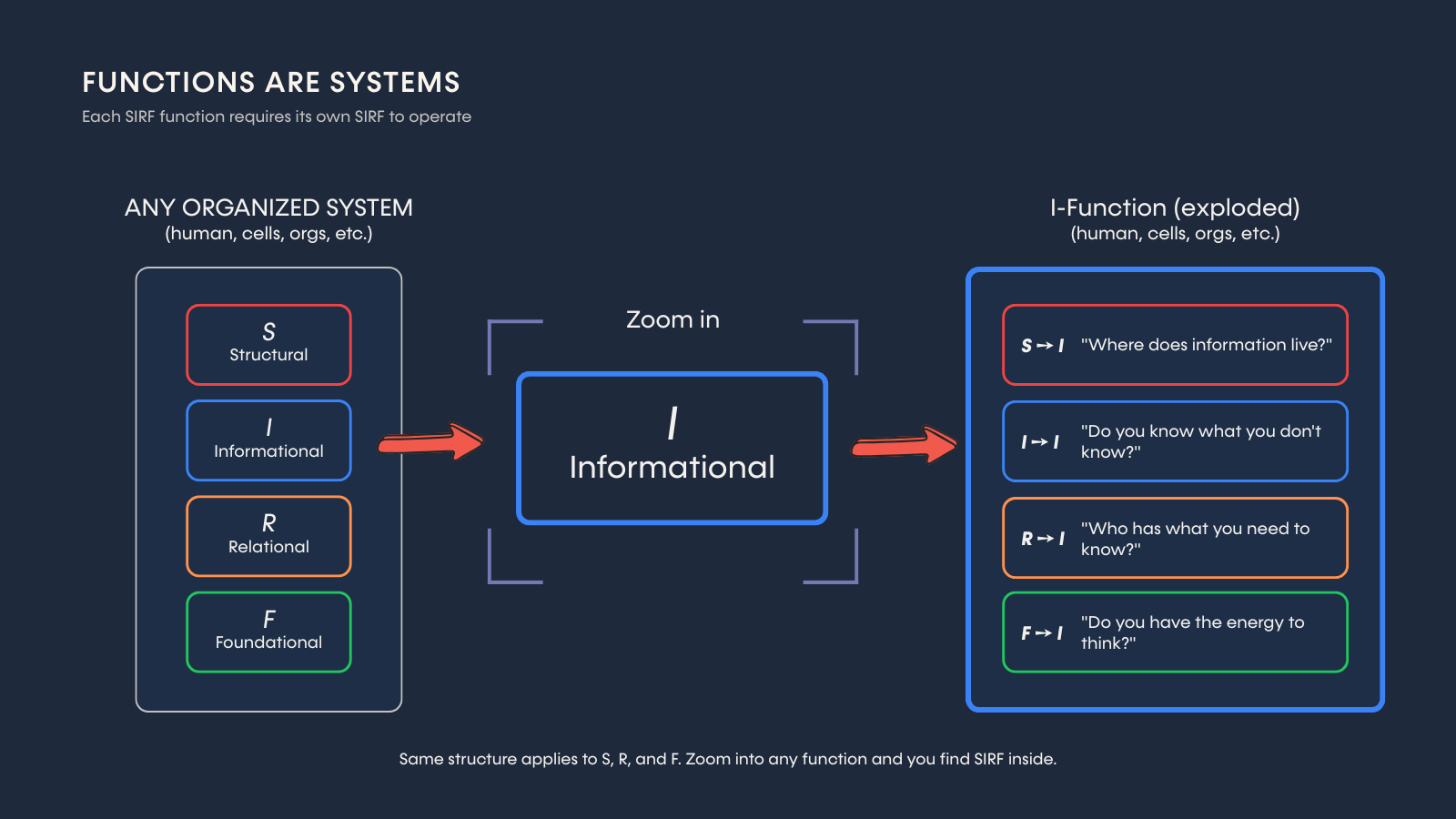
Take the Information function (I). It depends on four supports:
S→I (information infrastructure): Where does information live? How is it stored, versioned, and retrieved?
I→I (meta-cognition): Do we notice what we don’t know? Do we detect when our model is wrong?
R→I (truth channels): Who gets what signal? Can bad news travel?
F→I (cognitive bandwidth): attention, time, mental energy to process signal
That recursion creates depth.
Not just four functions. Sixteen intervention points.
The notation:
You don’t need symbols to use the method. The symbols are just coordinates.
The 16-cell map
Each cell is a distinct intervention point.
So when someone says “fix communication,” you can ask:
Which support is actually broken?
For communication-as-information (I), the usual suspects are:
S→I: infrastructure failure (no source of truth, scattered data, version chaos)
I→I: meta-cognition failure (unknowns stay hidden; certainty is unearned)
R→I: routing failure (the right people don’t get the signal; truth can’t travel)
F→I: bandwidth failure (overload; noise; no protected thinking time)
Same surface symptom. Different root cause. Different fix.
The critical cell: meta-cognition (I→I)
One cell deserves special attention: I→I — meta-cognition.
This is truth-sensing about truth-sensing: the ability to detect when your sensing is broken, when your models are wrong, and when confidence is running ahead of reality.
High I→I sounds like:
“We might be wrong.”
“We’re missing something.”
“That outcome contradicts our model — update the model.”
Low I→I sounds like:
“We know what’s happening.”
“Our analysis is complete.”
“The unexpected result must be noise.”
Systems with low I→I can’t correct. They preserve the map even when the territory is screaming.
This becomes crucial later (Series 4: model–reality gaps). For now, just notice: I→I is the cell that makes improvement possible.
Why depth matters
Surface-level diagnosis often fails because it doesn’t go deep enough.
Surface diagnosis: “We have an information problem.”
Surface intervention: “Buy a tool. Add a dashboard.”
Common outcome: Failure — because the real constraint wasn’t infrastructure (S→I). It was routing (R→I), bandwidth (F→I), or meta-cognition (I→I).
The 16-cell map forces a sharper question:
If the function is X, which support for X is failing — a structural, informational, relational, or foundational function?
A worked example
A team is stuck. Surface diagnosis: “communication issues.”
Run the Information (I) diagnostic:
S→I (information infrastructure): information is scattered; multiple versions; no source of truth.
I→I (meta-cognition): the team assumes it’s informed when it isn’t; unknowns never surface.
R→I (truth channels): critical information sits with a few people and doesn’t spread.
F→I (cognitive bandwidth): overload; too many meetings; too much noise; no thinking time.
Four different problems. All presenting as “communication.”
Four different interventions:
S→I: create a single source of truth
I→I: install a process that surfaces unknowns (pre-mortems, prediction logs, red-team critiques)
R→I: change routing (who is in which loops; who hears; who is allowed to speak)
F→I: reduce noise; protect focus; reallocate attention
Without depth, you’d do scattered fixes and call it “culture.”
Level-matched intervention
Principle: Match the intervention to the level of the failure.
Function-level failure: the entire I function is degraded (sensing, processing, modeling, updating). Fixing one cell won’t rescue it.
Cell-level failure: I is mostly fine, but one support is broken (often R→I or F→I). A broad rebuild is waste.
Mismatched intervention burns resources:
Too shallow: you patch symptoms.
Too deep: you over-engineer.
What’s next?
This completes Series 2.
We established:
Four work functions (S, I, R, F) are necessary and sufficient for organized systems
Bottlenecks: the minimum function sets the ceiling
Routing: energy can build, maintain, or clear
Alignment: stated vs. actual behavior
Encounter readiness: boundary quality × capacity
Recursive depth: 16 cells, not 4
Now you can ask a sharper question:
What do I bring to encounters — and what part of my system is actually failing when I get stuck?
Next: Series 3 — The physics of transformation.
How does change actually happen? What’s the sequence? Where does it stall?
Application
Notice: Take a vague prescription you’ve heard — “communicate better,” “improve culture,” “be more strategic.”
Name: Which function is it (F/S/I/R)? Then: which support is likely broken (S→X, I→X, R→X, or F→X)?
Test: If you target the right cell, you should see a specific change quickly — fewer duplicate efforts, fewer surprises, fewer coordination failures.
Keep in mind: Each SIRF function requires SIRF to operate. That’s why there are 16 cells, not 4. Level-matched intervention beats surface intervention.
The science
Established:
Hierarchical systems have nested structure (Simon; foundational to complexity theory).
Meta-cognition affects learning (cognitive psychology).
Genesis claim:
The 16-cell structure is a usable diagnostic map: each function requires SIRF to operate.
Falsification:
Level-matched interventions should reliably outperform level-mismatched interventions. If surface fixes work just as well, the extra depth doesn’t matter.
Series 2 complete.