


Where we are
In series 1, we explained that potential gets generated at boundaries. When systems encounter each other, new possibilities (reachable futures) emerge that didn’t exist before.
If this holds, then civilization becomes encounter architecture, and everything we have built shapes who meets whom, what meets what, and determines how much potential is generated or wasted.
Series 2 mapped what you bring to those encounters: SIRF. Foundational energy, structural integrity, informational awareness, relational channels.
These four functions determine whether you can show up at a boundary and convert what it offers. Your weakest function sets your ceiling.
So now you have two pieces:
Potential (what boundaries offer)
Capacity (what you bring to convert)
That should be enough. Potential + capacity = transformation.
But it’s not. Something’s missing.
Two directions
To see what’s missing, we need to distinguish two kinds of change.
Entropy is dissolution. Things fall apart.
The second law of thermodynamics says disorder increases unless you do work to prevent it. Your body decays without food. A company erodes without maintenance. A relationship fades without attention. Entropy is the default—it happens when you stop fighting it.
The second kind of change is Emergence. This is creation. New order arises. At boundaries, potential appears that didn’t exist before. New patterns become possible.
Two chemicals meet and form a compound with properties neither had. A river meets the ocean, and an estuary emerges—more diverse than either alone. A conversation sparks an insight. A collaboration produces something neither could build alone. A forest fire clears the canopy, and new growth emerges that couldn’t compete before.
These two directions are always operating:
Entropy pulls toward dissolution
Emergence pulls toward new order
Series 1 was about what boundaries offer: potential. Encounter quality—gradient, complementarity, bandwidth—determines what becomes possible. That’s the supply side.
Series 2 was about what you bring: capacity. SIRF is the ongoing work that keeps you organized enough to show up at boundaries and convert what they offer. Fighting entropy isn’t just survival—it’s staying ready. That’s the demand side.
Together: boundaries generate potential (emergence), SIRF lets you convert it (by resisting entropy long enough to do the work).
But here’s what we haven’t addressed:
How do you get from one stable pattern to another?
The change problem
Fighting entropy keeps you where you are. Accessing emergence shows you what’s possible.
Neither explains how transformation actually happens.
Transformation isn’t just “not dissolving” (that’s preventative maintenance). And it isn’t just “seeing new possibilities” (that’s potential). Transformation is the passage—moving from one stable pattern to a different stable pattern.
That passage has its own dynamics. And it can be risky.
You’ve probably seen this. The team with everything—resources, talent, information, relationships. The opportunity was real. The path was clear. And nothing changed. Why?
Not because they lacked potential. Not because they lacked capacity. But because something held the old pattern in place.
Or the opposite side: modest capacity, difficult circumstances, and somehow transformation happened—while the better-resourced system got stuck.
Potential + capacity is necessary for transformation, but not sufficient. The passage itself can stall.
Regimes: patterns that persist
Here’s the missing concept: regimes.
A regime is a stable pattern of operation. How things are done, not just how they’re structured. The configuration that’s become normal.
Regimes are useful. They’re how you fight entropy without exhausting yourself. Instead of deciding everything fresh each moment, you settle into patterns that persist. The pattern maintains itself. That’s efficiency.
But regimes pose a challenge to real change.
A regime is built to persist. It resists change—that’s its job. And it often can’t tell the difference between:
Entropy (dissolution—correct to resist)
Emergence (transformation—often wrong to resist)
From inside a regime, both look like disruption. Both threaten the pattern. Both can feel dangerous.
So a locked regime fights both. It uses energy to maintain itself even when the pattern has stopped working. It treats transformation as threat, the same way it treats decay.
This is why having potential + capacity still doesn’t guarantee change. The regime filters everything through the old pattern. It absorbs information that confirms and rejects information that challenges. It uses SIRF to block emergence, not just to fight entropy.
A regime could be an institution. An organization’s fixed system. Or individual habits that we want to change, but don’t.
What Series 3 covers
Series 3 maps the dynamics of transformation. We’ll apply the insights of fighting entropy (Series 2) and accessing new emergence (Series 1) to the passage between stable patterns.
We’ll answer:
Why do regimes lock in, even when they’ve stopped working?
How do you know when a regime is failing vs. just struggling?
What happens in the unstable middle—after the old breaks, before the new stabilizes?
Where does the passage stall?
What does “real change” actually look like in physics terms?
The key insight: transformation requires letting the old regime fail so a new one can emerge. That’s not entropy (giving up). It’s making room for emergence and requires navigating an unstable transition—which is where most change efforts die.
The map so far
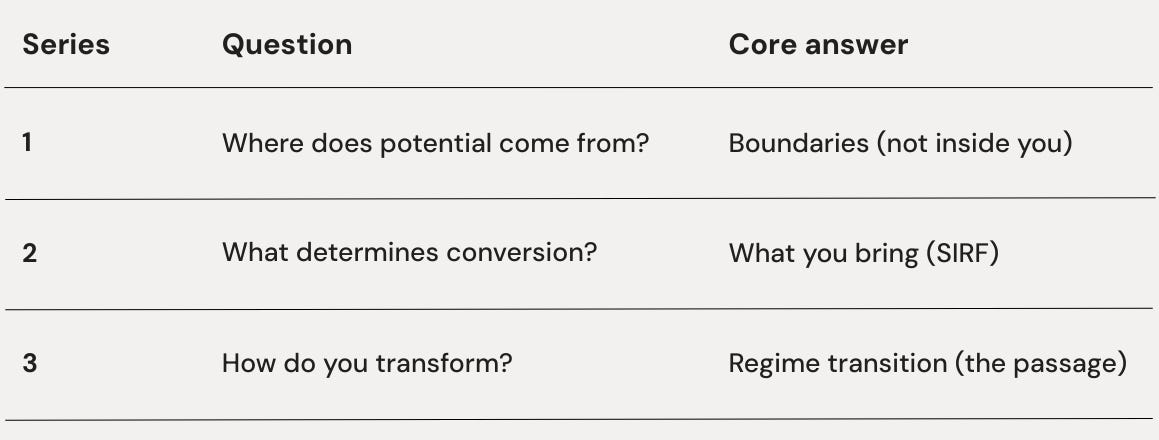
Series 1: What’s possible.
Series 2: What persists.
Series 3: How you move from one to the other.