



They said “growth”
The leadership team was clear: “This year is about growth. We’re investing in the future. Building new capabilities. Expanding into new markets.”
The strategy deck said growth. The all-hands said growth. The OKRs said growth.
But look at the calendar. Look at the budget. Look at where time and money actually went.
Maintenance of legacy systems. Firefighting existing problems. Meetings about meetings. Status quo preservation dressed up as “optimization.”
They said growth. But maintenance was on the calendar.
The alignment gap
Alignment measures whether energy goes where you say it goes.
If you say you’re investing in growth and you’re actually investing in growth, then A is high.
If you say growth but actually do maintenance, or say maintenance but actually do clearing, then A is low.
In plain terms: A ≈ 1 means you do what you say. A ≈ 0 means you mostly don’t.
Most systems have low A. There’s a persistent gap between stated priorities and actual resource flows.
This isn’t necessarily dishonesty. It’s often blindness. People genuinely believe they’re investing in X when the calendar and budget reveal Y. The gap is invisible to them.
Why the gap exists
Several forces create alignment gaps:
Incentive misalignment. People are rewarded for stated priorities rather than actual ones. If the organization says “innovation” but promotes people who maintain the status quo, actual resources flow to maintenance while stated resources flow to innovation.
Urgency bias. Short-term demands crowd out long-term intentions. You intend to invest in growth, but the urgent maintenance keeps eating your time. Stated priorities concern the future; actual priorities concern the present.
Measurement blindness. You measure some things but not others. What gets measured gets managed. If you’re measuring growth output but not maintenance investment, resources drift toward measurable growth even as maintenance starves.
Political displacement. Energy goes to managing politics, protecting turf, and performing status. None of this is stated. All of it is actual. The alignment gap widens with organizational complexity.
The revealed preference
Economists use the concept of revealed preference. Don’t ask people what they value—watch what they do. Their choices reveal their actual preferences, which often differ from their stated ones.
Organizations have revealed preferences, too. Don’t read the strategy deck—read their calendar and budget.
Where does time actually go?
Where does money actually flow?
What actually gets rewarded?
What actually gets punished?
The answers reveal actual priorities. The gap between actual and stated is the alignment gap.
The four combinations
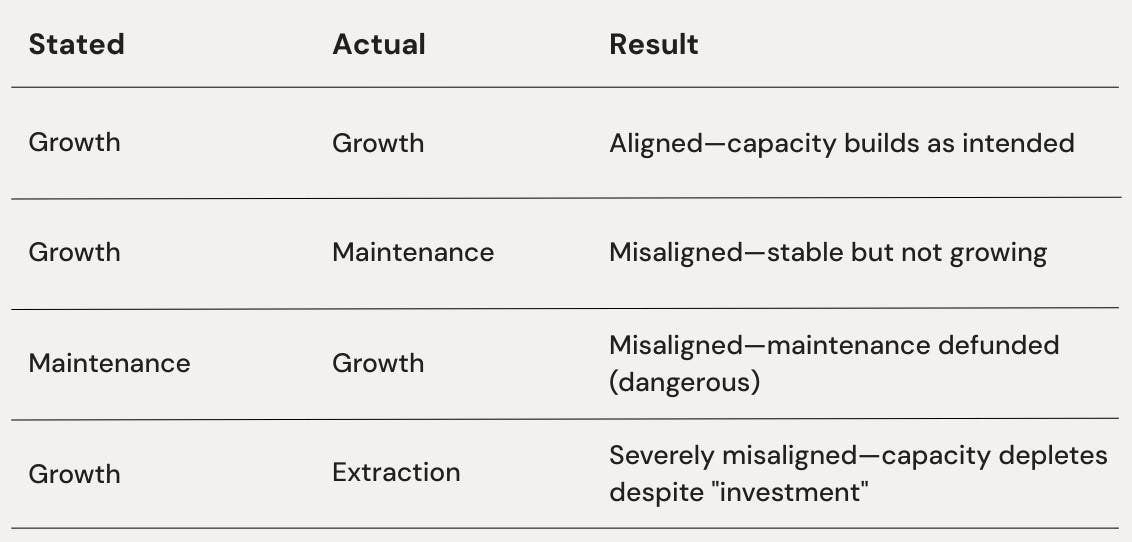
Growth/Growth is the happy case. You say you’re building; you’re actually building capacity. A ≈ 1.
Growth/Maintenance is common and survivable. You think you’re growing, but you’re actually maintaining. Nothing terrible happens—you just don’t grow. The gap is between aspiration and reality.
Maintenance/Growth is dangerous. You think you’re maintaining but you’re actually building. This sounds positive, but it means you’re not funding maintenance and that load isn’t being met. Collapse is coming.
Growth/Extraction is the worst case. You claim to be investing in the future while actually depleting it. Some turnaround and extraction playbooks do this, “growth initiatives” that extract value. The organization believes it’s building when it’s actually being hollowed out.
Intentions don’t count
Physics doesn’t care about your intentions.
If you intend to invest in relationships but actually invest in firefighting, relationships decay. The intention was good. The outcome follows the action, not the intention.
If you intend to maintain infrastructure but actually defer maintenance, the infrastructure degrades. Your intention doesn’t prevent decay. Only actual maintenance prevents decay.
Alignment matters because intentions don’t flow through the system—actions do. Low alignment (low A) indicates that the system is behaving differently from what it believes it’s doing. Consequences follow actions, regardless of beliefs.
Measuring alignment
How do you assess A?
Time audit. Track where time actually goes for a week. Compare to stated priorities. The gap is visible.
Budget analysis. Categorize spending by actual function, not stated purpose. The “innovation budget” that goes to legacy maintenance isn’t actually innovation spending.
Calendar review. What’s on the calendar? Not what should be there—what is there. Calendar reveals actual priorities.
Reward tracking. Who got promoted? Who got rewarded? What behavior was actually reinforced? Compare to stated values.
The gap between stated and actual is A. Most people are surprised by their own gap.
Raising A
Alignment can be improved:
Make the actual visible. Track where resources actually go. Make the tracking visible. Awareness reduces unintentional drift.
Align incentives. Reward what you actually want. If stated priorities and incentives conflict, incentives win. Make them match.
Reduce urgency. Create buffers so short-term demands don’t consume long-term intentions. Without some slack, urgency always wins.
Shorten feedback loops. The longer the delay between action and consequence, the easier it is to maintain false beliefs. Faster feedback reveals misalignment.
None of this is easy. But pretending A is high when it’s low doesn’t fix anything. Consequences follow actual allocation, not stated priorities.
The full picture
We now have the complete capacity equation:
min(S, I, R, F): The ceiling set by the weakest function
A: The alignment between stated and actual priorities
η: Efficiency (how much is lost in transit)
Low scores on any term reduce capacity. A system with strong SIRF but low A bleeds capacity through misalignment. A system with high A but weak SIRF hits a ceiling. Everything matters.
One thing left
We’ve covered SIRF, bottleneck, routing, and alignment. One piece remains: connecting all of this back to Series 1.
What do you bring to encounters? Series 1 established what boundaries provide. Now we can answer from the system side: you bring SIRF capacity.
That’s next.
Application
Notice: Write your top priority in one sentence.
Name: Check your last week: did time + budget match that priority? Score: High / Medium / Low.
Test: If alignment is low, your results will track your calendar more than your intentions within 30–60 days.
Keep in mind: Physics doesn’t care about your intentions. Consequences follow actual resource allocation, not stated priorities. The gap between actual and stated is alignment (A).
The science
Established:
Revealed preference differs from stated preference. This is foundational economics.
Principal-agent problems create misalignment. This is established in organizational theory.
Incentives drive behavior more than intentions. This is repeatedly validated.
Genesis claim:
A as a formal multiplier in the capacity equation. Misalignment as measurable capacity drag. Testable.
Falsification:
A should predict capacity trajectory better than stated priorities. If stated priorities predict as well as actual allocation, A doesn’t matter.