



The bridge that fell
In 2018, the Morandi Bridge in Genoa collapsed. Forty-three people died.
The bridge had stood for fifty years. It looked fine. Traffic crossed it daily.
But maintenance had been deferred. Cables had corroded. Concrete had degraded. The work that prevents failure—though invisible when it’s happening—had been cut. The collapse wasn’t sudden. It was the delayed consequence of years of invisible neglect.
This pattern repeats everywhere. The relationship that “suddenly” ends. The company that “unexpectedly” fails. The health crisis that came “out of nowhere.”
The signs were there—in what wasn’t being maintained.
Three routing regimes
Energy in any system goes to one of three places. We use ρ (rho) to represent net capacity change:
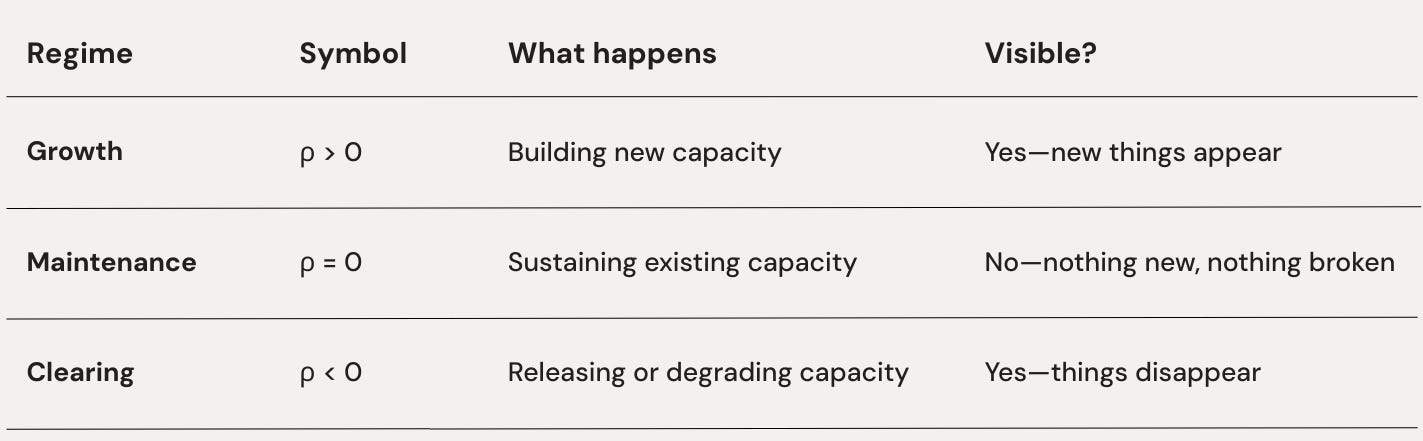
Three places energy can go. Two are visible; one is invisible. That’s where the trouble starts.
Growth is visible. You ship products, hire people, launch initiatives, and build things. Everyone can see the output. It shows up in metrics. It gets celebrated.
Maintenance is invisible. You maintain infrastructure, preserve relationships, service technical debt, and prevent decay. Nothing new appears. Nothing breaks either.
Maintenance output = nothing visible changes.
Clearing is visible again. Things disappear. Projects get cancelled. People leave. Systems degrade. It’s visible—but often comes as a “surprise” because the preceding maintenance neglect was invisible.
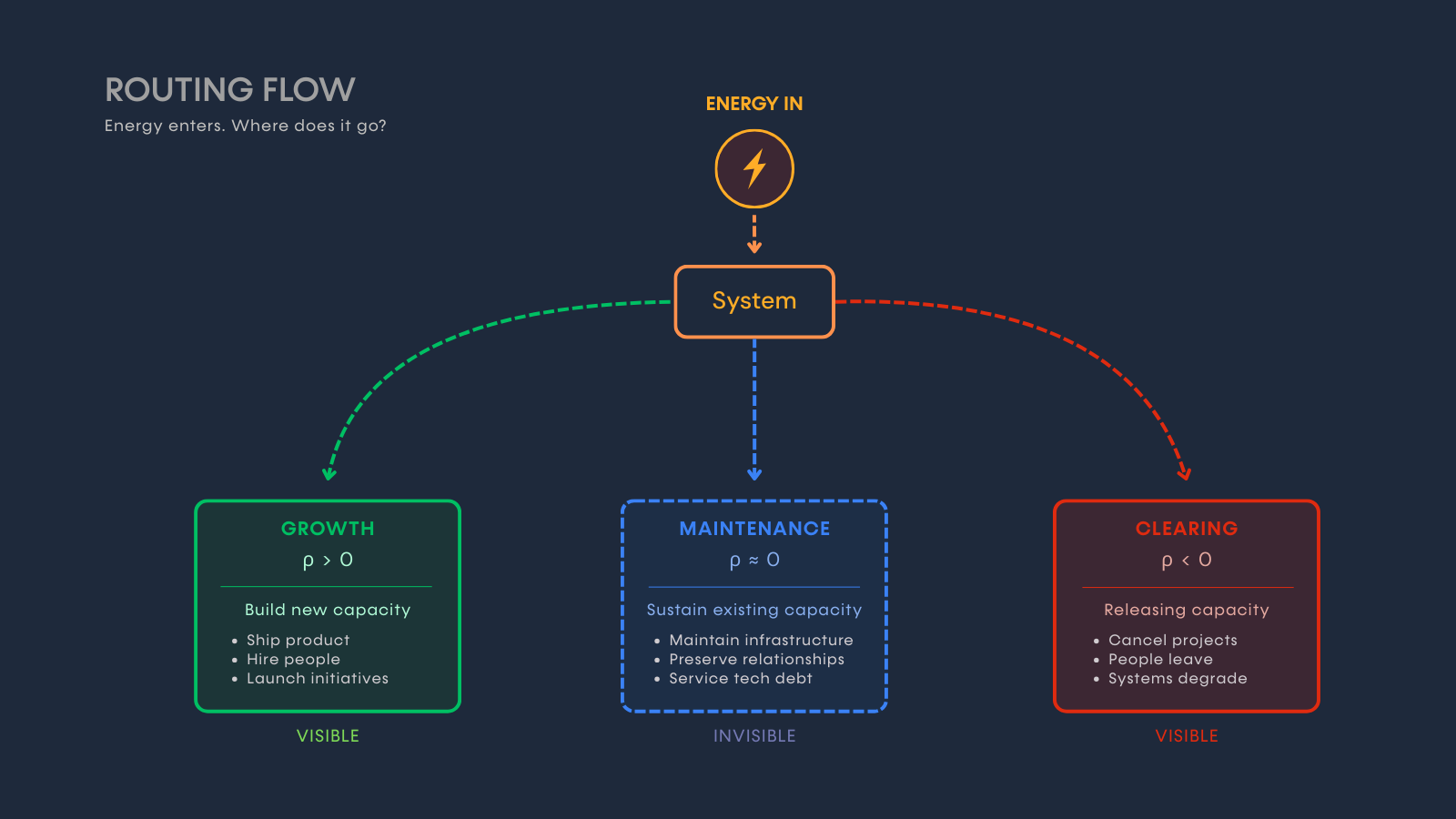
The maintenance trap
Maintenance work produces no visible output. So it’s easily forgotten.
The logic seems sound. You have limited resources. You need to show results.
Yet maintenance produces no visible results—it just keeps things from breaking. So it gets cut, and energy redirects to growth.
For a while, this works. Existing reserves buffer the system. You’re drawing them down, but the withdrawal isn’t visible.
Then reserves run out. Technical debt compounds. Relationships decay. Infrastructure fails. The “surprise” collapse arrives.
It’s not a surprise. It’s a predictable outcome from defunding maintenance work.
The physics beneath
Why does this happen? Because maintenance is thermodynamically mandatory.
Remember: all organized systems are far from equilibrium. In other words, it’s not naturally stable—it’s actively held together. Complex systems are constantly fighting entropy.
The second law says:
In an isolated system, entropy tends to increase over time.
Left alone, things don’t spontaneously get more organized. They drift toward messier, more spread-out, harder-to-use energy states.
Any organized system persists only through continuous work against dissolution.
Maintenance is critical work. It’s the energy that maintains structure (S), preserves knowledge (I), sustains relationships (R), and keeps resources flowing (F).
Cut maintenance, and you stop fighting entropy. Even if entropy wins eventually.
This isn’t negotiable. You can defer maintenance. You can’t eliminate it. The question isn’t “can we skip maintenance?” It’s “how long until physics collects?”
Routing flows through SIRF
SIRF isn’t a set of assets. They're also channels, pathways through which energy flows.
Each channel can be in one of three routing modes: Growth, Maintenance, and Clearing.
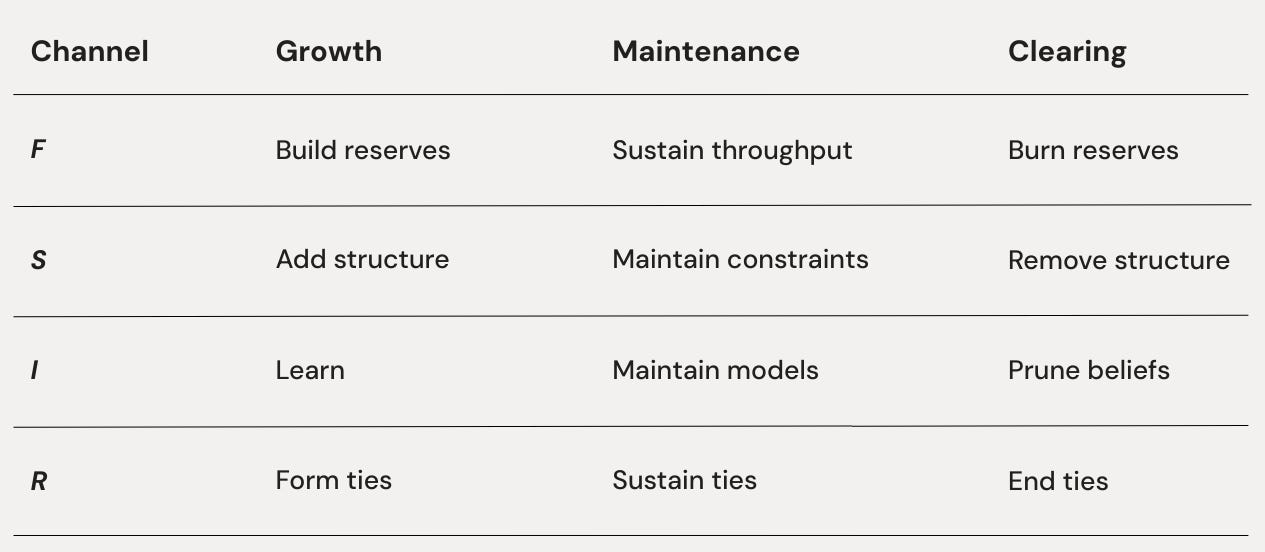
Routing describes what’s happening to each channel. Starve maintenance, and you’re not just skipping one kind of work, you’re letting all four channels degrade.
Most failures aren’t “lack of effort” more than they’re misrouting. They have plenty of energy, but it's sent down the wrong channel or under the wrong regime.
Maintenance at every scale
Personal: Sleep, recovery, relationships. These are maintenance. They don’t produce visible output. Cutting sleep for productivity feels like a win—more hours, more work. Until the crash. The productivity gains were borrowed from future capacity.
Team: Process maintenance, knowledge documentation, relationship upkeep. The team that ships constantly but never maintains its processes, documents its knowledge, or tends its relationships—this team is growth-only. It will hit a wall. The wall is maintenance debt.
Organization: Technical debt, trust maintenance, infrastructure investment. The company that cuts R&D, defers maintenance, and extracts from relationships—this company is optimizing short-term metrics by borrowing from maintenance. The collapse comes later.
Civilization: Infrastructure maintenance, institutional upkeep, social trust. Societies that defund maintenance—physical infrastructure, institutional quality, social cohesion—are drawing down maintenance reserves. The roads crumble. The institutions corrode. The trust evaporates. “Nobody saw it coming.”
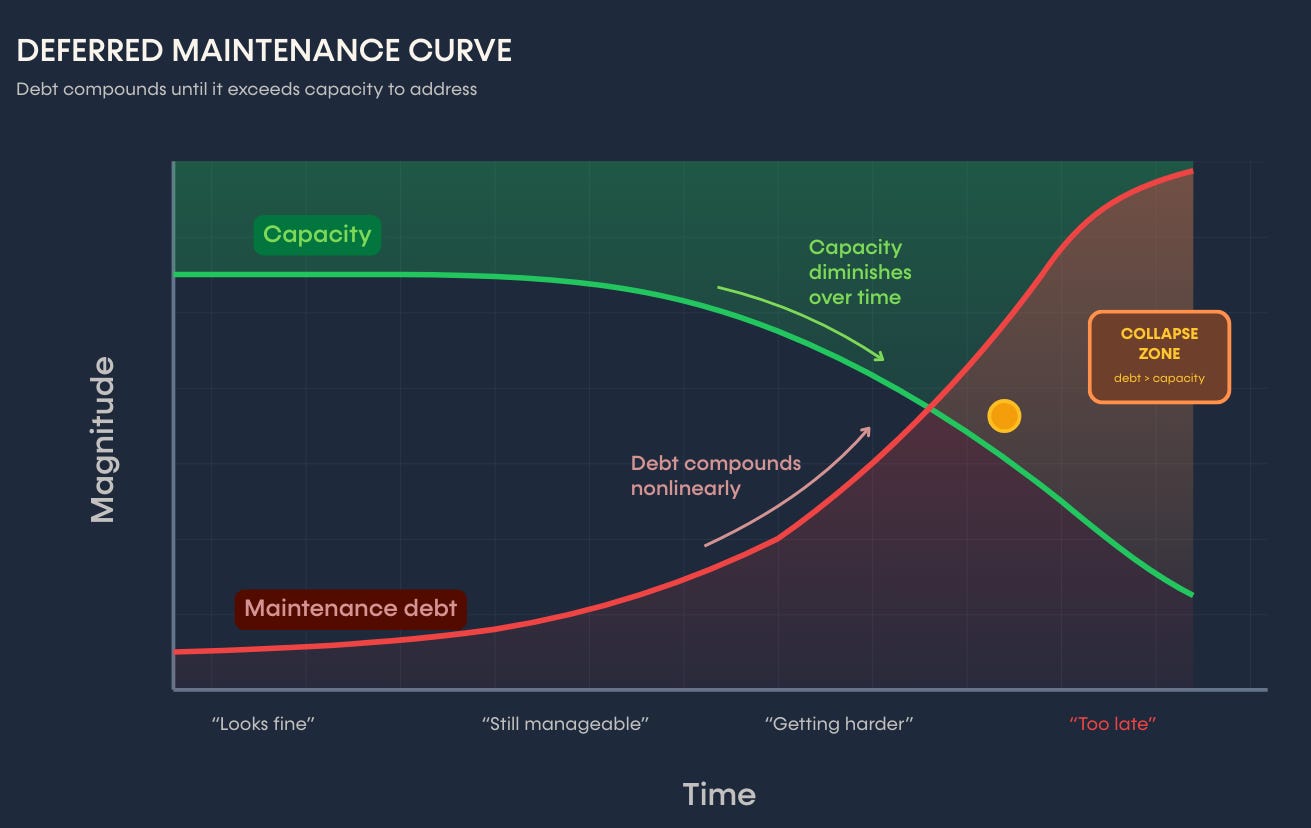
The maintenance load
Every system has a maintenance load—the minimum maintenance required to sustain current capacity.
The maintenance load isn’t fixed. It depends on:
Complexity: More complex systems require more maintenance
Age: Older systems often have higher maintenance needs
Environment: Hostile environments increase maintenance requirements
Prior neglect: Maintenance debt compounds, increasing future maintenance load
You can estimate your maintenance load by asking:
“How much would we need to spend just to stay where we are?”
Many organizations don’t know, or even understand, their maintenance load. They don’t track maintenance as a category. They see maintenance spending as overhead to minimize, not as investment to manage.
This is why “efficiency initiatives” often precede collapse. They’re cutting maintenance to boost visible output. The efficiency gains are real—for now. The maintenance debt is accumulating invisibly.
Clearing isn’t always bad
Clearing (ρ < 0) sounds negative. Sometimes it is—systems degrading, capacity eroding, things falling apart.
But sometimes clearing is necessary. Clearing out the old to make room for the new. Releasing what no longer serves. Pruning to enable growth.
Maintenance can include cleanup, but the difference is intent. Maintenance preserves capacity; clearing reduces it (to make room or because decay forces it).
Generative clearing: Deliberate. Shutting down failed projects. Ending relationships that extract rather than exchange. Simplifying structure that has become too complex. This creates space for growth.
Destructive clearing: Involuntary degradation. The system falls apart. Capacity erodes. This isn’t deliberate clearing—it’s decay.
The difference isn’t the routing regime—both are ρ < 0. The difference lies in whether the clearing supports future growth or represents an involuntary loss.
The danger is accidental clearing masquerading as optimization. “Efficiency initiative” or “restructuring” sounds like growth. Often it’s clearing—cutting what maintains the system.
Growth-only is a trap
“Growth mindset” has become a cultural value. Always be growing. Always be building. Growth forever.
But physics says this is impossible. Maintenance is mandatory. No system can grow indefinitely without maintenance. The attempt doesn’t produce endless growth—it produces collapse.
Sustainable operation: Growth + maintenance in appropriate balance. Some energy builds new capacity. Some maintain existing capacity. The ratio depends on context:
High-growth phases need more building
Mature phases need more maintaining
But zero maintenance isn’t sustainable.
Unsustainable operation: Growth without maintenance. All building, no upkeep. This works until the maintenance debt comes due. Then it fails.
The cult of growth often produces the opposite of its intention. Denying maintenance guarantees eventual clearing.
The routing question
When assessing any system, ask: where is energy actually going?
How much for growth (building)?
How much for maintenance (sustaining)?
How much to clear (release)?
If growth dominates and maintenance is starved, collapse will come, even if everything looks fine now.
If maintenance is funded but growth is absent, you’re stable but stagnant. No new capacity is being built.
If clearing dominates, something is either being cleared deliberately or decaying involuntarily. Which is it?
The answer isn’t a universal ratio. It’s context-dependent. But the question—where is energy actually going?—is always worth asking.
Application
Notice: Over the last 2 weeks, where did time/money go most?
Name: Mostly Growth (building new), Maintenance (holding steady), or Clearing (shedding)?
Test: If maintenance is underfunded, you should see “invisible debts” rising—tech debt, trust debt, fatigue debt—even while outputs look fine.
Remember: Energy goes to growth, maintenance, or clearing. Maintenance is invisible but thermodynamically mandatory. Defunding it guarantees eventual collapse.
The science
Established:
Infrastructure requires maintenance investment. This is basic engineering.
Technical debt accumulates nonlinearly. This is established in software development.
Deferred maintenance costs more later. This is validated across domains.
Genesis claim:
Growth/maintenance/clearing as formal routing regimes. The physics of where energy goes in any complex system.
Falsification:
Maintenance defunding should predict time-to-failure. Systems that cut maintenance should fail faster than systems that fund it, controlling for other factors.