


The weakest link
You’re a chain. One link is weaker than the others. What determines how much weight the chain can bear?
Not the average strength. Not the total strength. Not the strongest link.
The weakest link. That’s the ceiling.
This is obvious for chains. It’s less obvious—but equally true—for systems.
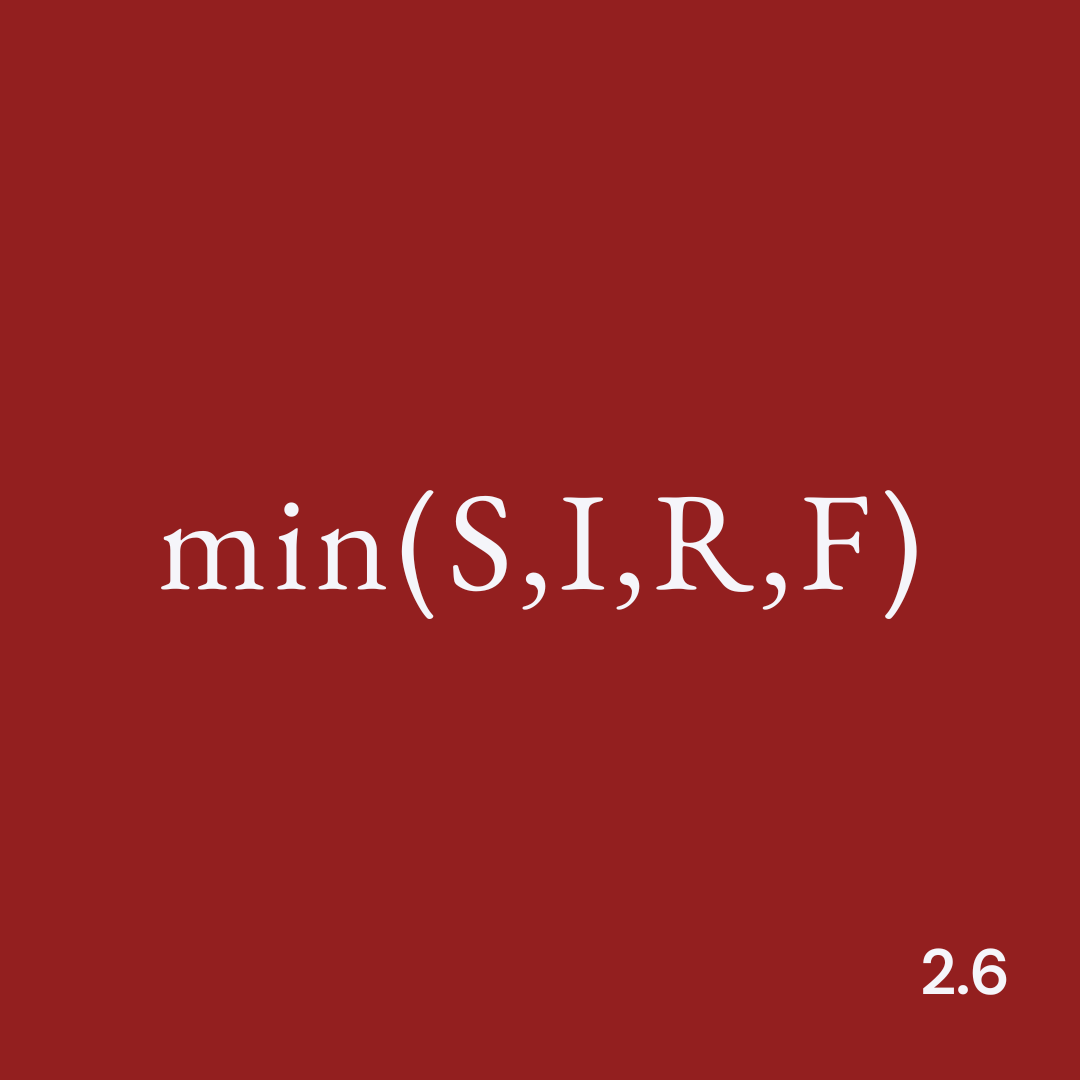
The minimum function
Post 2.5 introduced the equation:
The minimum function determines capacity. Everything else is above the ceiling.
This seems simple. Its implications are profound.
Most effort is wasted. If your bottleneck is I (information), and you’re investing in S (structure), you’re working on the wrong thing. Structural improvements don’t raise the ceiling. The ceiling’s set by I.
Diagnosis must precede intervention. You can’t know what to work on until you know what the bottleneck is. Most improvement efforts target the wrong thing.
We work on what’s visible, not what’s causal. Symptoms appear in one place; causes live in another. Low F (running out of cash) might manifest as R problems (conflict over scarce resources). We see the fighting, we try to fix the relationships—but the bottleneck is fuel.
We work on what we’re good at. If you’re a process person, every problem looks structural (S). If you’re a people person, every problem looks relational (R). Hammer, nail.
The bottleneck moves. Fix the I-function, and suddenly the ceiling is set by something else—maybe R, maybe F. The new bottleneck requires a different intervention. This is why “we fixed that last year” often doesn’t last—you fixed one bottleneck and created another.
Misdiagnosis tends to be the default.
Liebig’s Law
This isn’t new. Liebig discovered it in agriculture in 1840.
Plant growth is limited by the scarcest nutrient. If nitrogen is scarce, adding more phosphorus doesn’t help—the plant can’t use it. Only adding nitrogen raises the ceiling.
This became Liebig’s Law of the Minimum: growth is controlled by the limiting factor, not the total resources.
Goldratt rediscovered it for manufacturing. His Theory of Constraints says the same thing: system throughput is determined by the bottleneck. Optimizing non-bottleneck processes doesn’t improve throughput.
Genesis applies it to organized complexity. Capacity is determined by the minimum SIRF function. Improving non-bottleneck functions doesn’t raise capacity.
The diagnostic question
When something isn’t working, the first question is: which function is the bottleneck?
If S is the bottleneck
Structure is the constraint. Roles are unclear, processes are broken, boundaries are porous. The system has energy, information, and relationships—it just doesn’t know what to do with them. Fix: clarify structure.
If I is the bottleneck:
Information is the constraint. The system doesn’t know what’s happening. Sensing is weak, models are wrong, feedback is absent. The system has structure, relationships, and energy—but it’s blind. Fix: improve information flow.
If R is the bottleneck:
Relationships are the constraint. The system is isolated. Exchange channels are blocked, trust is low, connections are weak. The system has structure, awareness, and energy—but it’s suffocating. Fix: rebuild relationships.
If F is the bottleneck:
Resources are the constraint. There’s not enough energy to do the work. The system has structure, awareness, and relationships—but no fuel. Fix: get resources.
The intervention depends on the diagnosis. Mismatched intervention wastes effort.
Example:

A team has plenty of meetings and clear structure (S).

They have strong relationships (R), and adequate budget (F), but they keep getting blindsided by market shifts and customer complaints.

Their bottleneck is I.

Adding more process won’t help. Building more trust won’t help. They need better sensing.
The trap of strength
How do we get trapped? We tend to work on what we’re good at.
The team with strong relationships (R) wants more relationship-building. The team with a strong structure (S) wants to refine its processes. The team with good information (I) wants to analyze more data.
But if the bottleneck is somewhere else, working on your strength produces no gains. It feels productive—you’re doing things, improving things—but the ceiling doesn’t move.
Worse, working on strengths can be actively harmful. It creates the illusion of progress while the actual constraint goes unaddressed. By the time you realize the ceiling hasn’t moved, you’ve wasted time and burned resources.
Work on the bottleneck, not the strength.
Near-ties
What if two functions are close?
If S = 0.3 and I = 0.35, they’re both near the minimum. In practice, you might need to work on both. The effective bottleneck set includes near-ties.
But be careful. “Both are important” can become an excuse to avoid diagnosis. “Everything is a bottleneck” is cope—a way to avoid committing to a specific intervention. In most cases, one function is clearly lower than the others. The ceiling is set by that one. Near-ties are real but rarer than people claim.
Across scales
The bottleneck principle applies at every scale:
Individual: What’s limiting your capacity? If you have time and energy (F) and good habits (S) and strong relationships (R) but you’re not learning (I), the bottleneck is I. More time won’t help. Better habits won’t help. You need better information input.
Team: What’s limiting the team? Four people diagnosing their team’s bottleneck will often disagree—each sees through their own lens. The diagnosis requires honest assessment, not projection of personal concerns.
Organization: What’s limiting the organization? Large organizations often have different bottlenecks in different units. The sales team might be R-constrained (relationships). The engineering team might be I-constrained (information flow). The finance team might be S-constrained (process problems). Blanket initiatives ignore this variation.
Civilization: What’s limiting society? Different societies have different bottlenecks. Some are resource-constrained (F). Some have institutional decay (S). Some have information problems (I). Some have trust collapse (R). Policy that ignores the actual bottleneck is expensive noise.
The bottleneck moves
One more thing: bottlenecks move.
Fix I, and now maybe R becomes the constraint. Fix R, and then F becomes the constraint. The system’s weak point shifts as you address each limitation.
This is progress. Each time you raise a bottleneck, capacity increases. The new bottleneck indicates where to focus next.
But it requires continuous diagnosis. The intervention that worked last quarter may be working on a non-bottleneck this quarter.
You have to keep asking: what’s the current minimum?
The equation so far
We now understand the core term:
The minimum function sets the ceiling. Intervention should target the minimum. The bottleneck moves as you raise each function.
But where does the energy actually go? Even if you know the bottleneck, you need to understand where resources flow—and where they don’t.
That’s next.
Application
Notice: What’s the outcome you want that isn’t happening?
Name: Which is lowest right now: F (fuel), S (structure), I (awareness), or R (exchange)?
Test: If you improved only the minimum for 2 weeks, would throughput jump? If not, you misdiagnosed the bottleneck.
Note: The minimum function sets the ceiling. Most improvement efforts target the wrong thing. Diagnosis must precede intervention.
The science
Established:
Bottleneck determines throughput. Theory of Constraints (Goldratt), validated in manufacturing.
Limiting factor determines growth. Liebig’s Law, validated in agriculture and ecology.
Genesis claim:
SIRF as the specific constraint set. Minimum function as capacity ceiling.
Falsification:
Bottleneck-targeted interventions should outperform non-bottleneck interventions. If targeting the minimum function doesn’t produce better results than targeting other functions, the principle fails.