


The table that stands
A standard table needs four legs. Not three—it wobbles. Not five—the extra adds cost without stability. Four legs, each bearing weight, each necessary.
Remove one leg, and the table falls. Strengthen one leg, and it’s still limited by the others.
SIRF is like that. Four functions. Each bearing a different requirement of existence. Remove one, and the system fails. Strengthen one beyond the others, and you’ve wasted effort.
But unlike table legs, this isn’t a design choice. It’s physics.
Why exactly four functions?
We’ve introduced four functions: F, S, I, R. Foundational, structural, informational, relational.
This might seem arbitrary. Why not three? Why not five? Why these four and not others?
Each function maps to a fundamental requirement of organized complexity, grounded in physics. Four things must be true for an organized system to persist. Four types of work maintain those truths. No fewer, no more.
The four requirements
Requirement 1: Thermodynamic persistence.
Organized systems are far from equilibrium. They maintain low entropy. The second law says they should dissolve. To persist, they must continuously import free energy and export entropy.
This requires F-work: the acquisition, storage, and allocation of energy.
Requirement 2: Structural persistence.
Energy alone produces chaos. For organization to persist, patterns must be maintained—boundaries, constraints, configurations. These patterns aren’t static; they require active maintenance against perturbation.
This requires S-work: maintaining boundaries, constraints, patterns.
Requirement 3: Adaptive persistence.
A system that doesn’t sense its environment can’t respond to change. To persist in a changing world, systems need models—representations that track external reality and guide action against it.
This requires I-work: sensing, processing, modeling, updating.
Requirement 4: Exchange persistence.
Closed systems die. Open systems survive by exchanging across boundaries. But openness isn’t passive—it requires managing what crosses the boundary, maintaining relationships that enable exchange.
This requires R-work: importing, exporting, and maintaining exchange relationships.
Why not fewer?
Could we collapse any of these?
F and S? No. Foundational and structural work differ. A system can have energy but no structure (chaos). A system can have structure but no energy (decay). You need both.
S and I? No. Structural and informational work are also different. A system can maintain structure while blind to environment. A system can process information without stable structure. You need both.
I and R? No. Informational and relational work are different. A system can know everything but have no channels for exchange. A system can be deeply connected but process poorly. You need both.
Each function is distinct. Each can fail independently. Collapsing any two loses predictive power—you’d be unable to diagnose specific failure modes.
Why not more?
Could we split any of these?
People sometimes propose additional functions: creativity, leadership, culture, and strategy. These are real phenomena. But they’re not additional functions—they’re combinations of F, S, I, R at different levels.
Creativity = I-work (novel modeling) + R-work (boundary encounters that expand possibility)
Leadership = S-work (structural alignment) + I-work (vision, communication) + R-work (relationship management) + F-work (resource allocation)
Culture = S-work at collective level (shared constraints, patterns)
Strategy = I-work (modeling futures) + S-work (structural choices)
The four functions are primitives. Other concepts decompose into them. If you can’t decompose a proposed function into F, S, I, R, it might be a candidate for addition. So far, everything decomposes.
The capacity equation
Here’s a first-pass model we can test:
Where:
Ψ = capacity (what you can actually do)
min(S, I, R, F) = the lowest-scoring function
A = alignment (does energy go where you say?)
η = efficiency (how much is lost in transit?)
The minimum function dominates. Your capacity equals your weakest function, modified by alignment and efficiency.
This is a new synthesis of well-established physics. It’s a claim about how systems work. We’ll explore the implications in the next few posts.
A worked example
Consider a team (scores are illustrative, not precise measurements):
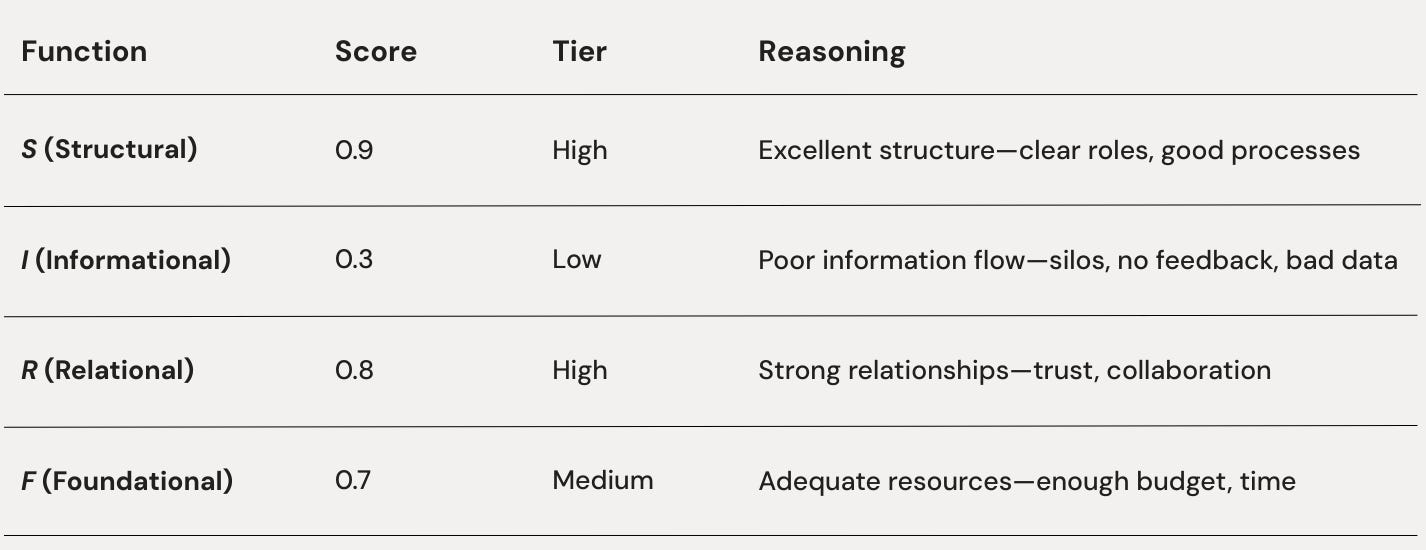
What’s the team’s capacity ceiling?
The team’s ceiling is 0.3—the I-function. No matter how good their structure, relationships, or resources, they’re limited by their information work.
Improving S (already at 0.9): nearly zero gain. You’re polishing what isn’t the constraint.
Improving R (already at 0.8): nearly zero gain. Same problem.
Improving F (at 0.7): nearly zero gain. Still not the constraint.
Improving I (at 0.3): significant gain. This is the bottleneck.
The minimum function is the ceiling. Everything else is non-bottleneck work until the minimum is raised.
The diagnostic power
You know how your phone has a Notes app to keep track of information? That app itself needs things to work:
Somewhere to store the data (structural)
A search function so you can find your notes (informational)
The ability to share notes with people (relational)
Battery power to actually run (foundational)
Your information system needs its own little system to function.
This is true for everything that stays organized.
Your friend’s chat group? That needs a group chat (structure), knowing who knows who (information), actual trust between people (relationships), and time to maintain it (resources).
Zoom into any piece. You find the same four things inside.
We’ll go into SIRF recursion more in 1.10, but here’s what matters now:
When someone says, “I’m bad at staying organized,” that’s too vague to fix.
But “my sorting system has no structure—I just throw everything in one pile”?
You can actually do something about that.
This is what makes SIRF useful. Instead of vague advice (”communicate better,” “build trust,” “get resources”), you can diagnose:
Score each function
Find the minimum
Intervene there
Then interventions become clear:
If the minimum is I, work on information systems—sensing, processing, modeling, feedback.
If the minimum is R, work on relationships—connections, trust, exchange channels.
If the minimum is S, work on structure—roles, processes, boundaries.
If the minimum is F, work on resources—funding, time, energy.
Mismatched intervention wastes effort. If the bottleneck is I and you’re working on R, you’re improving the wrong thing.
What we haven’t covered
The equation has two more terms: A (alignment) and η (efficiency).
Alignment asks: does energy actually go where you say it goes? Organizations claim to prioritize many things. Their calendars and budgets reveal different priorities. Misalignment bleeds capacity.
Efficiency asks: how much is lost in transit? Some systems have high SIRF scores but waste most of their resources through friction, politics, and poor execution.
We’ll address both in upcoming posts. For now, the core point: capacity is a function of four types of work, and the weakest function sets the ceiling.
The SIRF picture
Here’s the full frame:
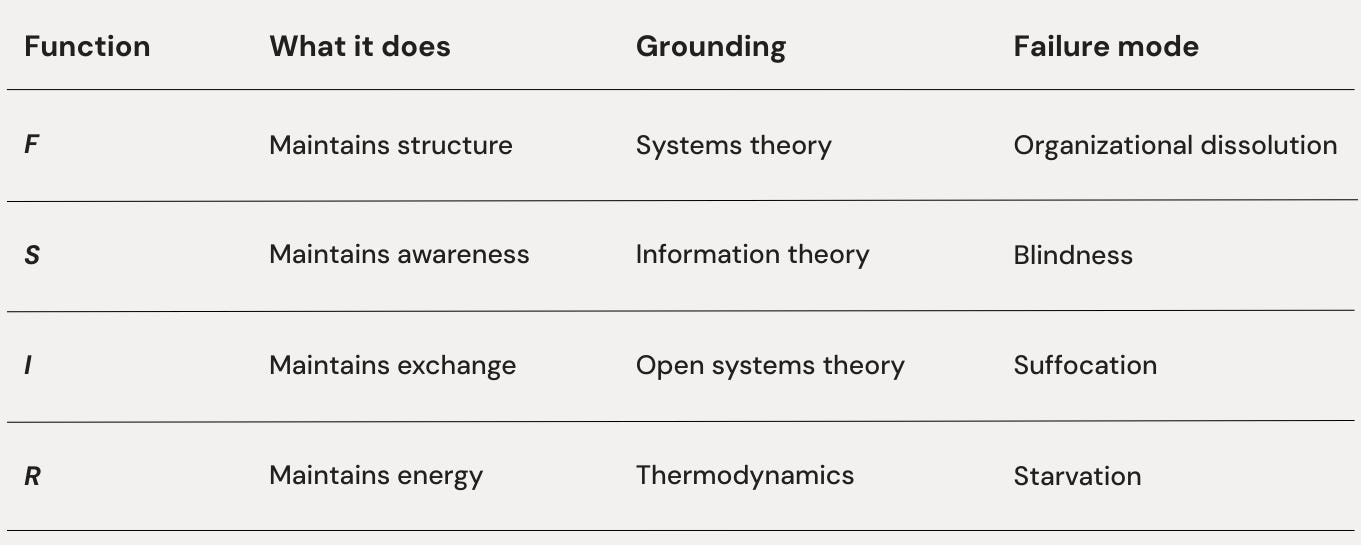
Four functions. Grounded in physics. Independently assessable. Bottleneck-findable.
This is what every system brings to encounters.
Series 1 established what boundaries provide (gradient, complementarity, bandwidth). Series 2 establishes what any system (i.e., you) provides (SIRF capacity).
But before we connect them, we need to understand three consequences of the SIRF structure: bottleneck exclusivity, routing regimes, and alignment gaps.
Application
Notice: Score your current system (you/team/org) 0–2 on each: F, S, I, R. (0=failing, 1=struggling, 2=strong)
Name: Your lowest score is the ceiling (for now).
Test: If you improve the minimum by one step, do you predict a noticeable increase in throughput within a month? If not, your scoring (or the min-claim) is wrong.
Keep in mind: Four types of work are necessary and sufficient for organized complexity. The minimum function sets the ceiling. Bottleneck-targeted intervention beats working on strengths.
The science
Established:
Bottleneck determines throughput. This is Theory of Constraints (Goldratt), validated in operations.
Limiting factor determines growth. This is Liebig’s Law, validated in biology and ecology.
Genesis claim:
SIRF as the specific four-function constraint set. The minimum function sets the capacity ceiling.
Falsification:
If a fifth function exists that doesn’t decompose into SIRF, the framework is incomplete.
If bottleneck-targeted interventions don’t consistently beat random interventions, the “min sets ceiling” claim is wrong.