


The sealed room
Imagine a room with everything you need: food, water, perfect temperature, and comfortable furniture. Now seal it. No exchange with the outside.
How long before you die?
Not long. Even with all resources present, a sealed system fails. Carbon dioxide builds up. Oxygen depletes. Waste accumulates. The system that looked self-sufficient turns out to depend entirely on exchange.
This is Schrödinger’s point, restated. Life persists by eating order and exporting entropy. Stop the exchange—seal the boundary—and the system suffocates in its own excrement.
Closed systems die. Open systems might live. What keeps systems open?
Exchange is work
Being connected isn’t passive. It requires active management.
Consider your relationships. They don’t maintain themselves. You invest time, attention, reciprocity. Stop investing and they decay. The “low-maintenance” relationship is a myth—it’s just a relationship where you don’t notice the maintenance you’re doing.
The same applies at every scale. Trade relationships require cultivation. Supply chains require management. International relations require diplomacy. Being connected is work.
This is the fourth type of work organized systems must do. We’ll call it R—relational work.
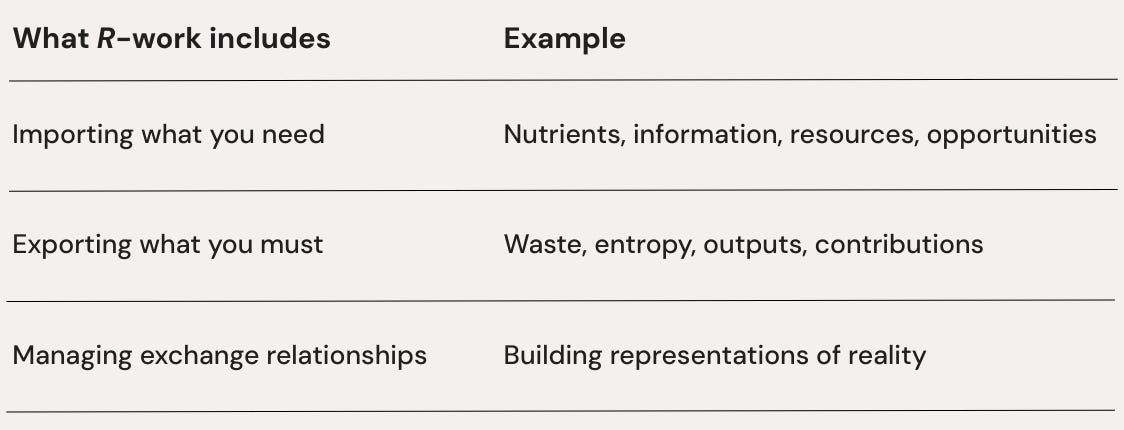
R isn’t just “networking” or social connection. APIs between systems, supply chains, distribution channels, customer feedback loops—these are R-work too. Anything that maintains managed permeability between a system and its environment.
Without R-work, systems close. When systems close, they die.
R vs. I: the distinction
This might seem like I-work (information function). Both involve exchange. But they’re different:
I is about modeling—sensing, processing, building representations. It’s cognitive work. A system with strong I knows what’s happening.
R is about exchange—maintaining the channels through which things flow. It’s relational work. A system with strong R can actually import and export what it needs.
You can have strong I and weak R: you know exactly what’s happening but can’t get what you need or contribute what you have. Good information, no relationships.
You can have strong R and weak I: rich relationships, active exchange, but you don’t understand what’s happening. Connected but confused.
Both matter. They’re not the same.
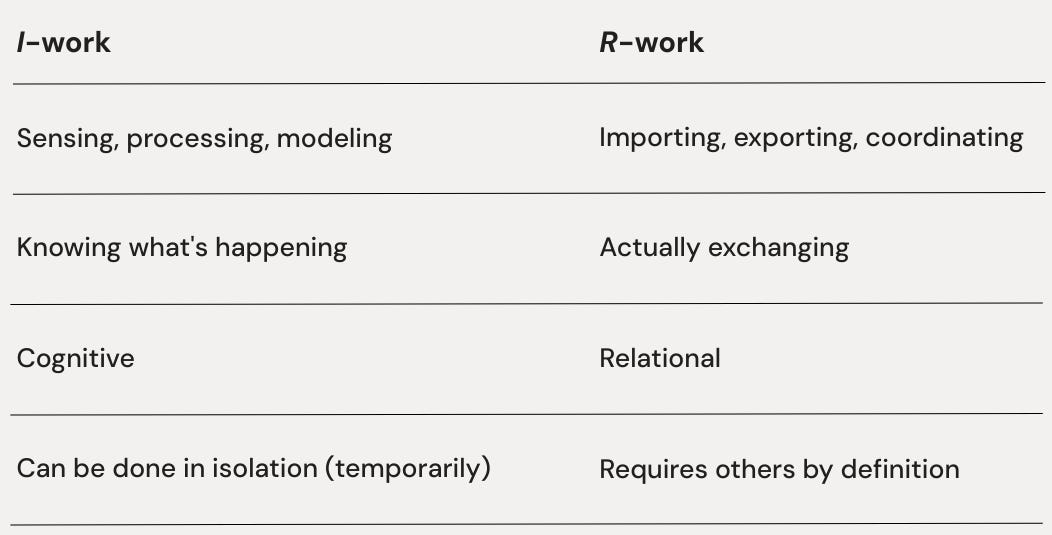
A team can have great information systems (I) but terrible relationships (R)—they know everything but can’t collaborate. Or great relationships (R) but terrible information (I)—they like each other but don’t know what’s going on.
Lineage
Schrödinger: Life requires continuous exchange with the environment. A closed system is a dead one.
Ashby: Law of Requisite Variety—a system can only control what it can match in complexity. Managing relationships requires variety.
Prigogine: Far-from-equilibrium systems require continuous throughput. Stop the exchange, system returns to equilibrium (dissolution).
Pattern: organized complexity requires continuous relational work.
Across scales
R-work looks different at scale:
Cell: Ion channels, nutrient import, waste export. The cell membrane isn’t a wall—it’s a managed interface. Channels selectively import and export. Transport proteins move specific molecules.
The cell’s R-work determines what crosses its boundary.
Individual: Relationships, communication, trust. You maintain connections with people—family, friends, colleagues, acquaintances. These relationships require investment.
Through them, you import what you need (support, information, opportunity) and export what you contribute (care, knowledge, help).
Team: Collaboration, hand-offs, feedback loops. The team maintains internal exchange (between members) and external exchange (with other teams, customers, stakeholders). Think of meeting culture, communication norms, and collaboration practices—these are team-level R-work.
Organization: Partnerships, supply chains, customer relationships. The organization maintains exchange with suppliers, customers, regulators, competitors, partners. Business development, account management, vendor relations—all organizational R-work.
Civilization: Trade, diplomacy, cultural exchange. Civilizations maintain exchange through trade networks, diplomatic relationships, cultural transmission. Isolationist civilizations eventually stagnate—they lose access to the exchange that sustains complexity.
The suffocation pattern
When R-work fails, systems suffocate. Not always quickly—reserves can buffer—but inevitably. Applied to the same scale:
Individual: Social isolation is a major mortality risk factor—comparable in magnitude to classic risks in some studies. The isolated person looks fine for a while—they have resources (F), structure (S), and awareness (I). But without relational exchange, they deplete.
Team: The team that stops talking to users, stakeholders, and other teams. They’re working hard internally. They’re building things. But they’re building in a vacuum. When they finally emerge, the world has moved on.
Organization: The company that cuts partnerships, neglects customers, and treats suppliers as adversaries. Cost savings in the short term. Suffocation in the long term. No one wants to work with them. Exchange dries up.
Civilization: The empire that closes its borders. Initial stability, perhaps. Then stagnation. The innovations happen elsewhere. The trade flows around them. They’ve sealed themselves into a very nice tomb.
The pattern: R-failure produces suffocation. The system has everything it needs internally—and slowly dies for lack of exchange.
Four functions complete
We now have the full set:
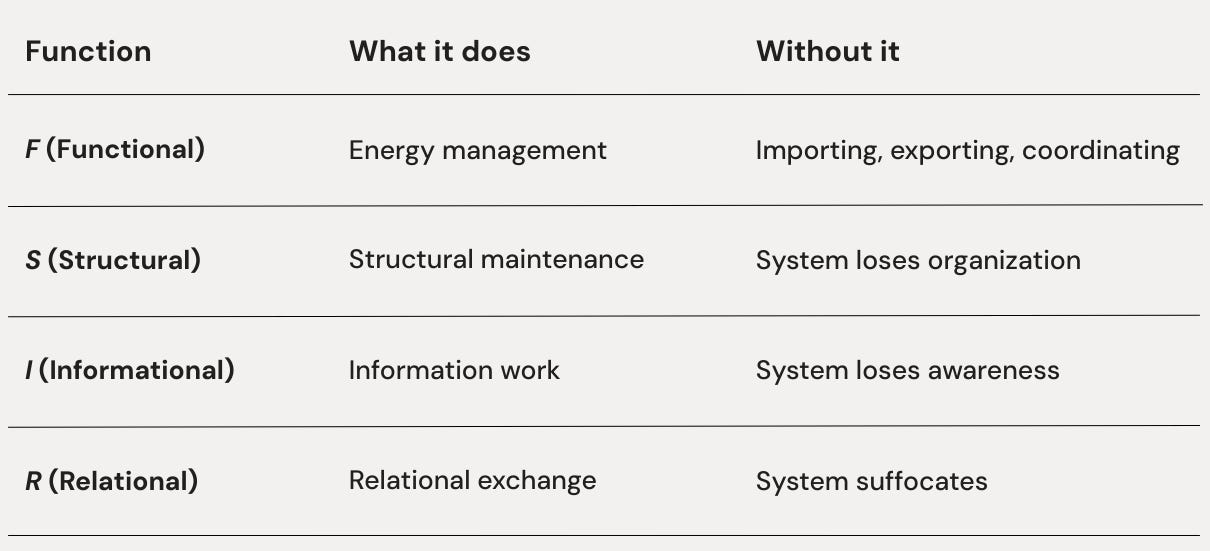
F, S, I, R. Four types of work. Each necessary. None sufficient alone.
This raises the obvious question: Why four? Why these four? Is this arbitrary, or is there something deeper that makes exactly these four necessary and sufficient?
That’s coming next.
Application
Notice: What do you need to import (inputs) and need to export (outputs/waste) to stay healthy?
Name: Are you sealed (few active channels) or porous but unmanaged (too many leaky channels)?
Test: If you strengthened one exchange channel—frequency + reciprocity—would your system’s stability improve without changing F/S/I?
Remember: Exchange isn’t passive—it’s work. Closed systems die. R-work maintains managed permeability between system and environment.
The science
Established:
Open systems require exchange. This is Schrödinger and Prigogine, foundational to understanding life.
Coordination is limited by requisite variety. This is Ashby’s Law, validated in cybernetics and management.
Genesis claim:
R as one of four necessary work-functions for organized complexity.
Falsification:
Closing boundaries should predict system failure independent of F, S, I. Systems maintaining F, S, and I but neglecting R should suffocate.