



Six fields, one gap
We’ve now traced the lineages:
Gradients from thermodynamics (Carnot, Clausius, Onsager)
Complementarity from exchange theory (Ricardo, mutualism research)
Bandwidth from information theory (Shannon, Granovetter, Nonaka)
Relational affordances from ecological psychology (Gibson)
Adjacent possible from complexity science (Kauffman)
Order through exchange from far-from-equilibrium thermodynamics (Prigogine)
Each theory is rigorous. Each has decades of validation. They’ve generated Nobel Prizes, transformed fields, and built new technologies.
And yet, they don’t talk to each other.
What each lineage provides
Here’s what the science provides us:
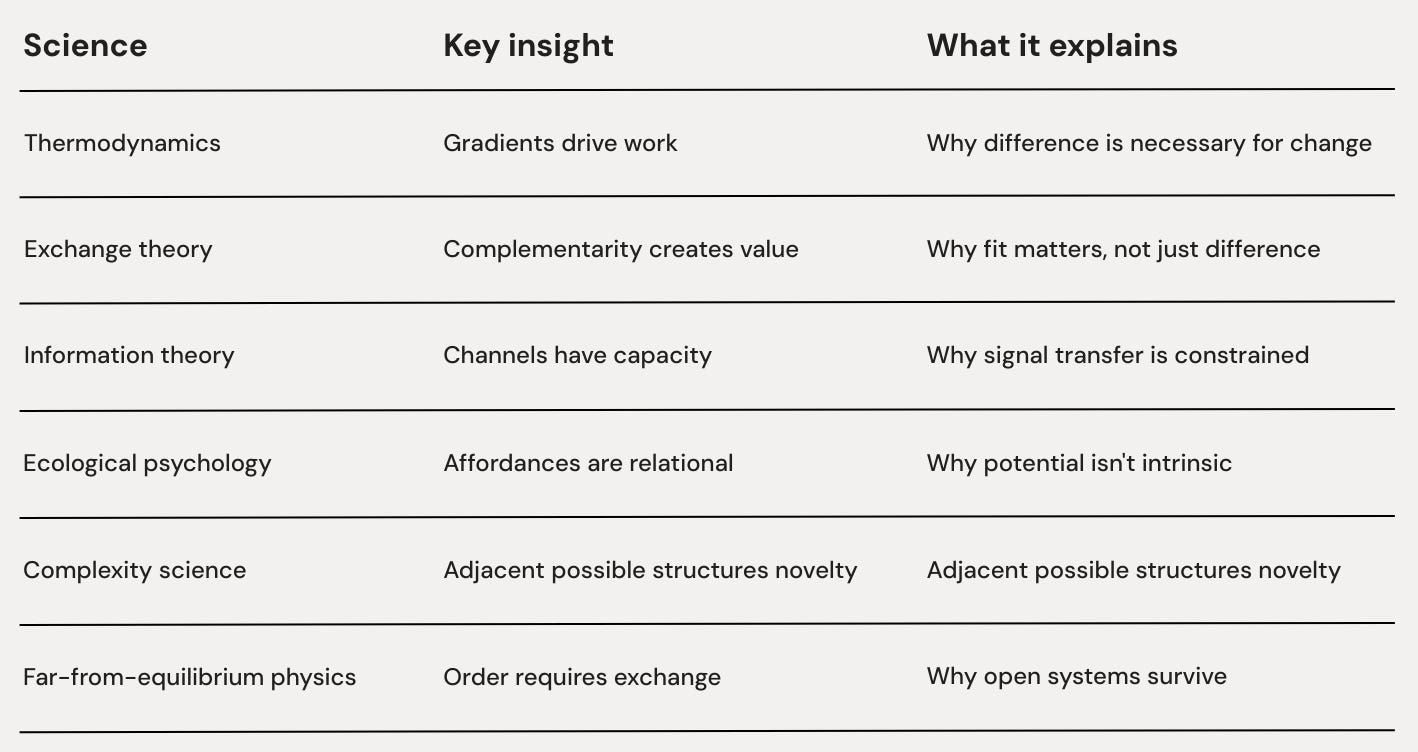
Each piece is solid. Together, they describe transformation.
But not integrated yet.
What each field doesn’t do
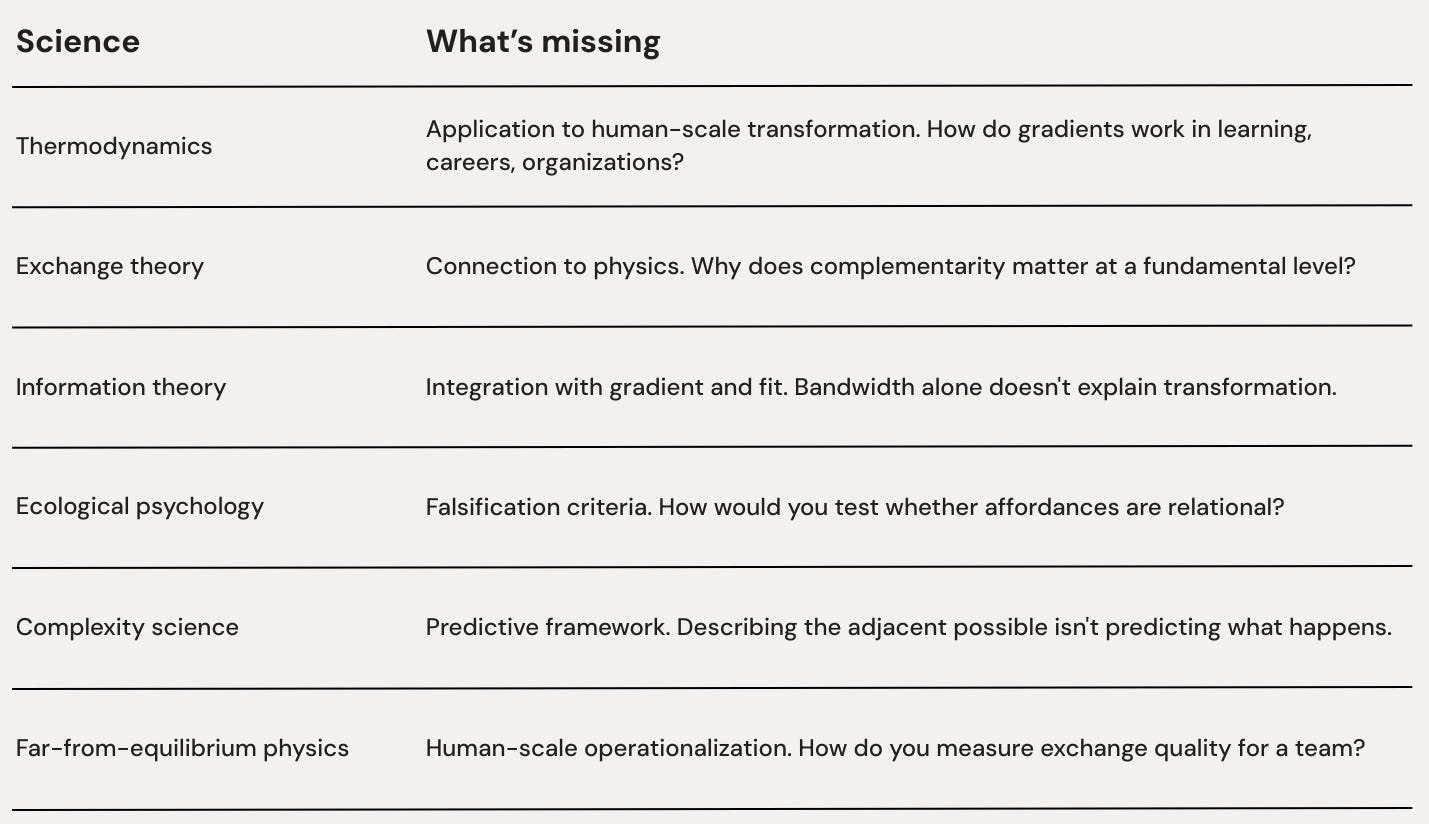
Each field doesn’t ask: How do human-scale systems transform?
Why the gap exists
Academic fields organize around problems and methods, not phenomena.
Physicists study physical systems.
Economists study economic systems.
Cross-disciplinary work is hard to publish, hard to fund, hard to get tenure with.
Result: excellent depth, poor integration.
So their pieces sit in silos—thermodynamics in physics, information theory in engineering, exchange theory in economics. Each validated, none connected.
What Genesis contributes
This theory aims to contribute to the synthesis and integration of those sciences, rather than to individual pieces.
The components aren’t new. Carnot, Shannon, Gibson, Kauffman—these thinkers did the hard work. Genesis doesn’t claim to improve on thermodynamics or information theory.
The claim is different: established physics, human-scale transformation, and falsification criteria.
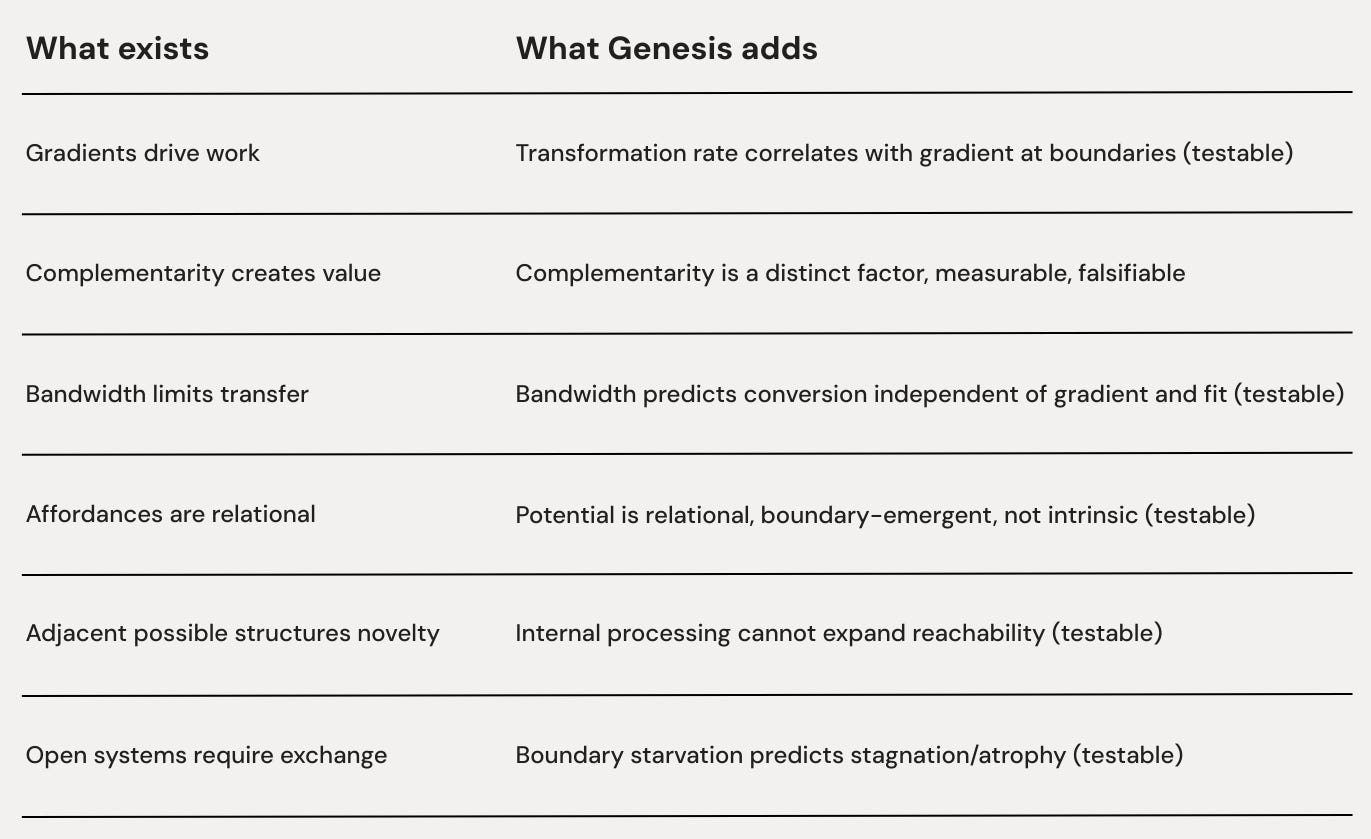
Again, the synthesis is the contribution, not the components.
The complete picture
We’ve built the factors that make encounters rich—gradient, complementarity, bandwidth. But encounter quality is only one piece of what determines potential.
In plain terms:
Encounter quality: Not just contact with a boundary, but quality contact. The gradient (real difference that can do work), complementarity (productive fit, not random novelty), and bandwidth (trust, clarity, signal crossing). We’ve spent the last several posts building these factors because they determine whether a boundary offers anything worth converting. Without quality encounters, potential stays sparse—there’s nothing substantial to work with.
Ψ (capacity): What you bring. Your readiness to do something with what you meet. The structural integrity to hold new configurations. The informational capacity to process what's happening. The relational capacity to actually exchange. The reserves to fuel the work. Capacity determines how much of what's available you can actually reach.
Φ (field): What the environment permits. The conditions surrounding the encounter. A supportive field amplifies what’s possible. A hostile field constricts it. The same person with the same capacity at the same type of encounter converts differently depending on whether the field helps or blocks.
Three variables. One output.
This changes where you look when something feels stuck.
Low potential? Most people assume they need to build more capacity—read more books, develop more skills, add more knowledge, or earn more credentials. Sometimes that’s true. But the equation reveals two other failure points:
Maybe capacity is fine, but encounters lack quality. You’re ready to convert, but what crosses your boundary has low gradient, poor fit, or blocked bandwidth. The monk in the monastery, cards in hand, yet no one to play with.
Or maybe encounters and capacity exist, but the field blocks expression. A hostile environment that penalizes the very conversion you’re capable of. High Ψ, good encounters, low Φ. The physics permits; the field doesn’t.
The equation doesn’t tell you which variable constrains you. It tells you there are three places to look.
The confidence tiers
Let’s be precise about what we’re claiming:
~95% confidence: The physics foundations. Thermodynamics, information theory, and open systems theory are validated sciences. Gradients drive work. Channels have capacity. Closed systems die. This is validated.
60% confidence: The three-factor model. Gradient, complementarity, and bandwidth as the specific factors determining boundary quality. This is synthesis—applying established physics to a new domain. Strong grounding, but the specific operationalization needs empirical validation.
60% confidence: Boundary-emergence as origin of potential. The claim that net-new potential only emerges at boundaries. Thermodynamically grounded, consistent with complexity science, but the universality claim requires testing.
This is how Genesis holds itself: confident about foundations, provisional about synthesis, explicit about what would prove it wrong.
What would falsify this?
If this integration adds nothing, domain-specific frameworks should predict transformation as well as the integrated model.
Here’s a concrete example:
High gradient + high complementarity + low bandwidth should predict “frustrating non-conversion.” The difference exists. The fit is there. The signal can’t cross. If you know all three factors, you should predict failure mode more accurately than if you know any single factor.
In practice, we can rank encounters by G/C/B and predict conversion probability. If rankings don’t outperform single-factor predictions, this synthesis is unnecessary.
Specifically:
If thermodynamics alone were sufficient, knowing gradients should fully predict transformation. But you also need complementarity and bandwidth.
If exchange theory alone were sufficient, knowing fit should fully predict. But you also need gradient and bandwidth.
If information theory alone were sufficient, knowing channel capacity should fully predict. But you also need gradient and fit.
The integration claim is that you need all three, and the integration predicts better than any piece alone.
Where we’re going
Civilization got us here. We survived. We built institutions that fed billions, connected continents, and extended lifespans. If the goal was survival, job well done.
But survival isn’t thriving. And the physics we’ve been building on—potential as intrinsic, waiting to be unlocked—may have capped what’s possible.
If potential is actually boundary-emergent, then every institution, market, school, company, and city is encounter architecture. We’ve been shaping boundaries for millennia—but optimizing for the wrong thing. Sorting people instead of connecting them. Hoarding access instead of multiplying it. Building walls where we needed membranes.
What would it look like to build for thriving? Thriving products, ecosystems, organizations, households, people?
Post 1.10 takes the synthesis to its logical conclusion.
Application
Notice: Recall one encounter that failed and one that succeeded.
Name: For each, identify the lowest of G/C/B.
Test: If the integrated model is real, the lowest factor should correctly predict the failure mode (stagnation vs. friction vs. stuck transfer) more reliably than “motivation,” “intelligence,” or “effort.”
Key claim: The physics pieces exist, but weren’t integrated. Genesis adds: established physics, human-scale transformation, and falsification criteria.
The science
Established:
Each science has been independently validated. Thermodynamics, information theory, exchange theory, ecological psychology, and complexity science—all validated.
Known but contested:
Whether these integrate into a single framework. The pieces exist. The synthesis is debated.
Genesis claim:
The integration, aimed at human-scale transformation, with falsification criteria.
Falsification:
If integration adds nothing, domain-specific frameworks should predict as well as the integrated model.