



Two brilliant people, going nowhere
Two brilliant people meet, both experts in their fields. Each has knowledge the other lacks, so there’s clearly a gradient.
The conversation goes nowhere. They talk past each other. An hour later, both leave with nothing new.
What happened?
Gradient exists, but something else was missing.
Difference isn’t enough
Post 1.6 established that gradients drive work. But gradient alone doesn’t guarantee productive exchange. The difference has to fit.
Consider the gradient between me and a paper written in Mandarin. The knowledge difference is real. Information I don’t have exists on that page. But I can’t read Mandarin. The gradient exists; I can’t use it until it’s translated.
Or consider a quantum physicist explaining advanced topology to a child. Massive gradient. Zero transfer. The difference is so large that nothing can flow.
Or consider an introvert and an extrovert with nothing else in common. They’re different—but in ways that don’t complement. The gradient doesn’t produce mutual benefit.
Gradient is necessary, but it’s not enough on its own.
The difference must be complementary—must fit together in a way that lets both parties gain from the exchange.
What complementarity means
Complementarity is mutual usability: each side has something the other can absorb, and the exchange improves both.
Think of puzzle pieces. Two different pieces can fit together—each provides what the other lacks. But two random shapes, however different, might not connect at all. Difference doesn’t equal fit.
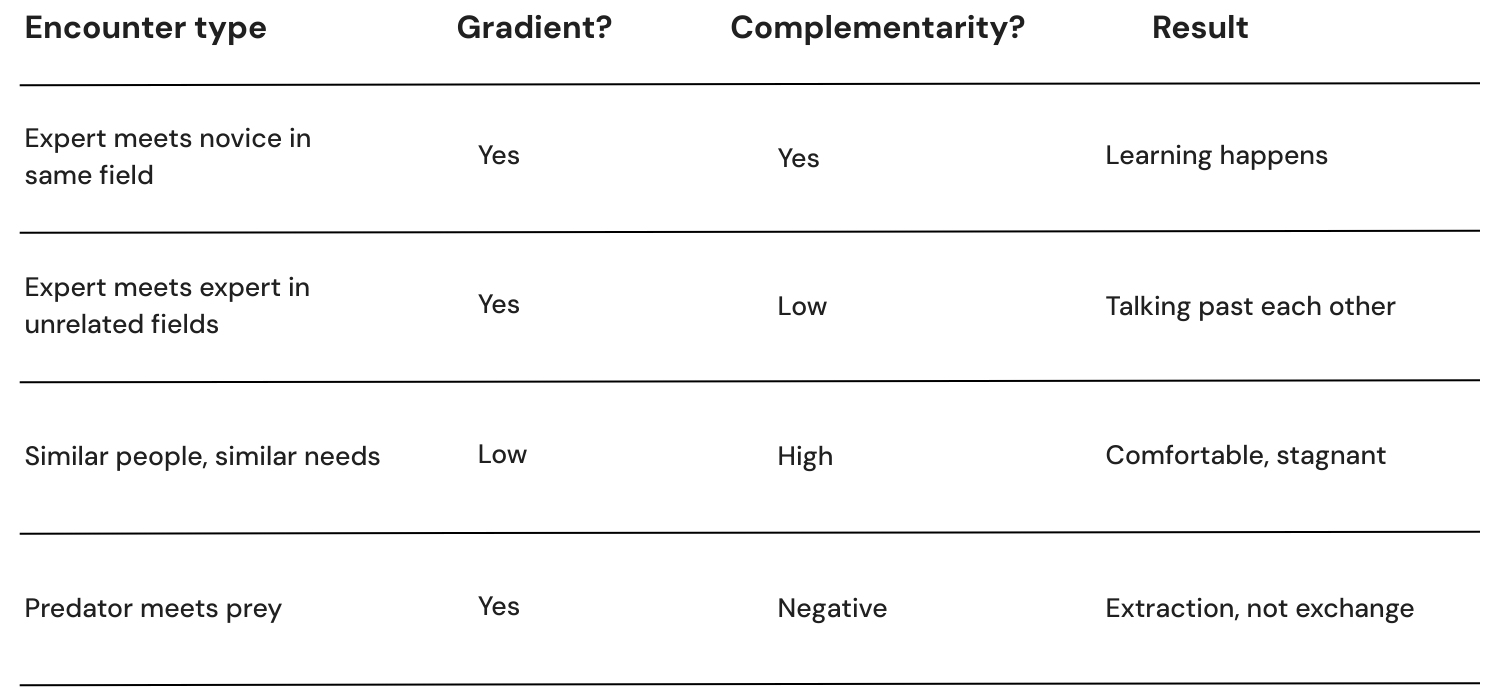
That last row matters.
Some pairings are extractive, not generative—flow exists, but one-sided. Complementarity can be negative—one party benefits at the other’s expense. That’s extraction, parasitism, predation. There’s gradient, and there’s flow, but the relationship isn’t mutual.
One more example: a brilliant product idea meets a market that can’t adopt yet. Gradient exists (the innovation is real). But low complementarity—the market can’t metabolize it. The fit isn’t there.
True complementarity is mutualistic: both parties gain from the exchange.
Lineage
Complementarity has deep intellectual roots:
Ricardo: Comparative advantage. Trade works when parties have different relative capabilities that complement.
Mutualism research: Symbiotic relationships require fit. Random pairing of different species doesn’t produce mutualism—the difference must fit.
Team composition research: Diversity alone doesn’t predict performance. Diversity plus integration does.
Pattern across fields: difference enables, fit converts.
Why random networking fails (part 2)
Post 1.5 explained why networking often fails despite access. Now we can say more:
Random collisions are gradient without complementarity.
Meeting strangers at an event gives you exposure to difference. But what fit exists? You have no way of knowing whether your differences complement.
Most encounters will be like the physicist and the child—a gradient exists, but very little transfers because of poor fit.
This is why warm introductions work better than cold approaches. The introducer is (implicitly) claiming complementarity: “You two should meet—you each have something the other needs.”
This is why curated communities outperform open conferences. Curation is a complementarity filter. Someone has identified who fits together.
And this is why the best encounters are often structured: mentorship programs, mastermind groups, and well-designed teams. The structure engineers for complementarity, rather than hoping a random collision produces it.
Culture fit vs. culture add
Organizations struggle with this when hiring.
“Culture fit” hiring prioritizes similarity. Hire people who are like us. This maximizes complementarity (they fit!), but harms gradient. Everyone’s the same. The team becomes low-tension, comfortable, and stagnant.
“Culture add” hiring prioritizes difference. Hire people who bring something new. This maximizes gradient—but can destroy complementarity. The new person is different, but do their differences fit? Can the organization metabolize what they bring?
The answer isn’t fit or add. It’s fit and gradient. Hire people who are different in ways that complement what exists.
This is harder than either extreme. It requires knowing what complementarity means for your specific situation. What difference would fit? What gap needs filling? What would genuinely integrate, versus just create friction?
The complementarity check
When evaluating a potential encounter—a job, a relationship, a partnership—gradient is the first question: what’s the difference?
Complementarity is the second question: does the difference fit?
Specifically:
Can I metabolize what they offer? (Do I have the capacity to absorb the gradient?)
Can they metabolize what I offer? (Is the flow mutual?)
Is the exchange mutualistic or extractive? (Do both parties gain?)
High gradient with low complementarity produces frustration. So close, yet so useless.
High complementarity with low gradient produces comfort. Pleasant, but no transformation.
High gradient and high complementarity produce generative encounters.
One factor left
We have gradient (difference that can do work) and complementarity (difference that fits).
One factor remains: what happens when gradient and complementarity exist, but the signal can’t get through?
That’s bandwidth, the subject of the next post.
Application
Notice: Think of a recent “high-gradient” interaction that produced nothing.
Name: Which side failed? I can’t metabolize them, they can’t metabolize me, or it’s extractive?
Test: If complementarity is the issue, a curated match (warm intro, scoped collaboration, clearer role) should outperform random collision even with the same “difference.”
Keep in mind: Difference isn’t enough. The difference must be complementary—each side able to absorb what the other offers, with both gaining from the exchange.
The science
Established:
Complementarity affects exchange outcomes. This is established in economics (comparative advantage), ecology (mutualism), and organizational psychology (team composition).
Team diversity requires integration to produce value. Diversity without fit often produces conflict, not innovation.
Genesis claim:
Complementarity as a distinct boundary factor. Not just “fit” in a vague sense, but a specific variable that, together with gradient and bandwidth, predicts encounter quality.
Falsification:
High-gradient, low-complementarity encounters should underperform. If complementarity doesn’t matter independently, gradient alone should predict outcomes. It doesn’t.