


The perfect mentorship?
The mentor has wisdom. Years of experience, hard-won insight, genuine desire to help.
The student wants to learn. Hungry, capable, ready to absorb.
The fit is there—they’re working on similar problems, different enough to have gradient, complementary enough to benefit from exchange.
But every conversation gets interrupted. Meetings get rescheduled. Communication happens through three layers of bureaucracy. When they do talk, there’s no privacy to discuss what really matters. The formal channel can only carry formal content.
What happens to the potential?
It doesn’t convert. The gradient exists. The complementarity exists. But the signal can’t cross. The channel is too narrow, too noisy, too constrained.
This is bandwidth: the third boundary factor. And when it’s missing, even perfect matches produce nothing.
What bandwidth means
Bandwidth is channel quality—how much signal survives the crossing.
In information theory, every channel has a capacity. You can only push so many bits per second through a wire. Add noise, and the effective capacity drops—some of what you send gets corrupted. Exceed the capacity, and information simply doesn’t transfer.
The same logic applies to human encounters. Access gives you gradient. Bandwidth determines whether anything actually crosses.
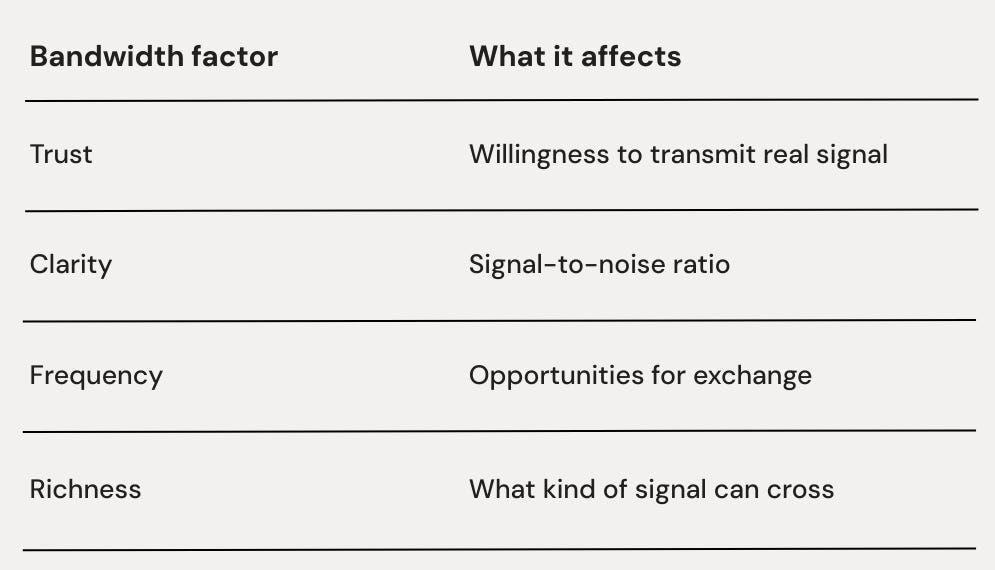
Let’s take each:
Trust determines what people are willing to send. Without trust, communication becomes guarded, and the signal is filtered before it leaves. The mentor shares the official story, but not the real lessons. The colleague gives the safe answer, not the useful one. Low trust means low signal, regardless of channel capacity.
Clarity determines the extent to which noise corrupts the signal. Ambiguous language, cultural mismatches, and unstated assumptions—all add noise. The sender transmits one thing; the receiver hears another. The signal degrades in transit.
Frequency determines the number of opportunities for exchange. A single conversation, however high-quality, can only transfer so much. Complex knowledge requires repeated interaction. Infrequent contact results in a lower total transfer, even if each interaction is high-bandwidth.
If you read a book a thousand times, its meaning will reveal itself.
—Chinese proverb
Richness determines what kind of signal can transfer. Some knowledge is explicit—it can be written down, sent via email. Some knowledge is tacit—it requires demonstration, practice, high-bandwidth interaction. Try learning to ride a bike from a manual. Try absorbing someone’s judgment through a memo. Richness constrains what can cross.
Lineage
The physics of channel capacity is well-established:
Shannon: Channels have finite capacity. Noise degrades signal. Now mathematical fact.
Granovetter: Tie strength affects information flow. Weak ties give access; strong ties enable deep transfer.
Nonaka: Tacit knowledge requires rich channels. You can’t email someone into expertise.
Pattern: Channel matters. What transfers depends on the properties of the path.
How institutions destroy potential
In theory, a large organization should be a high-potential environment.
Large organizations often have both gradient and complementarity. Different parts of the organization know different things (gradient). Those differences could be valuable to other parts (complementarity).
In practice, knowledge gets stuck. R&D discovers something the sales team could use. It doesn’t transfer. Sales learns something about customers that product teams need. It doesn’t transfer. The potential is there; the conversion doesn’t happen.
Why? Bandwidth.
The channels between silos are low-trust (political consequences for sharing), low-clarity (different jargon, different contexts), low-frequency (no regular interaction), wrong-medium (memos instead of conversation). The gradient and complementarity are real. The signal can’t get through.
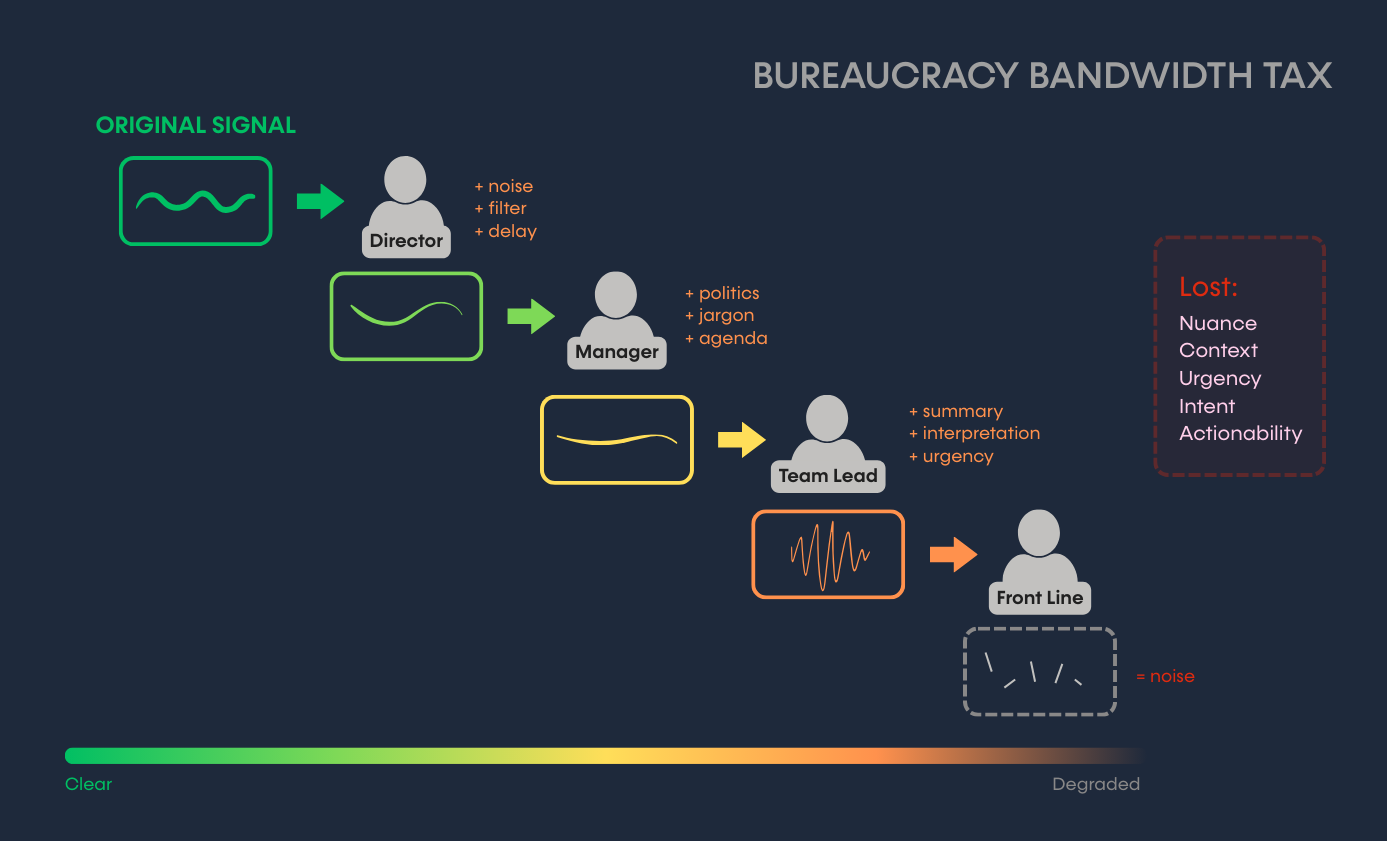
Bureaucracy is a bandwidth tax. Every approval layer, every formality, every political consideration adds noise and reduces capacity. By the time the signal navigates the org chart, it’s degraded beyond usefulness.
This isn’t a moral failing. It’s physics—plus incentives. Low-bandwidth channels can’t transfer a high-bandwidth signal.
Why high-trust relationships transfer more
On the flip side, consider the relationships in which real transfer occurs.
The mentor you could call at 2 am with a dumb question. No judgment, no filtering, no need to perform. High trust.
The collaborator you’ve worked with for years. Shared vocabulary, shared context, minimal need to explain. High clarity.
The partner you see every week, building on previous conversations. High frequency.
The co-founder you work alongside, observing and adapting in real time. High-bandwidth medium.
These relationships transfer more not because the people are smarter, but because the channel is wider. More signal gets through. Less gets lost in transit.
This is why deep relationships are irreplaceable, even in a world of infinite access. Access gives you gradient. Only bandwidth gives you transfer.
The complete three
We now have the full picture of what boundaries provide:
Gradient: A difference that can do work. No gradient, no transformation.
Complementarity: A fit that makes the difference usable. No fit, no conversion.
Bandwidth: A channel that can transfer the signal. No bandwidth, no exchange.
All three are necessary. None alone is sufficient.
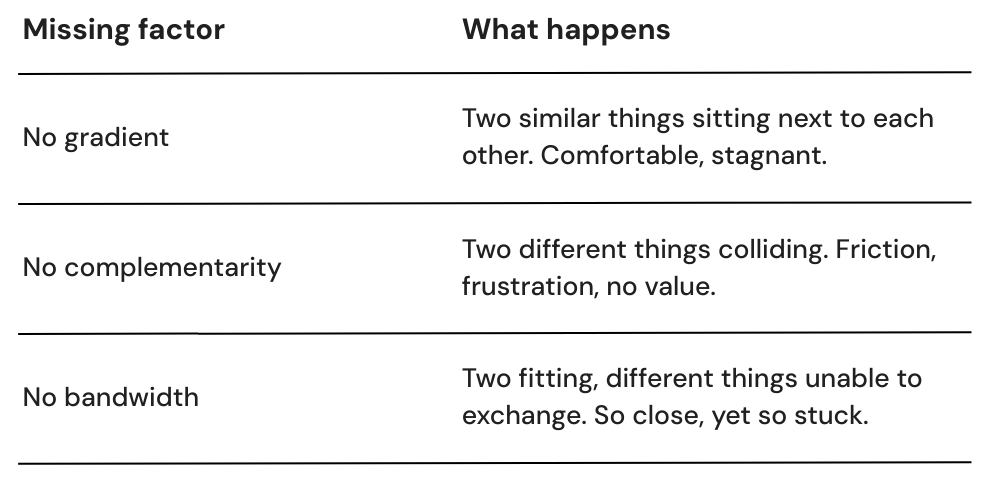
When you evaluate encounters—potential jobs, relationships, partnerships, collaborations—run all three checks:
Is there a difference? (gradient)
Does the difference fit? (complementarity)
Can the signal get through? (bandwidth)
High scores on all three: high-quality boundary, high potential for transformation.
Low score on any one: something will block the conversion.
One question remains
We’ve grounded all three factors in physics. Gradient from thermodynamics. Complementarity from exchange theory. Bandwidth from information theory.
But why weren’t these integrated before? Why does each science know its piece, but no one talks to the others?
That’s the subject of Post 1.9.
Application
Notice: Pick an important relationship or collaboration that “should work” but doesn’t.
Name: Which bandwidth limiter is dominant—trust, clarity, frequency, or richness?
Test: If you improve only that limiter (e.g., higher frequency, richer medium), conversion should rise even if gradient + complementarity stay the same.
Remember: Channel quality determines what can transfer. Access gives you gradient. Bandwidth determines whether anything actually crosses.
The science
Established:
Channel capacity limits information transfer (Shannon). This is mathematical fact.
Tie strength affects knowledge transfer (Granovetter). Strong ties transfer different things than weak ties.
Tacit knowledge requires rich channels (Nonaka). Some signal can only cross high-bandwidth paths.
Genesis claim:
Bandwidth as the third boundary factor in a unified model. Not just “communication matters,” but a specific variable that combines with gradient and complementarity to predict encounter quality.
Falsification:
Equivalent gradient and complementarity should produce different outcomes at different bandwidths. If bandwidth doesn’t matter independently, controlling for gradient and complementarity should eliminate its predictive power. It doesn’t.
Next: 1.9 — What they left unfinished