



The retreat that didn’t work
Have you seen this before?
A team goes on a retreat. No external input, just that team, alone and focusing inward. They do trust falls, brainstorm sessions, and values exercises. They come back... and nothing changes. Maybe a temporary bump in morale, then regression to baseline.
Why? No boundaries. They reconfigured what was already in the room. The retreat was an internally-focused intervention for a boundary-starved system.
Now consider the alternative: a team that spends the same amount of time on an external challenge. Customers who push back. Experts who expose gaps. Problems that exceed the team’s current capability. The gradient is real, encounters become generative, and people come back different.
Same time investment. Opposite architectures. Different outcomes.
A multi-billion-dollar category error
The self-help industry generates billions per year in the United States alone. Most of it rests on a single assumption:
Potential lives inside you, waiting to be unlocked.
The feeling is right. More IS available. The industry built itself around a real intuition—people correctly sense there’s something to unlock.
But when they designed interventions, they pointed them inward. The language gives it away.
“Unleash your potential.”
If boundary-emergence is true, this constitutes a category error at industrial scale.
It’s a fundamental misunderstanding of where potential comes from—baked into billions of dollars of advice, millions of hours of effort, and countless interventions that work on the wrong variable.
Two frames, opposite prescriptions
Let’s make this concrete.
Internalism says potential is a property you have. Like height or intelligence, it’s an internal attribute. You possess some amount of it. Development means unlocking more of what’s already there.
Relationalism says potential emerges at boundaries. It’s not a property but a relationship. You don’t “have” potential—you access it through encounters. Development means engineering better boundaries.
These aren’t just different emphases. They prescribe opposite interventions:
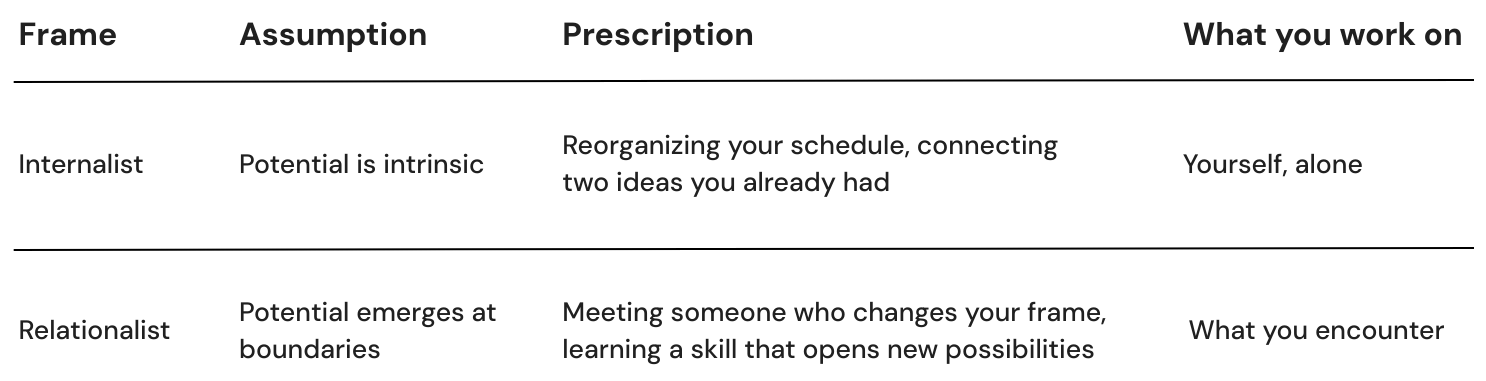
If internalism is right, then retreats, journaling, and solo optimization should reliably produce transformation.
If relationalism is right, internalist practices hit diminishing returns fast—and the real gains come from what you encounter.
Why internalist interventions plateau
Think about what happens with common self-improvement practices:
Meditation and introspection. Valuable for clarity, calm, and self-knowledge. But practitioners consistently report a plateau. After a certain point, more cushion time doesn’t produce more transformation. Why? Because you’re reconfiguring what’s already inside. The deck isn’t getting bigger.
Goal-setting and visualization. Useful for focus and commitment. But visualization without new input tends to recycle existing imagery. You can only visualize possibilities you’ve already encountered. The adjacent possible doesn’t expand through memory alone.
Discipline and habit optimization. Real gains in efficiency and consistency. But optimizing within your current possibility space doesn’t expand the space. You get better at running on the same track, not at reaching new tracks.
“Inner work” and self-help programs. Genuine benefits for processing past experience and reducing internal friction. But the transformation tends to asymptote. Something else is needed.
Notice the pattern: each of these works, up to a point. Then it stops working. The practice didn’t fail—it hit the ceiling of what internal processing can do.
Note: internal practices do build real capacity. Meditation, discipline, and self-knowledge are real. The failure is treating them as the primary engine of expansion. They prepare you to convert; they don’t generate the potential to convert.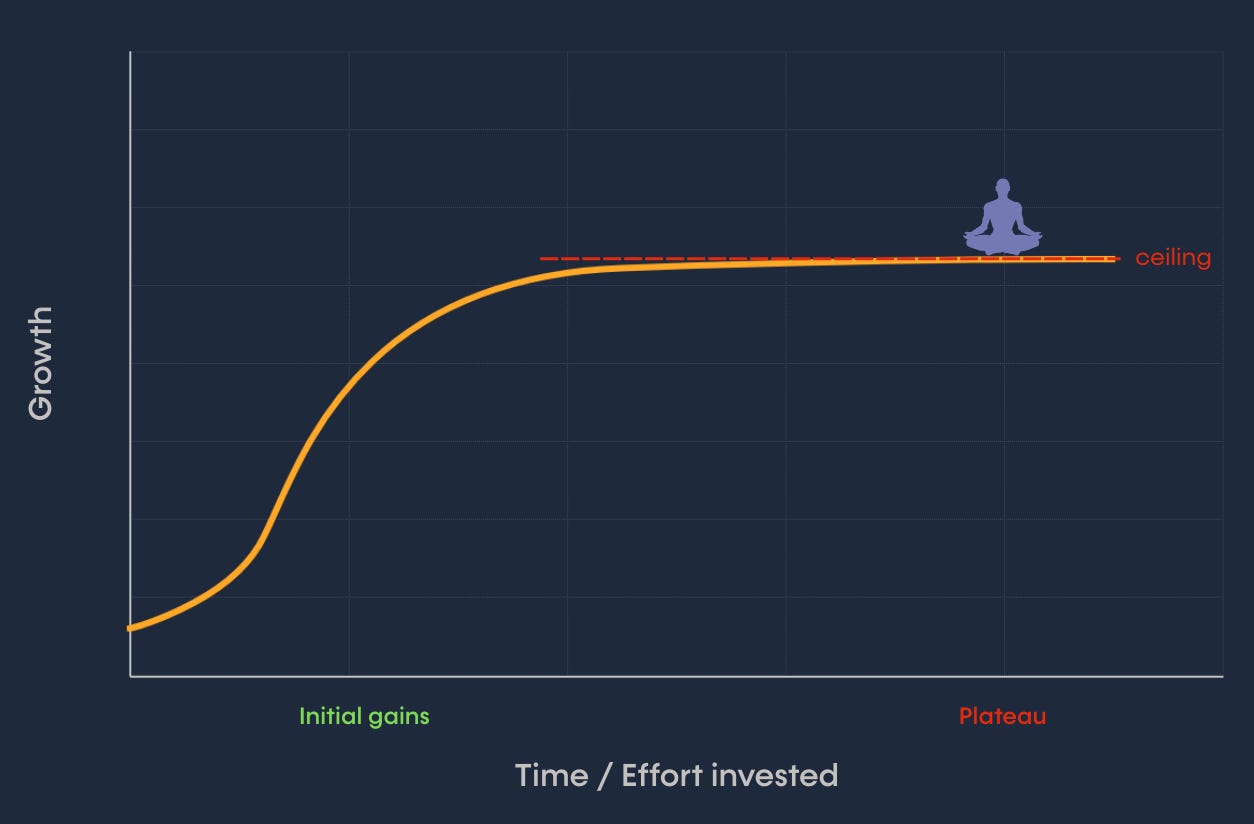
What actually produces transformation
Now consider what consistently produces transformation:
New relationships. Not just anyone different—someone whose difference creates productive tension. A mentor who sees gaps you can’t. A collaborator whose strengths meet your weaknesses. A challenger who won’t let your assumptions slide. The encounter transforms because the gradient is real and the fit is there.
New environments. Not just new zip codes—environments that won’t let you recreate old patterns. Travel that disrupts assumptions, not resort tourism. Job changes that demand new capabilities, not lateral moves. The transformation comes from differences you can’t avoid or insulate against.
New problems. Not just any problem—problems at your edge. Challenges that exceed current capability, but not by so much that you can’t engage. The problem forces encounter with the unknown—if you actually work it, not just think about it.
New ideas. Not just reading more—engaging with perspectives you have to wrestle with, not just consume. Cross-disciplinary collisions where translation is required. The novelty comes from contact you can’t easily dismiss.
In each case, the transformation comes from boundaries—not from deeper excavation of what was already inside.
Scale this up
Individual:
“Why don’t I grow when I work on myself?” → Boundary starvation
“Why did that trip/relationship/crisis change me?” → Boundary encounter
Team:
“Why did the offsite fail?” → Team-internal intervention, boundary-starved system
“Why did that partnership transform us?” → High-quality boundary, adequate capacity
Organization:
“Why doesn’t leadership development work?” → It develops internal capacity without providing boundaries to convert
“Why do external crises sometimes catalyze real change?” → Boundary encounter generates potential that the system could metabolize
The pattern is consistent. Internalist interventions plateau. Boundary interventions transform—if the capacity to convert it exists.
The fix isn’t more effort
When internalist interventions fail, the internalist explanation is “try harder.”
But if the ceiling is structural—if the problem is boundary starvation, not insufficient effort—then “trying harder” doesn’t help. It consumes capacity during reconfiguration, while the real constraint (boundary access) remains unaddressed.
The fix isn’t more effort. It’s more quality encounters.
Which raises the question: if boundaries matter so much, why don’t all boundary encounters produce change? Why do some encounters transform everything while others do nothing?
That’s where we’re going next.
Application
Notice: What’s your current “improvement plan”?
Name: Is it targeting capacity (skills/health/resources), boundaries (who/what you encounter), or boundary quality (gradient/fit/bandwidth)?
Test: If you ran the plan for 90 days with zero new boundaries, would you expect a step-change in outcomes? If not, it’s probably capacity-only.
Keep in mind: Internalism treats potential as internal property; relationalism treats potential as boundary-emergent. They prescribe opposite interventions. Internalist interventions plateau; boundary interventions transform.
The science
Established:
Skill acquisition requires external feedback (deliberate practice research). Internal practice without feedback plateaus quickly.
Social learning requires interaction (Bandura). We don’t learn complex behaviors from introspection alone.
Genesis claim:
Internalism vs. relationalism as a falsifiable, intervention-guiding distinction. Not just different emphases but different predictions about what works.
Falsification:
If internalism is physics-backed, internalist interventions (introspection, visualization, self-optimization) should produce transformation as reliably as boundary interventions. They don’t.