



The room where nothing happened
You got into the room.
You landed the meeting with the investor, the mentor, the decision-maker. You enrolled in the prestigious program. You joined the high-powered team. You accessed the boundary everyone said you needed.
And... nothing changed.
If potential is boundary-emergent, this shouldn’t happen. The boundary existed. Potential should have emerged. What went wrong?
Here’s the uncomfortable truth: access isn’t enough. You can be in the room where it happens and leave unchanged.
Not all boundaries are equal. Something about the encounter itself determines whether potential emerges and converts—or whether two systems collide and bounce off, unchanged.
The three factors
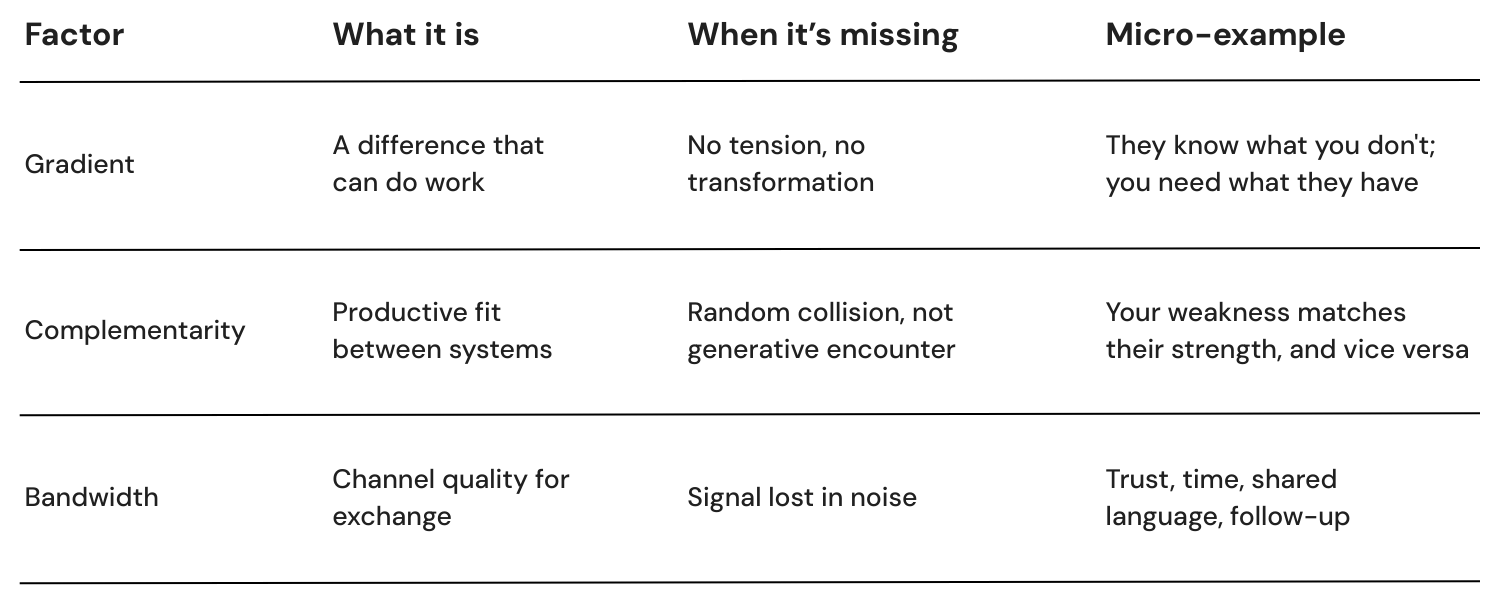
Boundaries provide three things. If any is missing, potential doesn’t convert.
We’ve touched on these before:
Gradient: A difference that can do work.
If there’s no difference between the two systems meeting, nothing can flow. Hot meets hot—no heat transfer. Expert meets expert with identical knowledge—nothing to exchange. Similar meets similar—comfortable, but stagnant. Gradient is the precondition for any transformation.
Complementarity: Productive fit between parties.
Difference isn’t enough. The difference has to fit—each party having something the other can use. A gradient exists between me and a quantum physicist, but if I can’t metabolize quantum physics, the potential can’t convert. Complementarity means the gradient produces mutual benefit, not just collision.
Bandwidth: Channel quality for exchange.
Gradient and fit can exist, but if the signal can’t get through, nothing transfers. Trust determines what people are willing to transmit. Clarity determines signal-to-noise ratio. Frequency determines how many opportunities exist for exchange. Medium determines what can be transmitted—some knowledge requires high-bandwidth channels.
One high-bandwidth complementary gradient beats a hundred weak collisions.
These are boundary properties—characteristics of the encounter itself. (What you bring to the encounter is a separate question. We’ll get there in Series 2.)
Why networking fails
This explains why “networking” rarely works as advertised.
Networking optimizes access. Go to events. Collect contacts. Get in more rooms.
The theory: more boundaries equals more potential.
But what kind of boundaries? Random collisions with strangers you’ll never see again. Low gradient (everyone at the event has similar backgrounds). Low complementarity (no structured fit). Low bandwidth (thirty seconds of small talk, no trust, no follow-up).
More access to low-quality boundaries doesn’t compound into transformation. It compounds into business cards in a drawer.
Compare this to what actually produces value: a single high-quality relationship.
Someone who has what you lack (gradient).
Whose needs your strengths address (complementarity).
With whom you’ve built trust and frequency of contact (bandwidth).
One boundary encounter like this outperforms a hundred conference handshakes.
Networking advice gets the direction wrong. It’s not about maximizing access. It’s about maximizing boundary quality × access. And quality always matters more than quantity.
Mentorship and its failures
Why do some mentors transform you while others just give advice?
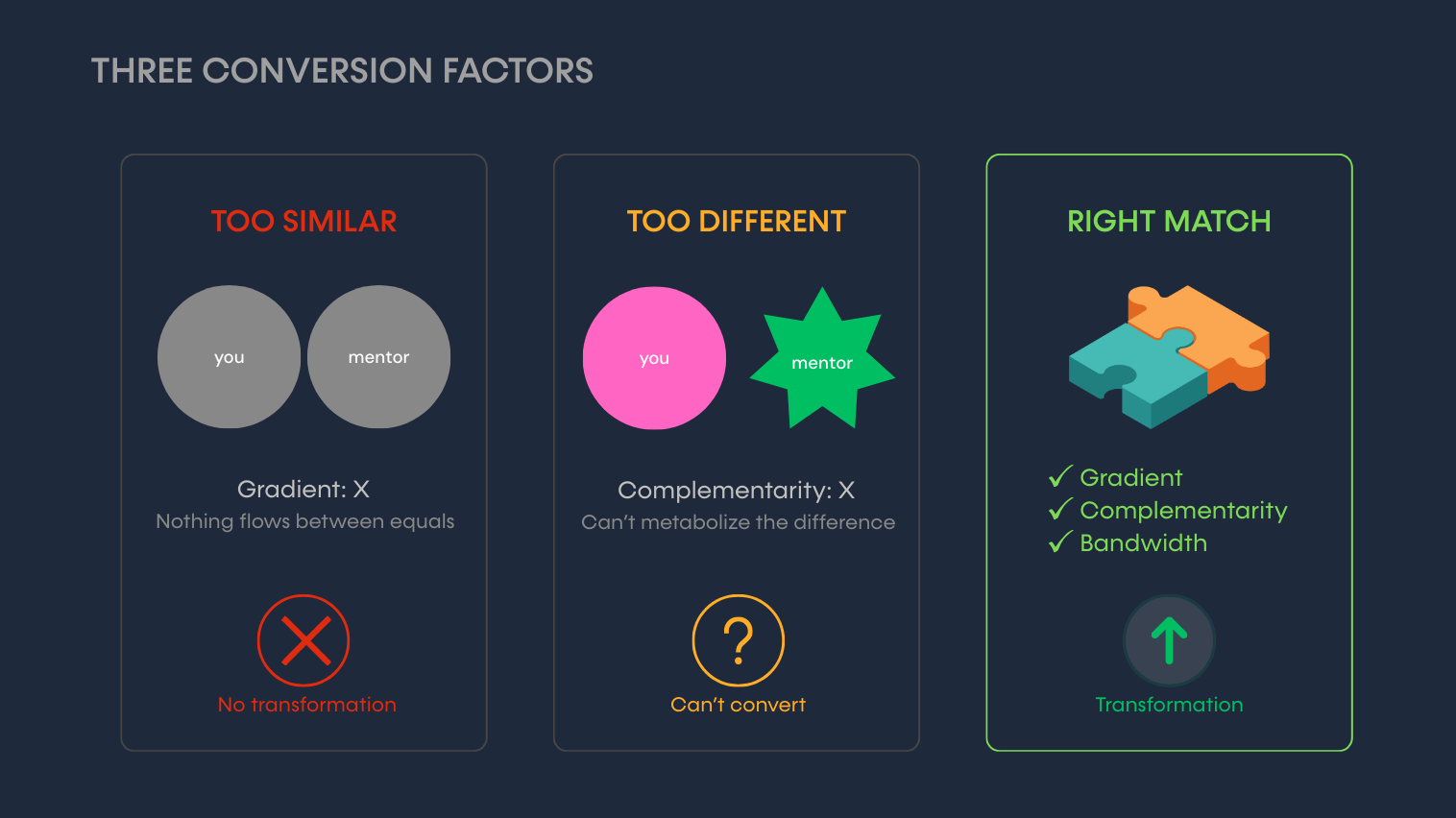
A mentor who’s too similar—no gradient. They’ve walked your path, but they can’t offer what you don’t already have. Comfortable, validating, not generative.
A mentor who’s too different—gradient without complementarity. They’re brilliant at something you can’t absorb. The gap is too wide; a poor fit. Impressive, perhaps, or alienating, but ultimately, not generative.
A mentor you only see once—gradient and complementarity, but no bandwidth. Their insight can’t transfer in a single interaction. The relationship doesn’t have the trust or frequency to move real signal.
The transformative mentor: genuinely different from you (gradient), but in ways that fit what you need (complementarity), with enough trust and contact to transmit real knowledge (bandwidth).
All three factors. Miss any one, and the boundary underperforms.
Partnerships and their failures
Scale this up to organizations.
Why do some partnerships create value while others extract it?
Extraction often looks like gradient without complementarity. One party has leverage over the other—there’s a difference that can do work, but the work only benefits one side. The gradient is real, but the relationship is parasitic rather than mutualistic.
Stagnation looks like complementarity without gradient. The partners are similar. They get along great. Their needs match. But nothing new emerges because there’s no difference to drive transformation.
Failure to execute looks like gradient and complementarity without bandwidth. The strategic logic is perfect—different capabilities that fit together. But the implementation fails because the actual exchange channels don’t work. Different systems, different languages, no trust, bureaucratic barriers. The signal can’t get through.
The partnerships that create value: real differences (gradient), that fit together productively (complementarity), with channels that can actually transfer (bandwidth).
The three factors at every scale
Individual:
That one teacher who changed your life:
gradient (they knew what you didn’t)
complementarity (it fit what you were ready to learn)
bandwidth (they had time and attention for you).
That credential that did nothing? It got you in the room—but presence isn’t conversion. Access without encounter quality is just expensive attendance.
Team:
Collaborations that click? Difference, fit, and communication.
Collaborations that drain? One or more factors go missing.
Organization:
Acquisitions that synergize? The capabilities genuinely complement, and the integration channels work.
Acquisitions that destroy value? Gradient might exist, but no fit or no bandwidth for actual integration.
The same three factors predict encounter quality across scales.
What’s coming
We’ve identified the three factors. But where do they come from? What’s the physics underneath?
Posts 1.6, 1.7, and 1.8 will ground each factor in established science:
Gradient comes from thermodynamics. Work requires free energy differences.
Complementarity comes from exchange theory. Trade requires fit.
Bandwidth comes from information theory. Transfer requires channel capacity.
The factors aren’t arbitrary. They’re physics, applied at human scale.
Application
Notice: Pick your last 3 “important” encounters—meetings, collaborations, introductions that were supposed to matter.
Name: Score each 0–2 on: Gradient (was there real difference?), Complementarity (did the difference fit?), Bandwidth (could signal actually transfer?). 0=missing, 1=weak, 2=strong.
Test: Your lowest factor predicts the failure mode. If you improved only that factor next time, would conversion rise?
Remember: Boundaries provide three things—gradient (difference that can do work), complementarity (productive fit), and bandwidth (channel quality). Missing any one, and the encounter doesn’t convert.
The science
Established:
Interaction quality predicts outcomes better than exposure time. High-quality relationships outperform large networks.
Complementarity affects partnership success. Mutualism research shows fit matters.
Genesis claim:
The three-factor boundary quality model: gradient, complementarity, bandwidth as the specific determinants of whether boundaries generate and convert potential.
Falsification:
If access alone were sufficient, boundary quality scores shouldn’t predict conversion after controlling for access frequency. They should.