


Potential is relational
Here’s the claim we’ve been building toward:
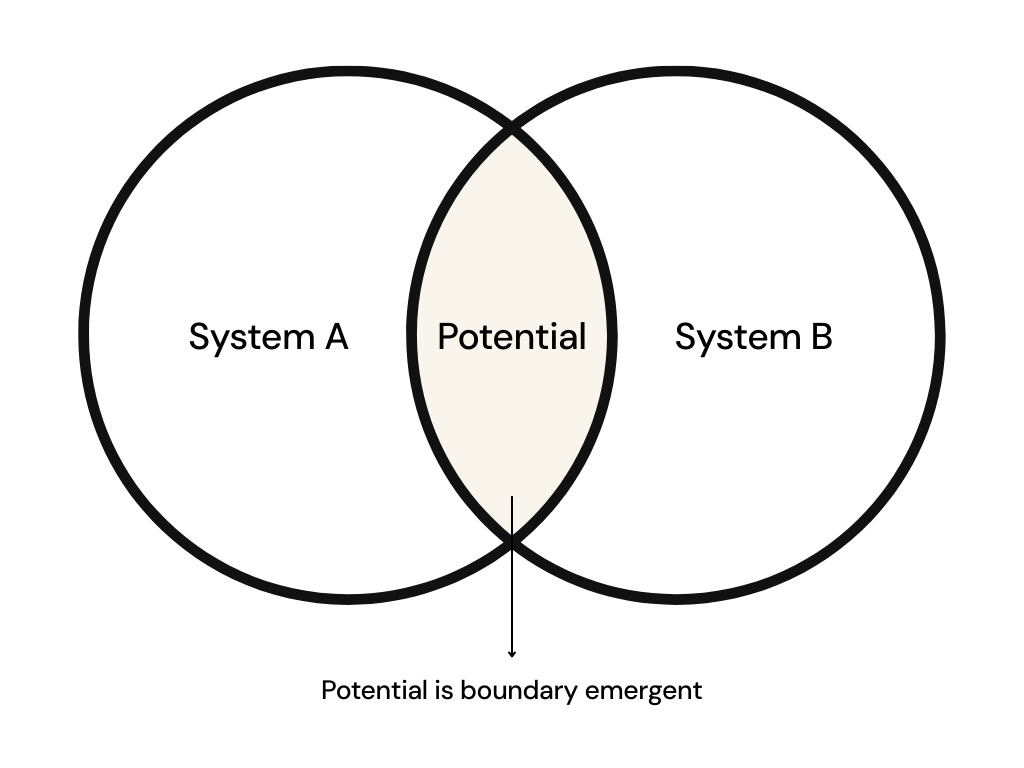
Potential doesn’t live inside you waiting to be unlocked. It emerges at boundaries—when organized complexity meets organized complexity.
Your next opportunity, your next capability, your next version don’t exist yet. They’re not stored somewhere, waiting. They emerge, or not, depending on what you encounter.
Net-new potential is boundary-emergent, not intrinsic.
What counts as a “boundary”? Three examples:
Person ↔ person: A mentor, collaborator, or challenger who thinks differently than you
Person ↔ problem: A new domain, project, or challenge that demands capabilities you don’t yet have
Organization ↔ market: The interface between what you offer and what reality actually needs
Anywhere organized complexity meets organized complexity—that’s where potential emerges.
Let that land for a moment. If it’s true, almost everything changes.
What boundaries generate
When you encounter something outside yourself—a person, a problem, an environment, an idea—three things can happen that couldn’t happen in isolation:
1. New gradients appear.
In physics, a gradient is a difference that can do work.
Think of it like a slope: if you put a ball on a hill, the height difference can move it. No slope, no motion.
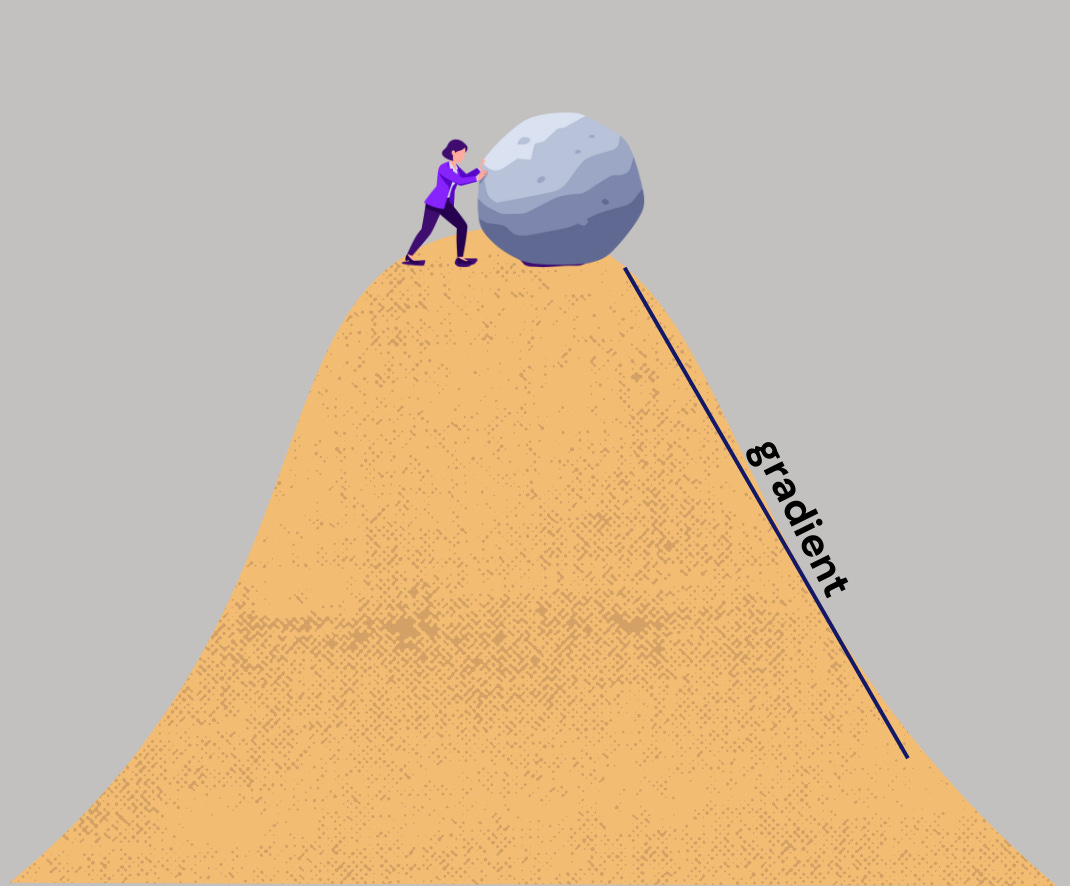
Hot moves to cold. Pressure moves from high to low. And know-how moves from someone who has it to someone who needs it—if they can actually transfer it.
Alone, you can work hard and still stay in the same box. Encounters can create new gaps, and gaps enable movement.
2. New complementarities form.
You have something; someone else needs it. They have something; you need it.
It’s not just difference—it’s fit.
Like two puzzle pieces: neither piece creates the match by itself. The complementarity is a property of the relationship, not either party.
Before an encounter, complements don’t exist. It might be more accurate to say “it wasn’t available,” but you get the point.
Complementarity isn’t a thing you own. It’s a thing that happens between two things.
3. New bandwidth opens.
New paths for exchange. New ways for signal to move—information, energy, resources.
Bandwidth is a property of the connection: how much can actually transfer, how reliably, how richly.
None of this is something you can generate purely inside yourself. You can build capacity. You can seek boundaries.
But you can’t create a transfer channel alone. You need a connection—like a bridge, a pipe, or a high-signal link.
Why capacity still matters
This doesn’t mean internal processing is useless. It does real things:
Reconfiguration: You can rearrange what you know—new combinations, new connections. Valuable. But it’s still a fixed deck.
Optimization: Within your current space, you can navigate better—more skill, less waste, better habits. Important. But it doesn’t create new options.
Preparation: You can build capacity so that when the right boundary appears, you convert it. Crucial. But it’s readiness, not expansion.
Internal processing improves what you can do inside your current possibility space.
Boundary encounters are what can add new cards to the deck.
You can get better without becoming new.
What about breakthroughs in isolation?
“But I’ve had breakthroughs in isolation. Meditation. Psychedelics. Experiences that changed everything without any external encounter.”
These aren’t counterexamples. They’re internal boundaries.
Meditation (especially intensive practices such as Vipassana) provides access to aspects of yourself normally below the awareness threshold—suppressed material, patterns, and sensations that don’t surface in ordinary consciousness. Silence and sustained attention open a boundary between the conscious ego and the subconscious structure. That’s a real encounter with genuine difference. The “other” just happens to be inside you.
Psychedelics are even more dramatic. It creates novel cross-talk between brain regions that don’t normally communicate. You’re meeting your own mind as a stranger—your neural architecture operating in an unfamiliar configuration.
The claim isn’t that boundaries must be external. It’s that potential emerges from encountering difference—structure you don’t already consciously possess. Vipassana and psilocybin work because they give you access to a structure that was always there but wasn’t available to conscious processing.
That’s not rearranging the deck. That’s finding cards you didn’t know you had.
The formal picture
If you want precision, here’s how this cashes out:
Let’s say your current state can give you access to a set of possible futures—we’ll call this your reachability set, or your option space. These are the states you could get to from where you are now.
Internal processing can move you around within that set—unless it opens access to a new internal structure, as is the case with serious meditators. You can reach different points. You can optimize your path. But the set itself doesn’t change.
A boundary encounter can expand the set. New points become reachable that weren’t reachable before. Your option space of what’s possible grows.
This is why “more effort” often doesn’t work. If your option space doesn’t contain where you want to go, no amount of internal optimization gets you there. You need a boundary encounter (a change-generating event) that expands the set.
In plain terms: thinking moves you around inside what’s already possible; encounters make new outcomes possible.
The test case: creativity
Consider how creative breakthroughs actually happen.
The mythology says: genius retreats to a secluded space, thinks hard, and emerges with the breakthrough. The idea came from within.
The reality is that, almost every time, the breakthrough emerged from a collision.
Darwin’s theory emerged from boundary encounters—the Galápagos, Malthus’s population essay, and years of correspondence with other naturalists.
Newton’s physics emerged from engagement with Kepler, Galileo, and the problem space of his time.
Einstein was steeped in electrodynamics, reference frames, and synchronization.
Breakthroughs in machine learning (ML) arose from interactions among computing, data, and novel architectures.
The “lone genius” narrative erases the boundaries. It attributes that genius to internal depth rather than what actually emerged from encounters.
This doesn’t diminish the genius—it explains it. Creative people are often those who maintain rich, diverse boundaries and have the capacity to convert what those boundaries generate.
They’re not better at internal processing. They’re better at positioning themselves where potential emerges.
So what?
If potential is boundary-emergent, then development isn’t about unlocking what’s inside. It’s about encounter architecture—shaping what you meet and how you meet it.
If this is true, then most “development” programs likely misfire. The real intervention isn’t inside people—it’s in the encounter landscape they can access.
That’s why the same person can look like a genius in one setting and average in another.
And that scales: from individuals to teams to institutions to entire societies.
For people, growth is less “discipline” and more who/what you regularly collide with.
For teams, performance is less “motivation” and more interfaces—handoffs, feedback loops, decision rights.
For organizations, innovation is less “vision” and more boundary access to reality—customers, competitors, constraints.
For society, inequality isn’t only resource distribution—it’s unequal access to high-quality boundaries (education, networks, capital, safety, information).
Development becomes encounter architecture: expanding access, improving boundary quality, and building capacity to convert quality encounters.
Development, at every scale, is about two things:
Access boundaries that generate potential
Build capacity to convert that potential
Work on one without the other and you either starve (high capacity, no boundaries) or drown (rich boundaries, no capacity).
Where we’re going
If potential is boundary-emergent, then certain frames are wrong (Post 1.4).
Access isn’t enough—boundaries have quality factors (Post 1.5).
Those factors have underlying physics (Posts 1.6-1.8).
The physics pieces exist but weren’t integrated (Post 1.9).
And if all this is true, then civilization itself is encounter architecture (Post 1.10).
But first, we need to see what the boundary-emergence claim breaks.
Application
Notice: List your 3 most important current “edges” (a person, a problem, and/or a market) where you’re getting real feedback—not just thinking alone.
Name: Are you boundary-rich (many active edges) or boundary-poor (few edges)?
Test: If you added one high-quality boundary this month (e.g., a mentor, a demanding customer, a hard problem, a high-signal community), would you expect a step-change in what becomes possible?
Remember: Potential doesn’t live inside you waiting to be unlocked. It emerges at boundaries—when a system meets something real.
The science
Established:
Open systems require exchange with environment to persist (Schrödinger). This is thermodynamics.
Affordances are relational—they exist in the organism-environment relationship, not as intrinsic properties (Gibson).
The adjacent possible structures novelty (Kauffman). Innovation happens at boundaries.
Genesis claim:
Formalizing boundary-emergence as the origin of net-new potential. Not just a useful frame, but a claim about where the raw material of possibility comes from.
Falsification:
If potential were intrinsic, systems should be able to generate net-new reachable states through pure internal processing. They can’t.