



The next version of you
Your next insight isn’t in your head yet. Neither is your next relationship, your next opportunity, your next version of yourself.
Where will they come from?
The intuitive answer: from within. Think harder. Reflect deeper. The breakthrough is in there somewhere—you just have to find it.
But try an experiment. Sit in a quiet room with no input—no books, no conversations, no new information of any kind. Just you and your ordinary thoughts. Not meditation, not altered states—just normal rumination.
You’ll wait a long time.
Now try something different. Have a conversation with someone who thinks differently from you. Read something outside your field. Visit a place that disrupts your assumptions. Work on a problem with someone whose skills complement yours.
Ideas appear. Possibilities emerge. Things become thinkable that weren’t thinkable before.
What’s the difference?
Reconfiguration vs. expansion
When you think in isolation, you’re doing something real—but it’s a specific kind of operation.
You’re reconfiguring. Taking the elements already inside you—memories, concepts, skills, beliefs—and rearranging them. Finding new combinations. Making new connections between existing pieces.
This is valuable. It’s how you organize what you know. It’s how you prepare to act on what you’ve learned. It’s how you integrate experience.
But it doesn’t expand what’s possible for you. The raw material stays the same. You’re shuffling a deck, not adding cards.
Two claims, different strengths:
Weak claim: Internal work can create new combinations from existing elements.
Strong claim: Expansion requires new elements entering the system—which only happens at boundaries.
The weak claim is obviously true. The strong claim is the one that matters.
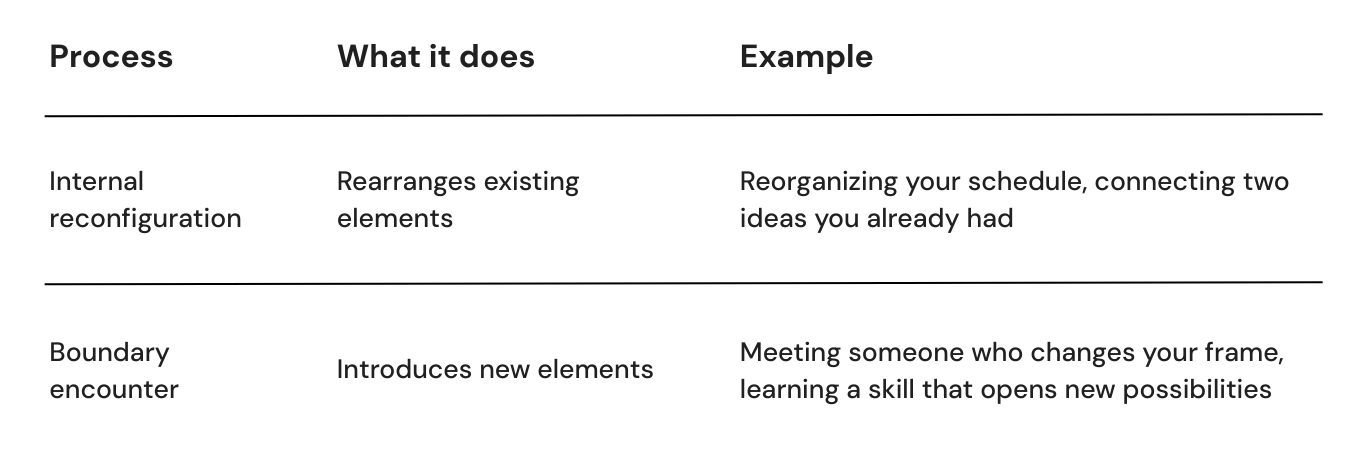
When you encounter something outside yourself—a person, an idea, a problem, an environment—new elements enter. The deck gets bigger. Possibilities that didn’t exist before now exist.
What counts as a “new card”? A tool you didn’t have. A dataset you couldn’t access. A collaborator with skills you lack. A constraint that forces new approaches. An environment that changes what’s thinkable. Each expands what’s possible in ways that internal reconfiguration can’t.
The adjacent possible
Stuart Kauffman, studying the origins of life and the nature of innovation, gave this a name: the adjacent possible.
At any moment, the space of what you could become isn’t infinite. It’s constrained by what you are now. Your next states are adjacent to your current state—one step away, not ten.
But here’s the key insight: those steps are at the boundaries.
Think about how innovation actually works.
A new technology doesn’t appear from nowhere. It emerges when existing elements—tools, knowledge, problems, materials—combine in new ways.
The steam engine emerged when metallurgy, thermodynamics, and industrial need encountered each other.
The smartphone emerged when touchscreens, miniaturized computing, and mobile networks met.
The adjacent possible is structured. Not everything is one step away. Only the things that can connect to what already exists.
And those connections happen at boundaries—where one system meets another.
Three ancestors
This isn’t new. Several traditions saw pieces of it:
Kauffman: The adjacent possible structures innovation paths. What’s possible next depends on where things meet.
Prigogine: Order emerges at boundaries where energy flows through. Isolation equals death. He won the Nobel Prize in Chemistry for this work.
Gibson: Affordances are relational—they live in the relationship between organism and environment, not in either alone.
Each saw something true. But all build toward a new synthesis.
Why this matters
Once you see that novelty comes from boundaries, not from internal depths, several things click into place:
Diverse networks outperform homogeneous ones. Not because diversity is a nice value to have, but because diverse networks have more boundaries. More boundaries means more places where the adjacent possible can expand. Homogeneous networks are comfortable—and stagnant. The encounters produce less novelty as differences diminish.
Travel, collaboration, and cross-disciplinary work generate insight. Not because they’re stimulating in some vague sense, but because they create boundary encounters. You meet ideas, problems, new experiences, and ways of thinking that weren’t in your existing deck. The adjacent possible expands.
“Thinking harder” has diminishing returns. Reconfiguration is valuable, but it’s limited by what’s already inside. After a certain point, more internal processing produces less and less novelty. The system needs new input—which means boundaries.
This is why the most creative people aren’t the ones who think the hardest in isolation. They’re the ones who maintain rich boundary encounters while having enough capacity to convert what those boundaries offer.
The stronger claim
Post 1.1 established that potential and capacity are distinct. Capacity is internal; potential is relational—and get them mixed up all the time.
Let’s add to that insight:
The reason potential is relational is that novelty itself comes from boundaries.
Internal processing can reconfigure. Only boundary encounters can expand.
If novelty requires boundaries, and potential is the space of what you could become, then potential doesn’t sit inside you waiting. It emerges at boundaries.
That’s next.
Application
Notice: Pick one recent “insight” you had alone. Did it, by itself, change your outcomes?
Name: Was it simply reconfiguration (new arrangement of existing elements) or expansion (new capabilities/options generated)?
Test: Identify what “new card” got added to your deck—person, tool, constraint, context. If no new card entered, expect limited expansion.
Remember: Internal processing reconfigures existing elements; only boundary encounters add new elements and expand what’s possible.
The science
Established:
The adjacent possible structures innovation paths (Kauffman). This is established in origins-of-life research and innovation studies.
Network diversity predicts innovation output (brokerage research). Structural holes and bridging ties consistently outperform dense, homogeneous networks.
Genesis claim:
Internal processing reconfigures but cannot expand the possibility space. Only boundary encounters expand what’s reachable.
Falsification:
If internal processing could generate genuine novelty, the rate of innovation should correlate with internal investment (thinking time, reflection, meditation) as strongly as with boundary encounter quality. It doesn’t.