


The isolation test
“Unlock your potential.”
You’ve heard it a thousand times. And it’s not entirely wrong—there IS something locked. Something to unlock. More available than you’re currently accessing.
But what if the lock isn’t where you think?
“Unleash your potential” implies potential sits inside you like gold in a vault. Find the right key—the right mindset, habit, belief—open the vault, treasure releases.
Try it. Lock yourself in a room. No distractions. No other people. Just you and your stored-up potential, finally free to emerge.
What happens is nothing. Or rather, what could happen is rearrangement. You reorganize what you already know. You recombine existing ideas. You might get clearer on something—but you don’t get new. After a week alone, you haven’t expanded what’s possible for you. You’ve just shuffled the deck.
Now try the opposite. Spend a week in intense conversation with someone who thinks differently from you. Work on a problem with a collaborator who has skills you lack. Travel to a place that challenges your assumptions.
Something different happens. New possibilities appear—ones that didn’t exist before the encounter.
This points to a distinction that changes everything.
Two different things
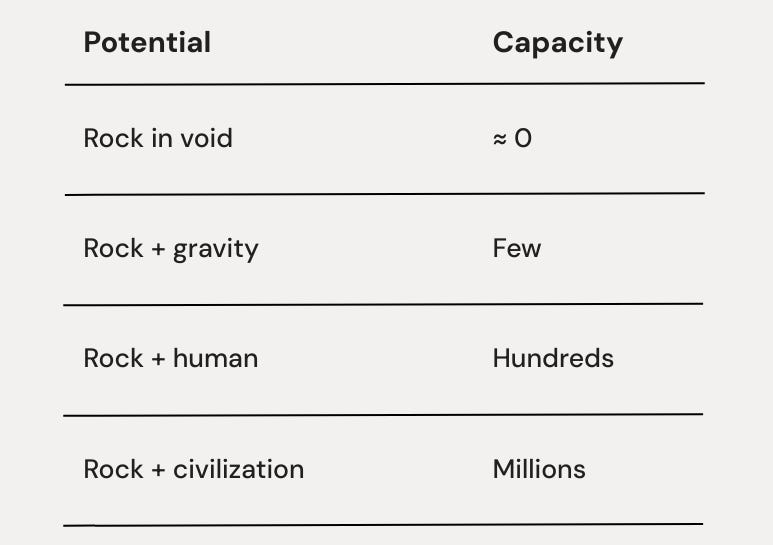
A rock alone has almost no potential. It can roll downhill. It can erode. That’s about it.
A human alone has more potential—but still limited by bare hands.
The human-rock encounter: tool, weapon, hammer, grinding surface, art material, foundation stone, cairn marker. Futures neither could reach alone.
Who “has” this potential? Neither. It doesn’t exist until the encounter. The rock didn’t store it. The human didn’t unlock it. The boundary generated it.
We use “potential” loosely. “She has so much potential.” “That company isn’t living up to its potential.” “You need to reach your full potential.”
But what do we actually mean?
Usually, we’re conflating two things:
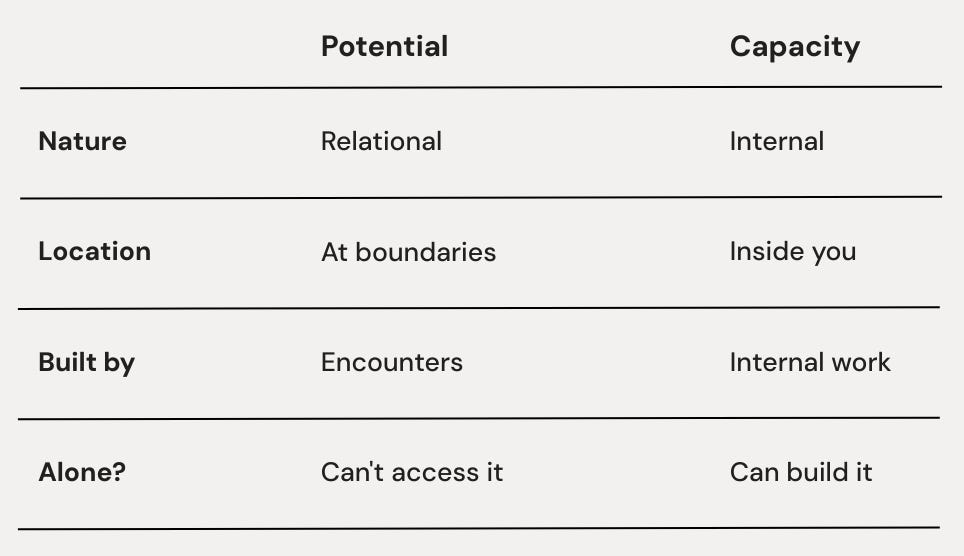
Capacity is what you can do right now. Your skills, resources, energy, knowledge, relationships—the internal machinery you bring to any situation. Capacity lives inside you. You can build it alone (though it’s easier with help). When you sleep well, eat well, learn a skill, save money, you’re building capacity.
Potential is what you could become or achieve—the futures available to you. And here’s the key: potential doesn’t live inside you. It lives at the boundaries between you and things outside you. Your potential isn’t stored up waiting; it emerges when your capacity meets an opportunity, a problem, a collaborator, an environment that generates new possibilities.
This isn’t just semantics. It’s a completely different picture of how development works.
The car and the roads
Think about a car and roads.
The car has capacity—engine power, fuel efficiency, handling. You can improve the car in your garage: tune the engine, upgrade the suspension, fill the tank. That’s internal work. The car gets better.
But the car’s potential—where it can actually take you—depends on the roads. A Ferrari in the desert has limited potential.
The same Ferrari connected to a highway network opens the world.

You can have a powerful car and no roads (high capacity, boundary-starved). You can have vast road networks and a broken car (rich boundaries, no capacity to convert). Neither produces movement.
The relationship multiplies. Zero on either side produces zero.
The multiplication problem
Here’s why this distinction matters practically.
If potential is intrinsic, then development is straightforward: building more capacity unlocks more potential. Work harder. Learn more. Optimize yourself. Show some grit. The equation would be additive—more of you equals more possibility.
But physics suggests that potential is relational. That makes the equation multiplicative:
Transformation ≈ Boundary encounters × Capacity.
If either term is near zero, the output is near zero. This produces two distinct failure modes:
Boundary-starved: High capacity + no boundaries = nothing to convert.
You can be brilliant, skilled, well-resourced, and healthy and still go nowhere. Without encounters that generate new possibilities, your capacity remains static.
This explains the stagnant expert, the plateaued career, and the talented person stuck in the wrong environment. Nothing’s wrong with them. They’re boundary-starved.
Overwhelmed: Rich boundaries + low capacity = potential passes you by.
The opportunity arrives. The collaboration forms. The door opens. And you can’t convert that potential. You lack the energy, the skills, the bandwidth, the readiness.
The potential was real—it was right there at the boundary—but you couldn’t metabolize it.
This explains the overwhelmed newcomer, the burned-out leader, and the under-resourced team handed a big opportunity too soon.
The relationship multiplies. Zero on either side yields zero.
Think about how this reframes every development question. “How do I reach my potential?” becomes two questions:
What boundaries can I access? (Where does new possibility emerge?)
What capacity do I bring? (Can I convert what those boundaries offer?)
Working harder only helps with the second question. And if the first question is your primary constraint, more effort just exhausts you faster.
The monastery and the trading floor
Consider two extremes.
First, a monk in isolated study.
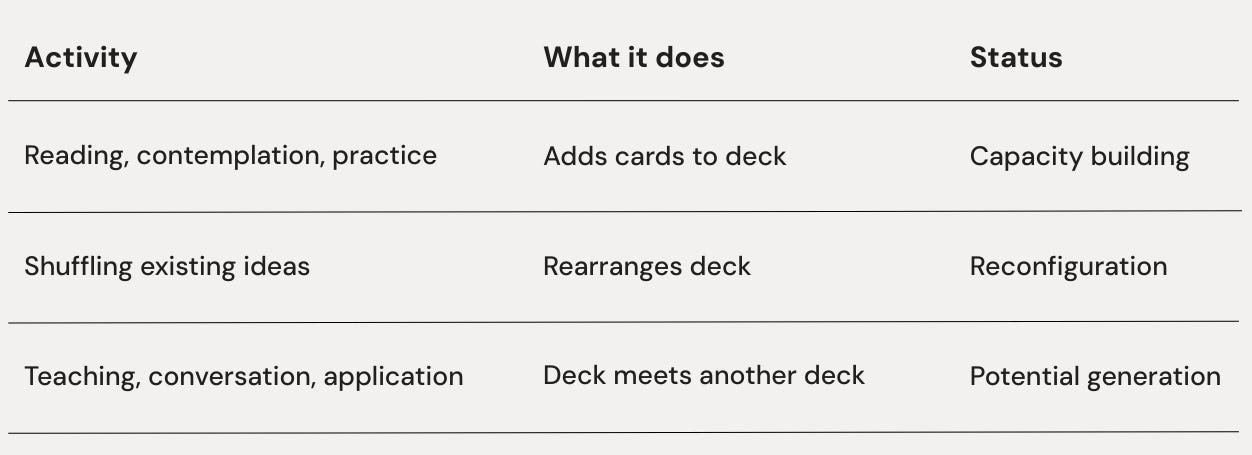
He reads philosophy, contemplates texts, and builds frameworks for understanding. He adds cards to the deck—new terms, new mental models, new ways of seeing.
But those cards sit dormant. They’re capacity—potential-to-convert-at-a-boundary. The expanded vocabulary, the refined frameworks, the deeper attention... all of it waits, latent, until it meets something external.
Then a student arrives with confusion, questions, a different frame. Suddenly the dormant knowledge does work. This encounter converts latent capacity into active potential.
Teachers often report the same thing: understanding crystallizes in the act of teaching—because explaining forces you to confront what you don’t actually know.
His isolation wasn’t wasted. It built capacity—richer offerings for future boundaries. But the possibility space didn’t expand until the boundary arrived.
Second, imagine a trader on a chaotic floor. Maximum boundary encounters. Information floods in. Relationships form and dissolve. Opportunities emerge constantly.
But if capacity can’t keep up—if there’s no time to process, no energy to respond, no structure to metabolize the flow—then the boundaries generate potential that never converts. The trader burns out and drowns in possibility.
Neither extreme works. Development requires both boundaries that generate potential and the capacity to convert it.
The sweet spot isn’t balance in some vague sense. It’s match. Your capacity matched to the boundaries you’re accessing—enough to convert, not so much that you’re boundary-starved, not so little that potential overwhelms you.
What this changes
Once you see the distinction, you start noticing it everywhere:
The startup with a strong team (capacity) but no market access (boundaries). They build and build but nothing takes off.
The executive with vast networks (boundaries) but no time to think (capacity). Opportunities fly past, unconverted.
The student in a resource-rich school (boundaries) without the preparation to absorb it (capacity). Access doesn’t equal conversion.
The employee that grinds away (building capacity) in a dead-end role (no boundaries). Effort doesn’t equal progress.
“Unlock your potential” is the wrong metaphor because of what it implies. Potential isn’t locked inside you. It doesn’t exist yet. It emerges—or doesn’t—depending on the quality of your encounters.
The question “what’s my potential?” still matters, but the answer points outward now. Not “how much is inside me?” but “what boundaries could I access, and what capacity would I bring to them?”
Application
Notice: Think of a situation where you worked hard, but outcomes plateaued.
Name: Was it capacity-limited (you lacked skill/resources) or boundary-limited (no new encounters/inputs)?
Test: If you changed only the encounter (who/what you collide with) while keeping effort constant, would results change more than expected?
Remember: Potential is relational and emerges at boundaries; capacity is internal and self-buildable. The relationship multiplies—zero on either side produces zero.
The science
Established:
Open systems require exchange with their environment to persist and develop (Schrödinger, Bertalanffy). This is thermodynamics.
Affordances are relational—they exist in the relationship between organism and environment, not as intrinsic properties (Gibson).
Genesis claim:
The formal distinction between potential (relational, boundary-emergent) and capacity (internal, self-buildable) as foundational categories.
Falsification:
If potential were intrinsic, isolated systems should expand their reachable state-space through pure internal processing. They don’t. Remember the rock.